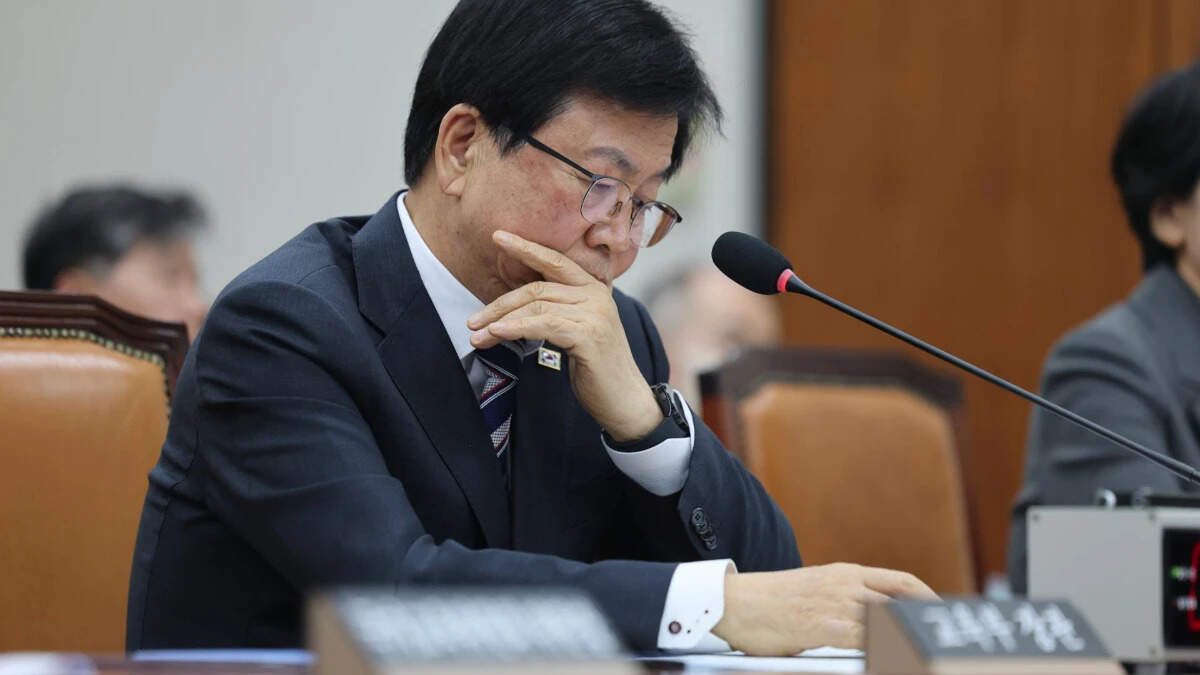
South Korea's Education Minister Choi Kyo-jin has resigned over an exam cheating scandal that shocked the nation. He said he took full responsibility for the confusion caused by last-minute measures aimed at stopping AI-assisted cheating during Thursday's annual college entrance exam, known as the Suneung. President Lee Jae Myung, who has been calling for an overhaul of the current exam system, later accepted the resignation. The departure of a cabinet minister over a school test illustrates how central the exam is to South Korean life, and how seriously the public takes any threat to its fairness.
"As the minister in charge, I believe I cannot escape criticism that we failed to prepare in advance," Choi was quoted as saying on Sunday by South Korea's Yonhap news agency. "Now that the exam has concluded, I feel a deep sense of responsibility and am offering my resignation," the minister added. His decision came three days after the exam, which was taken by about 500,000 students and plays a big role in the career trajectories of millions of South Koreans. The test takes up to nine hours to complete and is widely regarded as one of the most consequential days in a young person's life.
The scandal began a week earlier, when the top scorer in the national tax accountancy exam admitted to cheating. Han Won-seok, who had topped the April exam, said in a video message: "I used a microcamera to photograph the test questions and sent them to an AI, then checked my answers on my smartphone to commit the cheating." He is 34 years old. His confession followed speculation over his unusually high score, in which he got just one out of 160 questions wrong. The admission rattled public trust in the way high-stakes exams are administered, and raised alarm about the potential for cheating using artificial intelligence.
Authorities moved quickly, with only days left before the Suneung. They launched urgent measures to detect hidden devices, including sending emergency alerts to every mobile phone in the country. Three alerts were sent between 08:00 and 15:00 local time on Thursday, causing phones across the country to blare out in unison, even if they were on silent mode and even if they belonged to tourists using data roaming. The phones did not ring if they were switched off or in airplane mode. It was the first time South Korea had used its national disaster alert system to catch exam cheaters.
Other measures were equally unusual. Candidates had to cover up the buttons on their shirts and jackets to block any hidden cameras, and authorities conducted inspections of eyewear. The idea was to detect any device that might photograph questions or receive answers during the test. The result, though, was that even honest test takers became anxious about being wrongly suspected. Before the exam, one high school senior told the Korea Times he was worried his horn-rimmed spectacles would be mistaken for smart glasses. Another told Yonhap that he usually wore glasses but made an effort to put on contact lenses for the Suneung to avoid raising suspicions.
The education ministry said that 111 candidates were found with unauthorised smart devices during this year's exam. The figure shows that the problem was real, and that the new checks caught people who might otherwise have escaped detection. But it also raises questions about how effective and proportionate the measures were. Sending nationwide phone alerts disrupted the day for people who were not taking the exam, and the sudden changes added to the stress of a group of students who have spent years preparing for a single test.
South Korea's exam culture helps explain the intensity of the reaction. Results from the Suneung strongly influence which universities students can attend, and university admission in turn is closely tied to employment and social status. Families invest heavily in tutoring and preparation, and the stakes are so high that the exam is treated as a national event. In that context, even a rumour of unfairness can provoke public outrage.
That is why the AI element has been so alarming. Smart devices and artificial intelligence tools have made it far easier to transmit questions and receive answers in real time, and they are small enough to be hidden in clothing or glasses. Education authorities around the world are grappling with similar challenges, from universities to professional licensing bodies. South Korea's experience, in which a tax accountancy exam top scorer was able to use a micro-camera and an AI system, shows that traditional exam supervision can be outpaced by the technology available to cheaters.
President Lee has long argued that the existing system needs reform, and the scandal gives his calls fresh momentum. Critics of the high-pressure model say it encourages rote learning, intense competition and excessive private tutoring, and that it fuels the incentive to cheat. Supporters argue that a single standardised test is a relatively objective measure in a society that values fairness. The debate over how to preserve integrity while reducing the pressure on students is likely to intensify in the weeks ahead.
For the ministry, the resignation leaves a gap at a time when decisions must be made about how to handle both the immediate fallout and the longer-term security of examinations. Officials will need to decide what to do about the 111 candidates found with unauthorised devices, how to investigate the tax accountancy exam case, and what technical and procedural changes will be adopted for future tests. A new minister will inherit those tasks, along with the political pressure to restore public confidence.
Choi's resignation also demonstrates a feature of South Korean politics: ministers and officials often step down quickly when a controversy touches a sensitive public nerve, taking symbolic responsibility even where the underlying failures are complex. Whether that will satisfy the public is another question. Some will see it as an appropriate acceptance of accountability, while others will argue that the real challenge is reforming the system rather than changing the person in charge.
For the half a million students who sat the exam, the immediate concern is simpler: waiting for results and hoping that nothing in the scandal affects their scores. The government will need to reassure them that the process was fair. In the longer term, the case may prompt a rethink of how exams are designed and delivered in the age of artificial intelligence, from stricter device controls to different types of assessment. It is a reminder that technology can undermine even the most carefully guarded institutions, and that the response has to balance security with fairness and dignity for those who are doing nothing wrong.