Constantinople, the capital city of the Byzantine Empire, was captured by the Ottoman Empire on 29 May 1453, at the culmination of a 53-day siege that had begun on 6 April. The attacking Ottoman army, which significantly outnumbered the city's defenders, was commanded by Sultan Mehmed II, later known as "the Conqueror", while the Byzantine army was led by Emperor Constantine XI Palaiologos. After conquering the city, Mehmed made Constantinople the new Ottoman capital, replacing Adrianople. The fall of Constantinople and of the Byzantine Empire was a watershed moment of the Late Middle Ages, marking the effective end of the Roman Empire, a state that began in roughly 27 BC and had lasted nearly 1,500 years. For many modern historians, it marks the end of the medieval period and the beginning of the early modern period.
A City Besieged Many Times
Constantinople had been an imperial capital since its consecration in 330 under the Roman emperor Constantine the Great. In the following eleven centuries it had been besieged many times but captured only once: in the Sack of Constantinople during the Fourth Crusade in 1204. The crusaders established an unstable Latin state in and around the city, while the remainder of the Byzantine Empire splintered into successor states, notably Nicaea, Epirus and Trebizond. The Nicaeans eventually reconquered Constantinople from the Latins in 1261, re-establishing the Byzantine Empire under the Palaiologos dynasty. Thereafter there was little peace for the much-weakened empire, which fended off successive attacks by Latins, Serbs, Bulgarians and Ottoman Turks.
An Empire in Decline
Between 1346 and 1349, the Black Death killed almost half of the inhabitants of Constantinople. The city was further depopulated by the general economic and territorial decline of the empire, and by 1453 it consisted of a series of walled villages separated by vast fields, encircled by the fifth-century Theodosian walls. By 1450 the empire was exhausted and had shrunk to a few square kilometres outside the city itself, the Princes' Islands in the Sea of Marmara and the Peloponnese, with its cultural centre at Mystras.
Mehmed Prepares
When Mehmed II succeeded his father in 1451 he was 19 years old. Many European courts assumed that the young ruler would not seriously challenge Christian hegemony in the Balkans and the Aegean, and Europe celebrated his accession and hoped that his inexperience would lead the Ottomans astray. But Mehmed's mild words were not matched by his actions. By early 1452 work had begun on a second fortress, Rumeli Hisari, on the European side of the Bosphorus, several miles north of Constantinople. It sat directly across the strait from the Anadolu Hisari fortress, built by Mehmed's great-grandfather Bayezid I, and the pair ensured complete control of sea traffic on the Bosphorus. The new fortress was called Bogazkesen, which means "strait-blocker" or "throat-cutter", a wordplay on the Turkish word bogaz, which means both "strait" and "throat". In October 1452 Mehmed ordered Turakhan Beg to station a large garrison force in the Peloponnese to block Constantine's brothers Thomas and Demetrios, who ruled in southern Greece, from providing aid during the coming siege.
Too Little Help From the West
The defending army was small, about 7,000 men, 2,000 of them foreigners, to hold a perimeter wall of twelve miles. At the end of March 1453 Constantine ordered a census of able-bodied men, and his chancellor George Sphrantzes recorded 4,773 Greeks and just 200 foreigners, with volunteers from the Genoese, Venetians and others bringing the total to something under 8,000. Fewer than 50,000 people were living inside the walls, including refugees from the surrounding area. Some help did arrive. Cardinal Isidore, funded by the Pope, came in 1452 with 200 archers, and in January 1453 the Genoese soldier Giovanni Giustiniani arrived with 400 men from Genoa and 300 from the Genoese island of Chios. A specialist in defending walled cities, he was immediately given overall command of the defence of the land walls. The Venetian Senate decided in February 1453 to send a fleet, but its departure was delayed until April, when it was already too late to help. Morale suffered further when seven Italian ships carrying around 700 men, despite having sworn to defend the city, slipped out of the capital as soon as Giustiniani arrived.
Chains and Walls
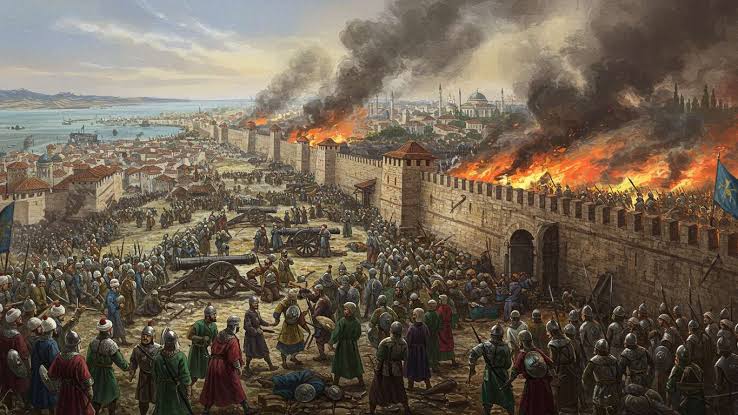
Fearing a naval attack along the Golden Horn, Constantine ordered that a defensive chain, floating on logs, be placed across the mouth of the harbour, and it was strong enough to prevent any Turkish ship from entering. The land walls were also repaired and fortified, and they consisted of a moat 60 feet (18 metres) wide in front of inner and outer crenellated walls with towers every 45 to 55 metres.
The Walls and the Cannon
The walls of Constantinople, especially the Theodosian walls, had protected the city from attack for 800 years and were noted as some of the most advanced defensive systems in the world at the time. But the Ottomans came with gunpowder. Their cannon repeatedly fired massive cannonballs weighing 500 kilograms (1,100 lb) over 1.5 kilometres (0.93 miles), which created gaps in the Theodosian walls. Since ancient times, cities and castles had depended upon ramparts and walls to repel invaders, and the fall of Constantinople stood as a turning point in military history because those fortifications were overcome by Ottoman infantry with the support of cannon and bombards, heralding a change in siege warfare.
The most famous of the Ottoman guns was cast by the Hungarian engineer Orban, who had first offered his services to the Byzantines, who could not afford to hire him, before going to Mehmed. His 27-foot (8.2-metre) cannon, named "Basilica", could hurl a 600-pound (270 kg) stone ball more than a mile, but it took three hours to reload, and cannonballs for it were in very short supply. In preparation for the final assault Mehmed had an artillery train of 70 large pieces dragged from his headquarters at Edirne, and Orban's enormous gun alone was said to need a crew of 60 oxen and more than 400 men. The Ottoman army encamped outside the city on 2 April 1453, the Monday after Easter, and Mehmed erected his red-and-gold tent near the Mesoteichion, where the guns and the elite Janissary regiments were positioned.
The Siege and the Final Assault
The siege began on 6 April 1453. The Ottoman army significantly outnumbered the defenders under Emperor Constantine XI, who had few troops and little help from the Christian West. After 53 days of bombardment and assaults, the city fell on 29 May 1453.
The Aftermath
Mehmed II made Constantinople the new capital of the Ottoman Empire, replacing Adrianople. The conquest ended the Byzantine Empire, the eastern continuation of the Roman state, and gave Mehmed the title "the Conqueror". The Ottomans would rule the city, later known as Istanbul, for almost five centuries.
Why 1453 Matters
The fall of Constantinople is often used by historians as the date marking the end of the Middle Ages. The Roman Empire, in the form of its Byzantine continuation, had lasted nearly 1,500 years, and the loss of its capital sent a shock through Christian Europe. It also marked a turning point in warfare: the city whose walls had defied attackers for eight centuries was brought down by artillery, and the age of the medieval castle and the fortified city gave way to the age of gunpowder. For the Ottomans, the conquest confirmed their rise as a great power at the crossroads of Europe and Asia, with a capital that commanded the passage between the Black Sea and the Mediterranean.