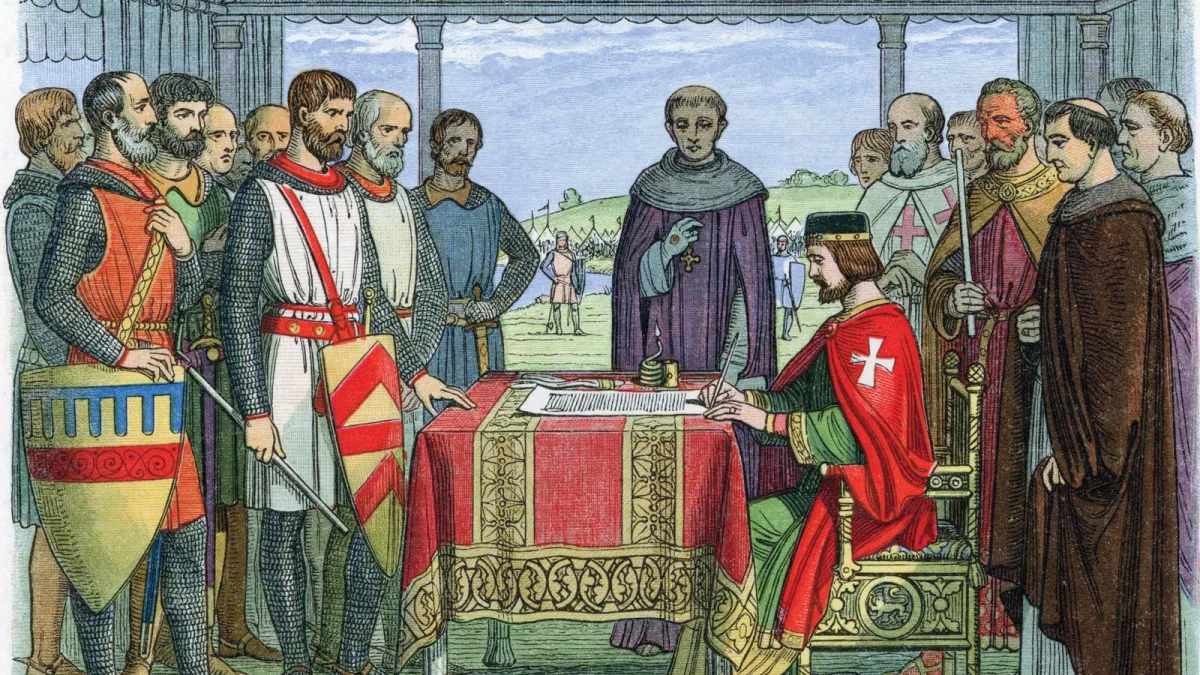
On 15 June 1215, at Runnymede, near Windsor, King John of England sealed a royal charter of rights that would later be known as Magna Carta, Latin for "Great Charter". It was first drafted by the Archbishop of Canterbury, Cardinal Stephen Langton, to make peace between the unpopular king and a group of rebel barons who demanded that he confirm the Charter of Liberties. It promised the protection of church rights, protection for the barons from illegal imprisonment, access to swift and impartial justice and limitations on feudal payments to the Crown, to be implemented through a council of 25 barons. It was, at the time, a failure. Neither side stood by its commitments, and the charter was annulled by Pope Innocent III, which led to the First Barons' War. Yet over the following centuries the document acquired a life of its own, and it is today recognised as one of the most important legal documents in history.
The Crisis That Produced the Charter
Magna Carta originated as an unsuccessful attempt to achieve peace between a king and his barons. John was an unpopular ruler, and the barons who rebelled against him demanded a written confirmation of the liberties that earlier kings had promised. The charter that emerged from the negotiations at Runnymede was less a statement of abstract principles than a practical treaty. Its clauses dealt with the concrete grievances of the barons: the king's ability to imprison them without lawful judgement, the amounts that he could demand in feudal payments, and the delays and costs of justice. To make the promises enforceable, the charter provided for a council of 25 barons who could hold the king to account.
Annulled Within Weeks
The peace did not last. Neither side stood by the commitments in the charter, and Pope Innocent III annulled it, leading to the First Barons' War. After John's death, the regency government of his young son, Henry III, reissued the document in 1216, stripped of some of its more radical content, in an unsuccessful bid to build political support for their cause. At the end of the war in 1217 it formed part of the peace treaty agreed at Lambeth, where the document acquired the name "Magna Carta", to distinguish it from the smaller Charter of the Forest, which was issued at the same time. Short of funds, Henry reissued the charter again in 1225 in exchange for a grant of new taxes, and his son, Edward I, repeated the exercise in 1297, this time confirming it as part of England's statute law.
Not the Only Charter of Its Time
Magna Carta was not unique. Other legal documents of its time, both in England and beyond, made broadly similar statements of rights and limitations on the powers of the Crown. The charter became part of English political life and was typically renewed by each monarch in turn. As time went by and the fledgling Parliament of England passed new laws, it lost some of its practical significance.
The Myth of the Ancient Constitution
At the end of the sixteenth century there was an upsurge of interest in Magna Carta. Lawyers and historians of the time believed that there was an ancient English constitution, going back to the days of the Anglo-Saxons, that protected individual English freedoms. They argued that the Norman invasion of 1066 had overthrown these rights and that Magna Carta had been a popular attempt to restore them, which made the charter an essential foundation for the contemporary powers of Parliament and for legal principles such as habeas corpus. Although this historical account was badly flawed, jurists such as Sir Edward Coke invoked Magna Carta extensively in the early seventeenth century, arguing against the divine right of kings. Both James I and his son Charles I attempted to suppress discussion of Magna Carta. The political myth of the charter as a medieval revival of ancient personal liberties persisted after the Glorious Revolution of 1688 and well into the nineteenth century.
Influence on the United States
Magna Carta influenced the early American colonists in the Thirteen Colonies and the formation of the United States Constitution, which became the supreme law of the land in the new republic. Copies of the 1297 charter survive today in both the United States and Australia.
What Historians Now Say
Research by Victorian historians showed that the original 1215 charter had concerned the medieval relationship between the monarch and the barons, and not ordinary subjects. The majority of historians now see the interpretation of the charter as a unique and early charter of universal legal rights as a myth created centuries later. Despite these changes in view, the charter has remained a powerful, iconic document, even after almost all of its content was repealed from the statute books in the nineteenth and twentieth centuries. None of the original 1215 charter is currently in force, since it has been repealed, although three clauses of the original charter are enshrined in the 1297 version and remain in force in England and Wales.
The Surviving Copies
In the twenty-first century four exemplifications of the original 1215 charter remain in existence: two at the British Library, one at Lincoln Castle and one at Salisbury Cathedral. They are recognised by UNESCO on its Memory of the World international register. There are also a handful of the later charters in public and private ownership. The 800th anniversary of Magna Carta in 2015 included extensive celebrations and discussions, and the four original 1215 charters were displayed together at the British Library.
Why It Still Matters
Magna Carta remains an important symbol of liberty today, often cited by politicians and campaigners, and it is held in great respect by the British and American legal communities. Lord Denning described it in 1956 as "the greatest constitutional document of all times, the foundation of the freedom of the individual against the arbitrary authority of the despot". The paradox of Magna Carta is that it failed as a peace treaty, was written to protect the interests of a few powerful men and was repealed almost entirely, and yet it has inspired lawyers, reformers and revolutionaries for more than eight centuries. Its central idea, that even a king is subject to the law and that power must be limited by agreed rules, is the reason it has endured.