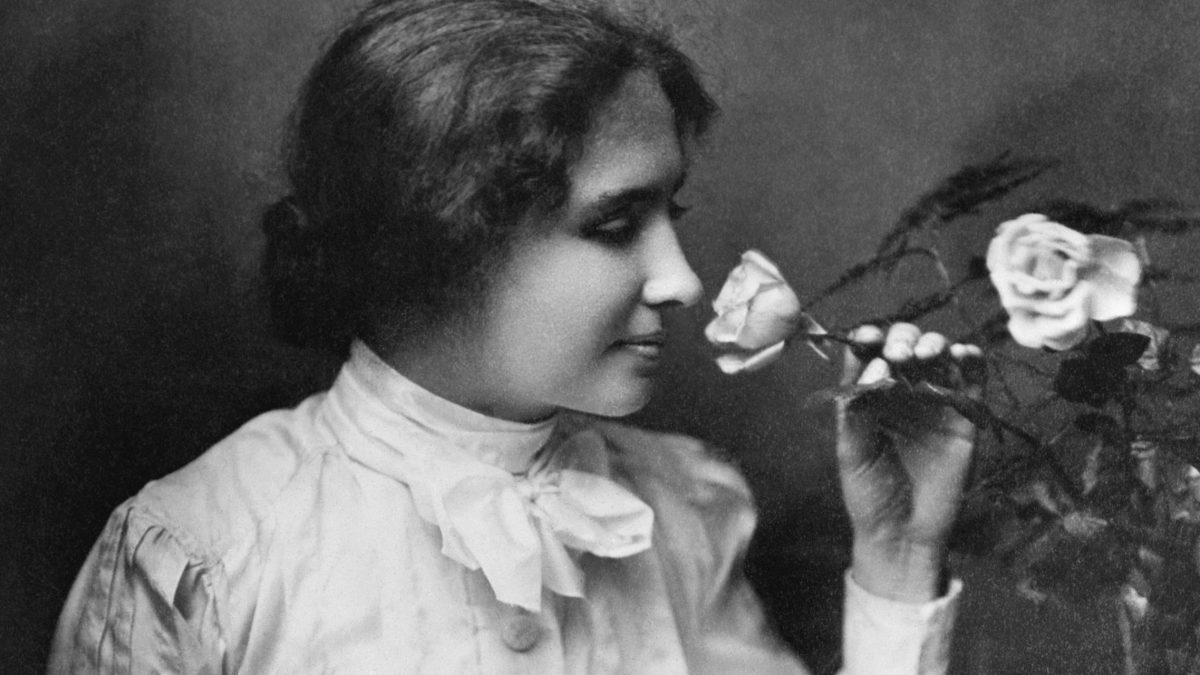
Helen Keller (Helen Adams Keller, 27 June 1880 to 1 June 1968) was an American deafblind author, disability rights advocate, political activist and lecturer. She lost her sight and hearing after an illness at the age of 19 months, and she went on to become the first deafblind person in the United States to earn a college diploma. She wrote 14 books and hundreds of speeches and essays, and she campaigned for people with disabilities, women's suffrage, labour rights and world peace. This biography follows her life and work.
Helen Keller at a Glance
| Full name | Helen Adams Keller |
| Born | 27 June 1880, Tuscumbia, Alabama, United States |
| Died | 1 June 1968 (aged 87) |
| Profession | Author, lecturer and activist |
| Best known for | Her autobiography The Story of My Life (1903); first deafblind person in the US to earn a college diploma |
| Teacher | Anne Sullivan |
| Education | Perkins Institute for the Blind; Radcliffe College of Harvard University (graduated 1904) |
| Organisations | Founding member of the American Civil Liberties Union; member of the Socialist Party of America (from 1909) |
Childhood
Keller was born at Ivy Green, the family homestead in Tuscumbia, Alabama, to Arthur Henley Keller, an editor of the Tuscumbia North Alabamian who had served as a captain in the Confederate Army, and Catherine Everett Adams, known as Kate. She had four siblings, two full siblings and two older half-brothers. The family was part of the slaveholding elite before the American Civil War but lost status afterwards. At 19 months old she contracted an unknown illness, described by doctors as "an acute congestion of the stomach and the brain", which contemporary doctors believe may have been meningitis, and she was left permanently blind and deaf, as she recalled in her autobiography, "at sea in a dense fog". She communicated primarily using home signs until the age of seven.
Anne Sullivan
Keller's mother, inspired by an account in Charles Dickens's American Notes of the successful education of Laura Bridgman, a deaf and blind woman, took the young Helen and her father to consult a physician in Baltimore, who referred them to Alexander Graham Bell. Bell advised them to contact the Perkins Institute for the Blind, and its director, Michael Anagnos, asked Anne Sullivan, a 20-year-old alumna of the school who was visually impaired, to become Keller's instructor. It was the beginning of a nearly 50-year relationship in which Sullivan was Keller's governess and later her companion. Sullivan arrived at the house on 5 March 1887, a day Keller remembered as "my soul's birthday", and she began teaching Helen to communicate by spelling words into her hand, beginning with "d-o-l-l" for a doll she had brought as a present.
The Word "Water"
Keller at first struggled with the idea that every object had a word, and when Sullivan tried to teach her the word for "mug" she became so frustrated that she broke it. The next month came the breakthrough. While cool water ran over one of her hands, Sullivan spelled the word "water" into the other. In her autobiography Keller wrote: "I knew then that w-a-t-e-r meant the wonderful cool something that was flowing over my hand. The living word awakened my soul, gave it light, hope, set it free!" She then demanded that Sullivan spell the names of all the other familiar objects in her world.
Formal Education
In May 1888 Keller started attending the Perkins Institute for the Blind. In 1893 she and Sullivan attended the William Wade House and Finishing School, and in 1894 they moved to New York to attend the Wright-Humason School for the Deaf and to learn from Sarah Fuller at the Horace Mann School for the Deaf. In 1896 they returned to Massachusetts, and Keller entered the Cambridge School for Young Ladies before gaining admittance in 1900 to Radcliffe College of Harvard University. Her admirer Mark Twain had introduced her to the Standard Oil magnate Henry Huttleston Rogers, who with his wife Abbie paid for her education. In 1904, at the age of 24, Keller graduated from Radcliffe as a member of Phi Beta Kappa, becoming the first deafblind person to earn a Bachelor of Arts degree.
Author and Activist
Keller became a world-famous speaker and author, and she travelled to more than 40 countries with Sullivan, making several trips to Japan and becoming a favourite of the Japanese people. She was very fond of Akita dogs: she visited Akita Prefecture in June 1937, asked about Hachiko, the loyal dog who searched for his deceased master for about 10 years, and began keeping Akitas as pets, introducing them to America. She met every US president from Grover Cleveland to Lyndon B. Johnson and was friends with many famous figures, including Alexander Graham Bell, Charlie Chaplin and Mark Twain. In 1915 she and George A. Kessler founded the organisation Helen Keller International, which is devoted to research in vision, health and nutrition, and in 1916 she sent money to the NAACP, as she was ashamed of the Southern treatment of "colored people". In 1920 she helped to found the American Civil Liberties Union. After Sullivan died in 1936, with Keller holding her hand, Polly Thomson became her companion until Thomson had a stroke in 1957 and died in 1960, after which the nurse Winnie Corbally remained her companion for the rest of her life.
Keller was a prolific author, writing 14 books and hundreds of speeches and essays on topics ranging from animals to Mahatma Gandhi. Her autobiography, The Story of My Life (1903), publicised her education and her life with Sullivan. She campaigned for people with disabilities and for women's suffrage, labour rights and world peace. In 1909 she joined the Socialist Party of America, and she was a founding member of the American Civil Liberties Union.
In Popular Culture
The playwright William Gibson wrote a theatrical adaptation of her story, The Miracle Worker, in 1959, and adapted it as a film of the same name in 1962. Her birthplace has been designated and preserved as a National Historic Landmark, and since 1954 it has been operated as a house museum that sponsors an annual "Helen Keller Day".
Death and Legacy
Keller died on 1 June 1968, shortly before her 88th birthday. Her life showed that deafblind people could be educated and could take part fully in public life, and she became a symbol of perseverance and of the right of people with disabilities to education and dignity.