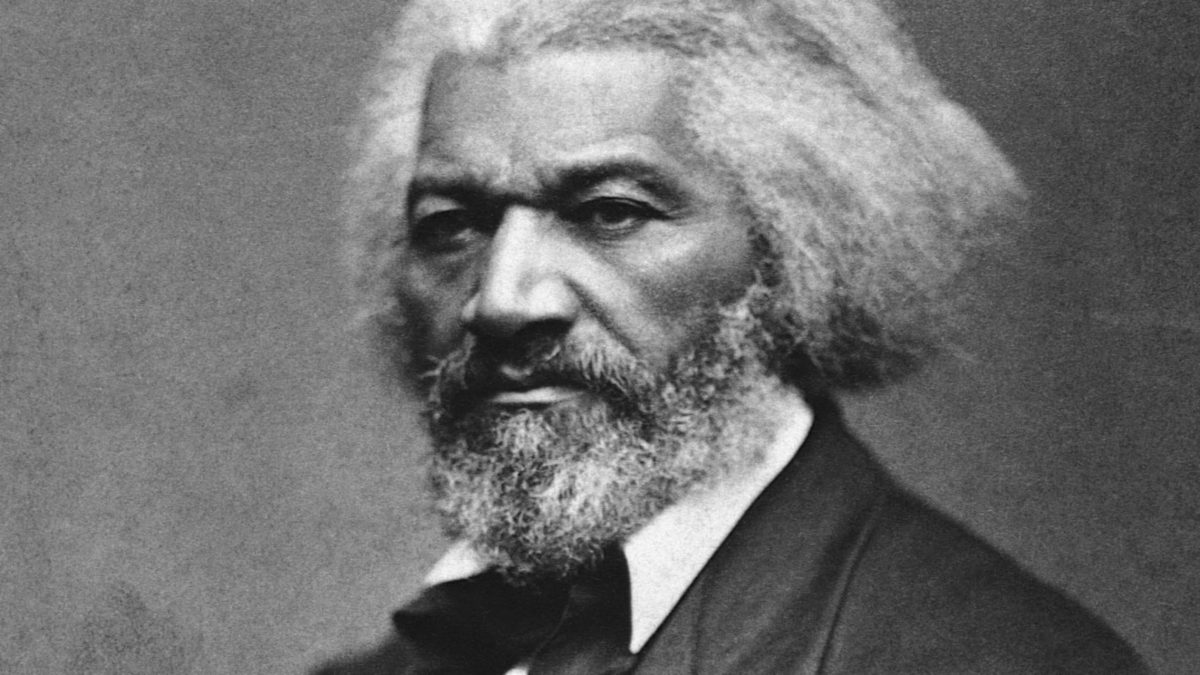
Frederick Douglass (born Frederick Augustus Washington Bailey, c. 14 February 1818 to 20 February 1895) was an American social reformer, abolitionist, orator, writer and statesman. He has been called the most important leader of the movement for African-American civil rights in the 19th century. After escaping slavery in Maryland in 1838, he became a national leader of the abolitionist movement and gained fame for his oratory and his incisive antislavery writing. This biography follows his life, his three autobiographies and his legacy.
Frederick Douglass at a Glance
| Full name | Frederick Augustus Washington Bailey, later Frederick Douglass |
| Born | c. 14 February 1818, Talbot County, Maryland |
| Died | 20 February 1895 |
| Profession | Abolitionist, orator, writer and statesman |
| Known for | Escape from slavery in 1838; the Narrative of the Life of Frederick Douglass (1845) |
| Newspaper | The North Star, founded in Rochester, New York |
| First wife | Anna Murray (married 15 September 1838; she died 1882) |
| Second wife | Helen Pitts (married 1884) |
| Children | Rosetta, Lewis Henry, Frederick Jr., Charles Remond and Annie |
Born Into Slavery
Frederick Augustus Washington Bailey was born into slavery on the Eastern Shore of the Chesapeake Bay in Talbot County, Maryland. In his first autobiography he wrote that he had no accurate knowledge of his age, having never seen an authentic record of it. His mother, Harriet Bailey, was enslaved and of African descent, and his father was apparently of European descent. In his 1845 Narrative he wrote: "My father was a white man." For the rest of his life he searched in vain for the name of his true father, according to the historian David W. Blight.
He was separated from his mother in infancy and lived with his maternal grandmother, Betsy Bailey, who was enslaved, and his maternal grandfather, Isaac, who was free. His mother stayed on a plantation about 12 miles away and visited only a few times before her death when he was seven. He later wrote that he did not recall ever seeing his mother by the light of day: she came to him at night, and was gone before he woke.
Learning to Read
At six he was moved to the Wye House plantation. After the overseer died in 1826 he was given to Lucretia Auld, whose husband Thomas Auld sent him to serve Thomas's brother Hugh Auld and Hugh's wife Sophia in Baltimore. When Douglass was about 12, Sophia Auld began teaching him the alphabet. Hugh Auld disapproved, saying literacy would encourage enslaved people to desire freedom. Douglass later called this the first decidedly antislavery lecture he had ever heard: "Knowledge unfits a child to be a slave." He learned to read from white children in the neighbourhood and by observing the writing of the men with whom he worked, and he later often said that knowledge is the pathway from slavery to freedom. He credited an anthology, The Columbian Orator, which he found at about 12, with clarifying his views on freedom and human rights.
In 1833 Thomas Auld sent him to a farmer with a reputation as a slave-breaker, Edward Covey. After frequent whippings, the 16-year-old finally fought back. He later wrote that the fight was life-transforming: "You have seen how a man was made a slave; you shall see how a slave was made a man."
Escape
In 1837 Douglass met and fell in love with Anna Murray, a free Black woman in Baltimore about five years older. Her free status strengthened his belief in the possibility of gaining his own freedom, and she supported his efforts with encouragement and money. On 3 September 1838 he escaped by boarding a northbound train in Baltimore, dressed in a sailor's uniform provided by Murray, and travelled through Delaware by train and steamboat to Philadelphia and on to New York. He wrote later that he lived more in one day of freedom than in a year of his slave life. Murray joined him, and they married on 15 September 1838, eleven days after he reached New York.
Abolitionist Leader and Writer
Douglass became a leader of the abolitionist movement in Massachusetts and New York. Northerners at the time found it hard to believe that such a great speaker had once been enslaved, and abolitionists described him as a living counterexample to claims that enslaved people lacked the intellectual capacity to function as independent citizens. He wrote three autobiographies. The first, the Narrative of the Life of Frederick Douglass, an American Slave, published in 1845, became a bestseller and promoted the cause of abolition. He followed it with My Bondage and My Freedom in 1855 and, after the Civil War, Life and Times of Frederick Douglass, first published in 1881 and revised in 1892.
After returning from the United Kingdom in 1847, using 500 pounds given to him by English supporters, he began publishing the North Star, a weekly paper with the motto "Right is of no sex, Truth is of no color, God is the Father of us all, and all we are Brethren." In 1851 he merged it with another paper to form Frederick Douglass' Paper, which was published until 1859. In 1852 he gave a famous oration in Rochester, What to the Slave Is the Fourth of July?, in which he sharply criticised religious people who kept silent about slavery. He said of his alliances: "I would unite with anybody to do right and with nobody to do wrong."
Women's Rights
In 1848 Douglass was the only Black person to attend the Seneca Falls Convention, the first women's rights convention, in upstate New York. When Elizabeth Cady Stanton asked the assembly to pass a resolution calling for women's suffrage, many of those present opposed it. Douglass spoke in favour and wrote an editorial in the North Star afterwards, stating: "We hold woman to be justly entitled to all we claim for man." His position on suffrage was an early example of his willingness to link the rights of different groups.
The Civil War and Emancipation
Douglass argued that because the aim of the Civil War was to end slavery, African Americans should be allowed to fight for their freedom, and he promoted this view in his newspapers and in speeches. After President Abraham Lincoln allowed Black soldiers to serve in the Union army, Douglass continued to press for their equal treatment. He met Lincoln in 1863 about the treatment of Black soldiers and in 1864 about how to mobilise enslaved people in the Confederate states. The Emancipation Proclamation took effect on 1 January 1863, declaring the freedom of all enslaved people in Confederate-held territory. After the war, Douglass continued to campaign for the rights of freed people.
Harpers Ferry
On 12 March 1859 Douglass met the radical abolitionist John Brown and others at a house in Detroit to discuss emancipation, and he met Brown again at his home two months before the raid on Harpers Ferry. After the raid, between 16 and 18 October 1859, he was accused both of supporting Brown and of not supporting him enough. He was nearly arrested on a Virginia warrant and fled briefly to Canada before travelling on to England on a lecture tour that had been planned beforehand.
Family Life
Douglass and Anna Murray had five children: Rosetta, Lewis Henry, Frederick Jr., Charles Remond and Annie, who died at the age of ten. Charles and Rosetta helped produce his newspapers. Anna died in 1882, and in 1884 Douglass married Helen Pitts, a white suffragist and abolitionist from Honeoye, New York, who was a graduate of Mount Holyoke and the daughter of an abolitionist colleague. He was a deeply spiritual man who criticised religious hypocrisy and distinguished between the Christianity of Christ and the Christianity of America. He died on 20 February 1895.
Legacy
Douglass is remembered as an orator, a writer and an advocate of equal rights. His autobiographies remain widely read, and his insistence that knowledge is the path from slavery to freedom, and that rights should be defended through alliances across racial and ideological divides, has influenced later movements for equality. His life is also a reminder of how literacy was treated as a threat by those who enslaved people, and how powerful words can be.