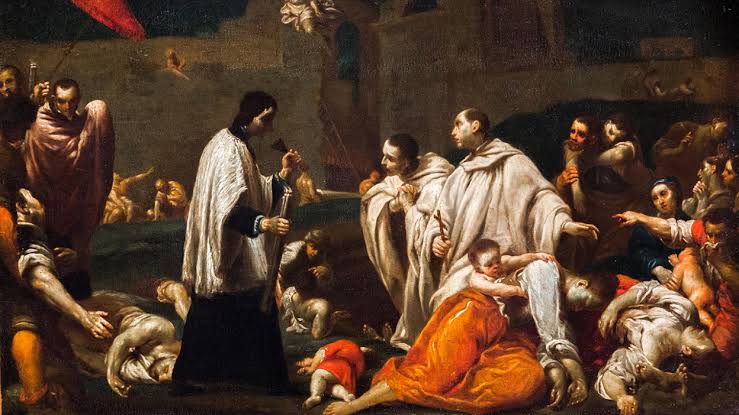
The Black Death was a plague pandemic that struck Europe from 1346 to 1353. It was one of the most fatal pandemics in human history, killing up to 50 million people, around 30 to 60 per cent of the European population and approximately a third of the population of the Middle East. The disease was caused by the bacterium Yersinia pestis, which is primarily spread by flea bites, although it may also spread through contact with infected tissues or fluids and, in pneumonic cases, through respiratory droplets. The Black Death had far-reaching effects on population, the economy and culture. It has been tentatively considered the second plague pandemic, although each of the outbreaks is separated from the others by around 500 to 600 years.
A Second Disaster
The Black Death was the second great natural disaster to strike Europe in the late Middle Ages, after the Great Famine of 1315 to 1317. There were further outbreaks throughout the late Middle Ages, and because of the crisis of the period the European population did not regain its fourteenth-century level until the sixteenth century. Outbreaks of plague recurred around the world until the early nineteenth century.
Why "Black"?
European writers who lived through the plague described the disease in Latin as pestis or pestilentia, "pestilence", epidemia or mortalitas, "mortality". In English before the eighteenth century the event was called the "pestilence" or "great pestilence", "the plague" or the "great death". The mid-fourteenth-century pandemic was not referred to as "black" in any European language at the time. The expression "black death" had occasionally been applied to other fatal or dangerous diseases. In English the term was not used for this pandemic until the 1750s, and it is first attested in 1755, as a translation of the Danish den sorte dod. The name had been popularised by Swedish and Danish chroniclers in the fifteenth and early sixteenth centuries, and in the sixteenth and seventeenth centuries it was transferred to other languages, as in the German der schwarze Tod and the French la mort noire. Before that, most European languages used a variant of the Latin magna mortalitas, "great death".
Earlier Plagues
Research from 2017 suggests that plague first infected humans in Europe and Asia in the Late Neolithic to the Early Bronze Age, and in 2018 evidence of Yersinia pestis was found in an ancient Swedish tomb. In 2013 researchers confirmed earlier speculation that the cause of the plague of Justinian, which began in 541 and lasted until 549, with recurrences until 750, was Y. pestis; this is known as the first plague pandemic. In 610 the Chinese physician Chao Yuanfang described a "malignant bubo" appearing abruptly with high fever, and the historian Ole Jorgen Benedictow believes that this indicates an offshoot of the first pandemic that reached China around 600.
Where Did It Come From?
The origin of the Black Death is disputed. Genetic analysis suggests that the bacterium evolved about 7,000 years ago, at the beginning of the Neolithic, with flea-mediated strains emerging around 3,800 years ago, in the late Bronze Age. The immediate territorial origins of the Black Death remain unclear, with some evidence pointing towards China, Central Asia, West Asia and Europe.
The Siege of Caffa
The pandemic was reportedly first introduced to Europe during the siege of the Genoese trading port of Caffa in Crimea by the Golden Horde army of Jani Beg in 1347. From Crimea it was most likely carried by fleas living on the black rats that travelled on Genoese ships, and it spread through the Mediterranean basin, reaching North Africa, West Asia and the rest of Europe through Constantinople, Sicily and the Italian Peninsula. There is evidence that once it came ashore the Black Death spread mainly from person to person as pneumonic plague, which explains the quick inland spread of the epidemic, faster than would be expected if the primary means had been through rat fleas.
The Spread Across Europe
The plague reached Sicily in October 1347 and spread rapidly over the island. Galleys from Caffa reached Genoa and Venice in January 1348, but it was an outbreak in Pisa a few weeks later that was the entry point into northern Italy, and towards the end of January one of the galleys expelled from Italy arrived in Marseilles. From Italy the disease spread north-west across Europe, striking France, Spain, Portugal and England by June 1348, and then spread east and north through Germany, Scotland and Scandinavia between 1348 and 1350. It was introduced into Norway in 1349 when a ship landed at Askoy, and it spread to northern Russia in 1352 and reached Moscow in 1353. Plague was less common in parts of Europe with less-established trade relations, including most of the Basque Country, isolated parts of Belgium and the Netherlands, and isolated Alpine villages. According to some epidemiologists, periods of unfavourable weather decimated plague-infected rodent populations, forcing their fleas onto other hosts, and pre-existing malnutrition weakened the immune response, contributing to the immense decline in European population.
West Asia and North Africa
The disease also struck West Asia and North Africa, leading to serious depopulation and permanent change in economic and social structures. By autumn 1347 plague had reached Alexandria in Egypt, transmitted by sea from Constantinople on a single merchant ship carrying enslaved people, and by late summer 1348 it reached Cairo, the capital of the Mamluk Sultanate and the largest city in the Mediterranean basin. The child sultan an-Nasir Hasan fled, and more than a third of the 600,000 residents died.
Consequences
The scale of the mortality changed Europe. A population that lost between a third and more than a half of its people faced labour shortages, changed land use and altered relations between peasants and lords, and the shock reached religion, art and ideas about death and the body. It also contributed to the political and social crisis of the late Middle Ages. For centuries afterwards the arrival of plague remained one of the greatest fears of European societies, which responded with measures such as quarantine that are among the origins of modern public health.
Why It Matters
The Black Death is one of the most studied events of the Middle Ages because it shows how quickly a disease can move across trade routes and how deeply a pandemic can change societies. It is also a reminder of how history is written: the very name "Black Death" was applied centuries after the event, and historians continue to debate its origin, its spread and its demographic effects. Modern genetic research on the bacterium has opened new ways of understanding it, but the essential fact remains the one that contemporaries recorded: a "great death" that came to nearly every part of Europe in a few years and left a changed world behind it.