Kenya has recorded its first death from Ebola, in a patient who travelled overland from the Democratic Republic of the Congo to Uganda and then flew to Nairobi without being stopped. A second suspected case has tested negative. The outbreak in the DRC has now killed more than 4,200 people.
Kenya has reported its first death from Ebola, a case that has raised questions about border screening across East Africa, Al Jazeera reported.
A second suspected case, a 20-year-old man in Wajir County who had travelled the same route, returned a negative preliminary test on Thursday, October 8.
The Outbreak
The death is linked to an epidemic in the Democratic Republic of the Congo (DRC), which officially declared an outbreak in May. It is the second-largest Ebola epidemic on record.
- At least 4,205 people have died in the DRC
- More than 8,700 cases have been reported
- The outbreak has spread to seven provinces in the country’s north and east
- Kenya is the fourth country to record a linked case
The strain is the Bundibugyo virus, first detected in Uganda in 2007. There is no vaccine for it. The vaccine developed after the West African epidemic of 2014 to 2016 works against a different strain, known as Zaire.
How the Case Reached Nairobi
According to Kenyan Health Minister Aden Duale, the patient, a Kenyan who had lived in the DRC for several years, fell ill there about a month ago.
On October 2, he travelled by road to the Ugandan capital, Kampala, and then flew to Nairobi, arriving the next day. A relative and a friend took him from the airport to a hospital, where he was isolated and tested positive. He died on Monday.
Tracing Contacts
Kenyan health authorities have identified 28 potential contacts, including family members and health workers. They are separately tracking 23 passengers and four crew members from his flight, the World Health Organization said.
How Screening Missed Him
Travellers passing through Uganda and Kenya must go through several airport temperature checks and complete at least two digital forms.
Uganda’s health ministry said the man had a “normal temperature” when screened at Entebbe airport. Kenyan authorities say he may have taken medication that masked his symptoms. Investigations are continuing.
Uganda was declared Ebola-free in July after about 20 cases. Its government rejected any suggestion that it was responsible. “Leave Uganda out of this conversation. We don’t have Ebola here,” spokesperson Alan Kasujja wrote on X.
What Experts Say
Wolfgang Preiser, head of medical virology at Stellenbosch University in South Africa, said the outbreak’s scale is now “overwhelming for many systems”.
“I am not surprised that cases have reached other provinces in DRC and neighbouring countries,” he told Al Jazeera. He added that “even cooperative travellers and good systems may fall through the net”.
Doctors Without Borders has warned of an “alarming surge” in North Kivu province, where 40 percent of new cases are being recorded. “It is like fighting a megafire,” said Stephanie Hoffmann, who coordinates its treatment centre in the city of Butembo.
What Happens Now
The WHO is working with Kenyan authorities to trace contacts and strengthen checks on arriving travellers. It has delivered about 1,000 Ebola tests and 1,000 protective equipment kits to high-risk counties.
“The priority now is to move swiftly to detect any further cases before the virus has an opportunity to spread,” said Mohamed Janabi, the WHO’s regional director for Africa.
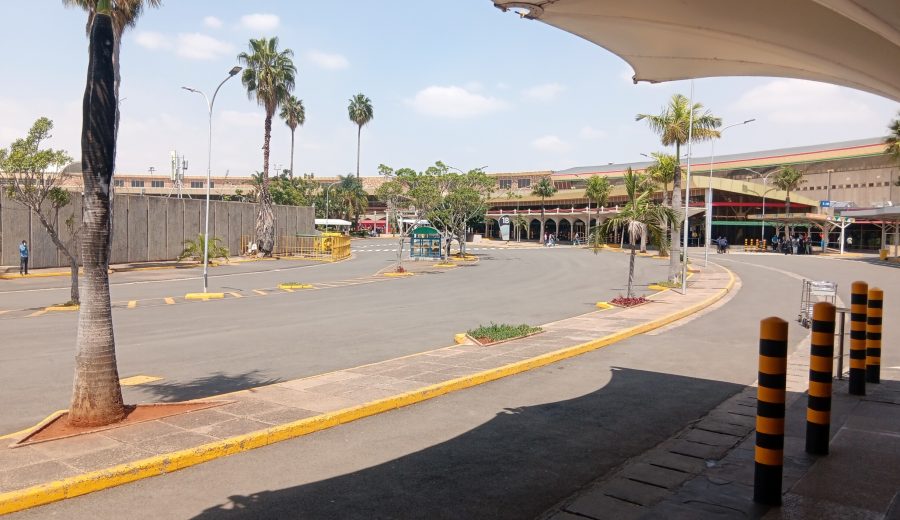
Image: Jomo Kenyatta International Airport in Nairobi, August 2025. Photo by Bahnfrend via Wikimedia Commons, CC BY-SA 4.0.