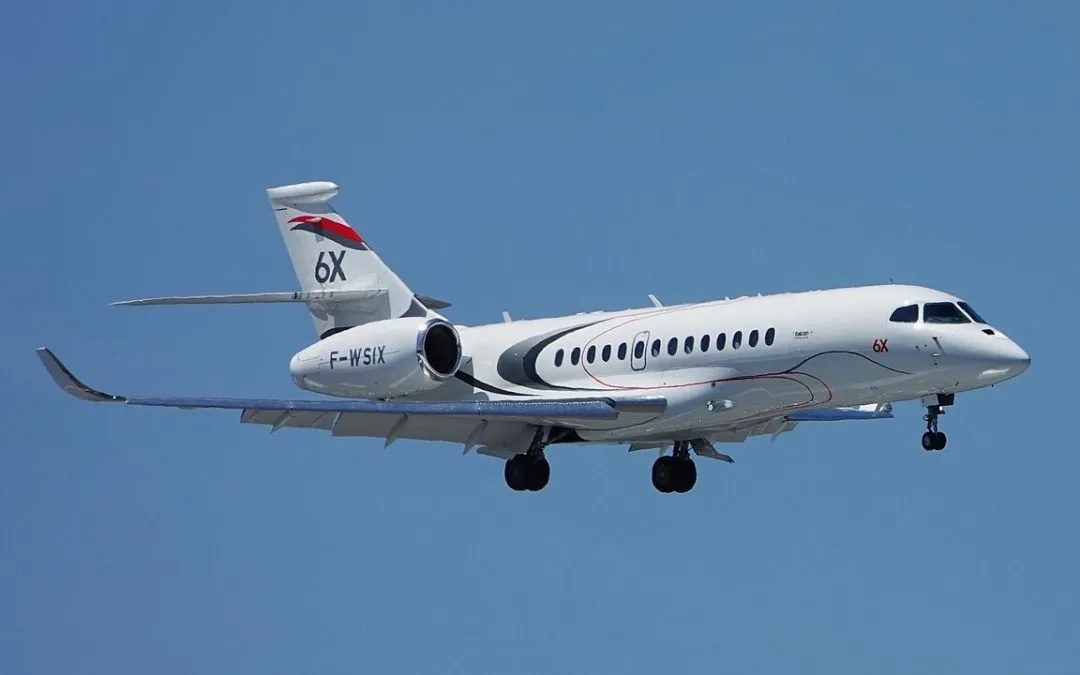
Ghana's government has defended the purchase of a new presidential jet after the aircraft's arrival triggered public outrage and a sharp political row. The $60m (£46m) French-made Falcon 6X, built by Dassault Aviation, was delivered to the Ghana Air Force on Monday at a reported cost of $61m. It was welcomed with a water salute, but criticism followed quickly online and among opposition politicians, who say the expenditure is a misplaced priority at a time when many Ghanaians continue to struggle with the high cost of living. The BBC's Africa team reported on the dispute.
The controversy lands at a sensitive moment for President John Mahama's administration, which is trying to demonstrate an economic recovery after years of financial difficulty that forced Ghana to seek help from the International Monetary Fund. Parliament approved the purchase last December as part of a wider programme to modernise the country's military aviation fleet, which also includes four helicopters from Airbus. The government says the jet will replace the 16-year-old Falcon 900EX, which it says has suffered recurring maintenance problems, including corrosion and leaks in its fuel tank, and which was reportedly grounded in France for several months in 2025 while undergoing repairs.
Officials argue that the new aircraft makes practical sense. They say the Falcon 6X has a longer flying range, which reduces the need for refuelling stops on international trips and improves the reliability of presidential travel. The government's position is that a head of state needs dependable transport, and that an ageing jet with repeated faults is a risk to both safety and schedule. The economist Godfred Alufar Bokpin of the University of Ghana agreed that the president's safety is paramount, but told the BBC that the timing is "a bit difficult to understand" given severe austerity measures, high unemployment and widespread infrastructure challenges.
The political sting comes from the history. While in opposition, Mahama himself opposed buying a new presidential jet, and the BBC notes that this has led to questions about why his administration has now gone ahead. Opposition MP Samuel Abu Jinapor said the spending came when many Ghanaians were struggling with the cost of living and when youth unemployment remained "alarmingly high". "What was unacceptable in opposition cannot suddenly become acceptable in government merely because the occupants of power have changed," he said. He accused the governing National Democratic Congress of hypocrisy, recalling that its senior figures had strongly opposed proposals for a new presidential aircraft when they were in opposition, and he called for greater transparency over the procurement process, how the purchase was financed and the government's justification.
The government answered on two fronts. First, it said it never opposed the idea of a presidential jet in principle. Peter Lanchene Toobu, chairman of parliament's defence committee, said the party's objection had been about timing, when Ghana was in severe economic difficulty. "We agreed in principle that we needed to purchase a new presidential jet," he said, adding that Ghana could not justify the expenditure while it was seeking a $3bn bailout from the IMF. Second, he argued that conditions have changed. "The strength and macroeconomic stability of this country have enhanced our status in the sense that imports have become cheaper, and this is the right time," he said. He added that the government purchased the aircraft without borrowing, citing a stronger Ghanaian currency and improved economic conditions.
Government spokesperson Kwakye Ofosu rejected the idea that the purchase was a misplaced priority and pointed to falling prices of construction materials and lower borrowing costs as signs of improvement. Recalling his own experience on the campaign trail, he told the broadcaster JoyNews that in 2024, when he was donating cement, a bag cost 115 cedis (£7.5), while today "for 80 cedis, you will get a bag of cement". That claim is the minister's own account, and the BBC reported it as such rather than as an independently verified price series.
The row has also reached the aircraft's interior. Claims circulated that the jet has a dedicated bedroom and bathroom, which the government rejected. "There certainly is no bathroom. President Mahama has no intention of bathing in the air," Ofosu said. He explained that the jet has reclining seats that can be converted into sleeping arrangements but denied it has a dedicated bedroom. The detail matters politically because a plane with luxury features would be easier for critics to portray as an indulgence, while a plane described as a replacement for an unreliable one is easier to defend as a practical purchase.
Online reaction has been sharp. One X user posted that the money "can employ over 100,000 nurses and 200,000 teachers", a comparison that quickly spread because it expresses what many citizens feel: that large sums for the presidency compete with spending on public services. The claim is a social media user's estimate and not an official figure, but it captures the political framing of the debate. For many Ghanaians, who have lived through a period in which the government sought an IMF programme and imposed austerity, a $60m purchase is read as a signal about priorities.
Economists and opposition figures are asking for more detail. Bokpin said the government should publish a cost-benefit analysis explaining why buying the jet was preferable to leasing one and how the decision serves Ghana's interests. Jinapor wants clarity on how the purchase was financed. The government has said no borrowing was involved and that parliament approved the acquisition last December, but the public conversation has moved beyond legal approval to the question of whether the spending is wise and fair.
The episode shows how quickly a single procurement can become a test of political credibility. For the government, the case is that the old aircraft was unreliable, that the economy has recovered enough to afford a replacement, and that no new debt was taken on. For critics, the case is that the president once opposed such a purchase, that hardship remains widespread, and that transparency has been lacking. Which view prevails will depend less on the technical specifications of the Falcon 6X than on whether Ghanaians feel the promised economic recovery is reaching their own households.