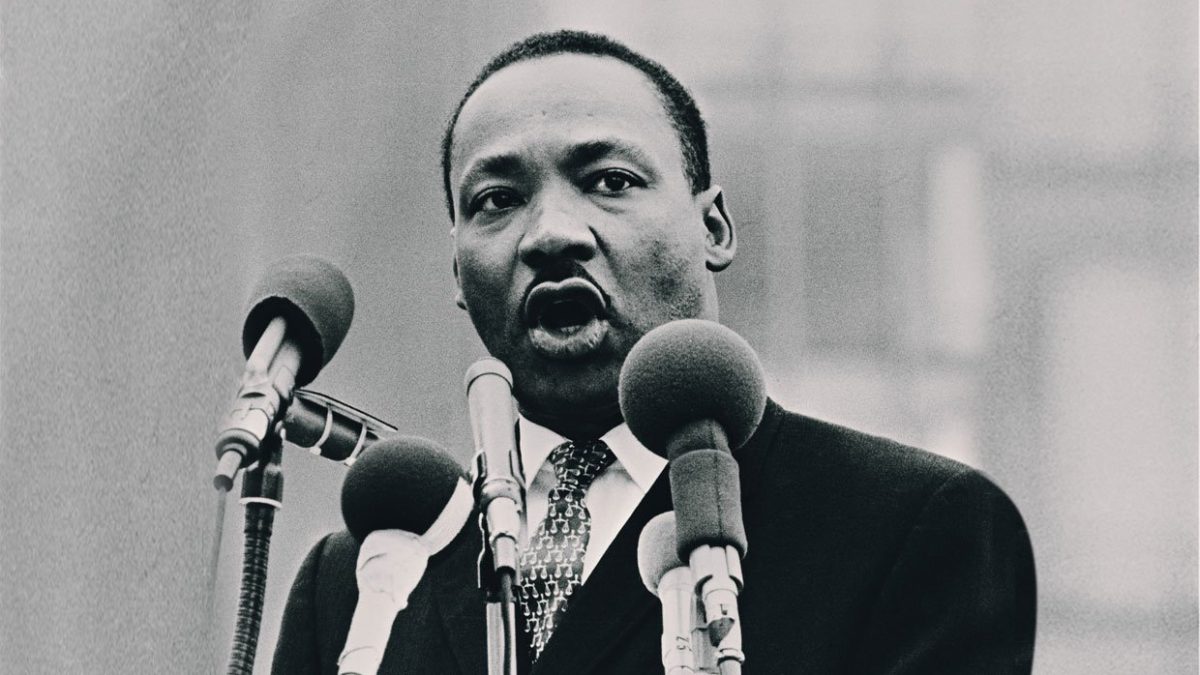
Martin Luther King Jr. (born Michael King Jr., 15 January 1929 – 4 April 1968) was an American Baptist minister and civil rights activist who was a prominent leader of the civil rights movement from 1955 until his assassination in 1968. He advanced civil rights through nonviolence and civil disobedience against Jim Crow laws, delivered the "I Have a Dream" speech at the 1963 March on Washington, and won the 1964 Nobel Peace Prize.
Martin Luther King Jr. at a Glance
| Birth name | Michael King Jr. |
| Born | 15 January 1929, Atlanta, Georgia, United States |
| Died | 4 April 1968, Memphis, Tennessee, aged 39 |
| Profession | Baptist minister and civil rights leader |
| Organisation | First president of the Southern Christian Leadership Conference (SCLC) |
| Major events | Montgomery bus boycott (1955); Birmingham protests (1963); March on Washington (1963); Selma marches (1965) |
| Nobel Prize | Peace, 1964 |
| Posthumous honours | Presidential Medal of Freedom (1977); Congressional Gold Medal (2003) |
| Spouse | Coretta Scott King (married 18 June 1953) |
| Children | Yolanda, Martin III, Dexter and Bernice |
Early Life and Education
Michael King Jr. was born in Atlanta, the second of three children of Michael King and Alberta King. His maternal grandfather, Adam Daniel Williams, had been pastor of the Ebenezer Baptist Church, and his father became senior pastor there in 1931. He entered Morehouse College, the historically Black men's college his father and grandfather had attended, after passing the entrance examination during his junior year of high school. He then enrolled at Crozer Theological Seminary in Pennsylvania, where he was elected president of the student body, and he went on to study at Boston University.
Marriage and Family
While studying at Boston University King met Coretta Scott, and they married on 18 June 1953 on the lawn of her parents' house in Heiberger, Alabama. They had four children: Yolanda (1955 to 2007), Martin Luther King III (born 1957), Dexter Scott King (1961 to 2024) and Bernice King (born 1963).
Civil Rights Leadership
King oversaw the 1955 Montgomery bus boycott and became the first president of the SCLC. He led the unsuccessful Albany Movement in Georgia, helped organise the nonviolent protests in Birmingham, Alabama, in 1963, and was one of the leaders of the 1963 March on Washington for Jobs and Freedom, where he delivered the "I Have a Dream" speech, regarded as one of the finest speeches in the history of oratory. He helped organise two of the three 1965 Selma to Montgomery marches for voting rights. He was jailed several times. The movement achieved pivotal legislation in the Civil Rights Act of 1964, the Voting Rights Act of 1965 and the Fair Housing Act of 1968.
Nobel Prize
In 1964 King won the Nobel Peace Prize for combating racial inequality through nonviolent resistance. In his last years he widened his focus to include opposition to poverty and to the Vietnam War, and he planned a national occupation of Washington, D.C., called the Poor People's Campaign.
Surveillance
FBI director J. Edgar Hoover considered King a radical and made him a target of the bureau's COINTELPRO programme from 1963. FBI agents investigated him for possible communist ties, spied on his personal life and secretly recorded him. In 1964 the FBI mailed King a threatening anonymous letter that he interpreted as an attempt to make him take his own life.
Assassination
In March 1968 King went to Memphis to support Black sanitation workers who were on strike, and on 3 April he delivered his "I've Been to the Mountaintop" address. He was assassinated on 4 April 1968 in Memphis. James Earl Ray was convicted of the killing, though the assassination remains the subject of conspiracy theories. His death led to riots in US cities.
Legacy
King was posthumously awarded the Presidential Medal of Freedom in 1977 and the Congressional Gold Medal in 2003. Martin Luther King Jr. Day began to be observed in cities and states from 1971, and the first federal holiday was observed in 1986. The Martin Luther King Jr. Memorial on the National Mall in Washington, D.C., was dedicated in 2011. This biography draws on [Wikipedia](https://en.wikipedia.org/wiki/Martin_Luther_King_Jr.).