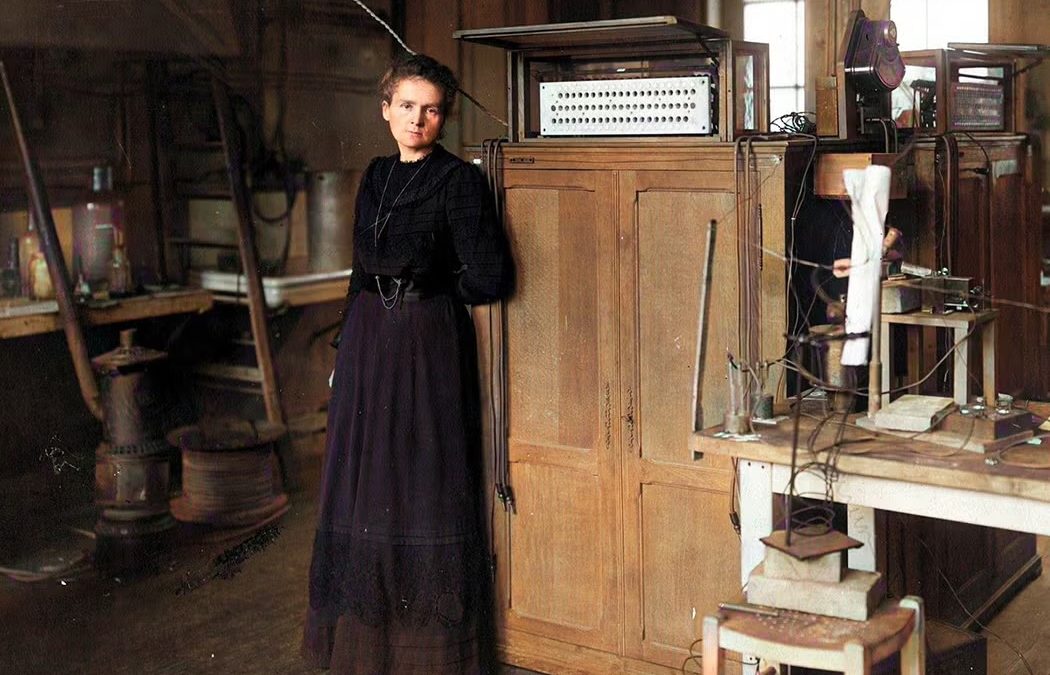
Marie Curie (Maria Salomea Skłodowska, 7 November 1867 to 4 July 1934) was a Polish-born French physicist and chemist who pioneered research on radioactivity. With her husband Pierre she discovered the elements polonium and radium, announced in 1898. She was the first woman to win a Nobel Prize and remains the only person to have won Nobel Prizes in two different scientific fields. This biography follows her life from Warsaw to her death in the French Alps.
Marie Curie at a Glance
| Full name | Maria Salomea Skłodowska-Curie |
| Born | 7 November 1867, Warsaw, Congress Poland, Russian Empire |
| Died | 4 July 1934, Passy, Haute-Savoie, France (aged 66) |
| Profession | Physicist and chemist |
| Nobel Prizes | Physics, 1903 (shared with Pierre Curie and Henri Becquerel); Chemistry, 1911 |
| Discoveries | Polonium and radium (announced 1898) |
| Spouse | Pierre Curie (married 26 July 1895; he died 19 April 1906) |
| Children | Irène and Ève |
| Cause of death | Aplastic anaemia |
Early Life in Warsaw
Maria Skłodowska was born in Warsaw to Władysław Skłodowski and Bronisława Boguska, who were both teachers. Poland was then ruled by the Russian Empire, and women could not study at the university in Warsaw. She worked as a governess to support her older sister's medical studies, and in late 1891 she moved to Paris to study at the University of Paris.
Pierre Curie and the Discovery of Radium
In Paris she met the physicist Pierre Curie, and they were married on 26 July 1895. Their daughters Irène and Ève were born in the following years. Working in a shed laboratory, Marie Curie and her husband identified two new radioactive elements in 1898, polonium, which she named after her homeland, and radium. She coined the term "radioactivity" for the phenomenon that Henri Becquerel had discovered.
Two Nobel Prizes
In 1903 Marie Curie shared the Nobel Prize in Physics with Pierre Curie and Henri Becquerel, which made her the first woman to win a Nobel Prize. After Pierre died in a road accident in Paris on 19 April 1906, she took over his teaching post at the University of Paris and became its first woman professor. In 1911 she was awarded the Nobel Prize in Chemistry on her own, for isolating pure radium, and she became the first person to win two Nobel Prizes. The same year a press scandal over her friendship with the physicist Paul Langevin threatened her reputation.
The First World War and the Radium Institute
When the First World War began, Curie developed mobile X-ray units to help surgeons locate bullets and shrapnel in wounded soldiers. She equipped about 20 vehicles, which the soldiers nicknamed "petites Curies", and she directed the installation of about 200 radiological units at hospitals in the first two years of the war. Her daughter Irène, who was 17 when the war began, assisted her. After the war she led the Radium Institute in Paris, and in 1932 a sister institute opened in Warsaw with her sister Bronisława as its director.
Death
Curie died at the Sancellemoz sanatorium in Passy on 4 July 1934, aged 66, of aplastic anaemia, an illness that is linked to her long exposure to radiation. Her daughter Irène and son-in-law Frédéric Joliot-Curie went on to win the Nobel Prize in Chemistry in 1935.
Legacy
In 1995 Curie became the first woman to be buried in the Panthéon in Paris on her own merits. Her notebooks are still radioactive and are expected to remain so for more than a thousand years because of the long half-life of radium-226. Her work opened the way to modern nuclear physics and to the use of radiation in the treatment of cancer.