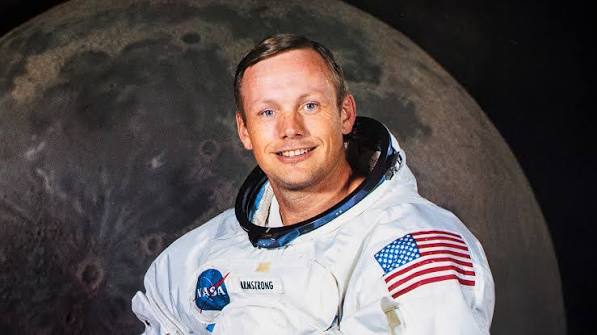
Neil Armstrong (Neil Alden Armstrong, 5 August 1930 to 25 August 2012) was an American astronaut, naval aviator and test pilot who became the first person to walk on the Moon. As commander of the Apollo 11 mission, he stepped onto the lunar surface on 20 July 1969, an event watched on television by more than half a billion people. He later taught engineering and served on the commissions that investigated the Apollo 13 and Challenger accidents. This biography follows his life and career.
Neil Armstrong at a Glance
| Full name | Neil Alden Armstrong |
| Born | 5 August 1930, near Wapakoneta, Ohio, United States |
| Died | 25 August 2012, Fairfield, Ohio (aged 82) |
| Profession | Astronaut, test pilot and engineer |
| Education | Purdue University (bachelor's, 1955); University of Southern California (master's, 1970) |
| Missions | Gemini 8 (1966); Apollo 11 (1969) |
| Honours | Presidential Medal of Freedom (1969); Congressional Space Medal of Honor (1978); Congressional Gold Medal |
| Spouse | Janet Shearon (married 1956) |
Early Life and Service
Armstrong was born in rural Auglaize County, Ohio, near Wapakoneta. He started flying as a child and earned his pilot's certificate before he had a driver's licence. He studied aeronautical engineering at Purdue University and earned his degree in 1955. As a naval pilot in the Korean War he flew 78 combat missions.
Test Pilot and Gemini 8
After the war Armstrong became a test pilot for NACA, the forerunner of NASA, at Edwards, and he flew the X-15 rocket plane seven times. In March 1966 he was the command pilot of Gemini 8, which achieved the first docking of two spacecraft in orbit. The mission was cut short after a stuck thruster sent the spacecraft into a dangerous roll.
Apollo 11
Armstrong commanded Apollo 11 in July 1969, with Buzz Aldrin and Michael Collins. The lunar module landed on 20 July 1969, and Armstrong and Aldrin left it at about 11 pm Eastern time, which was 0300 GMT on 21 July. Armstrong stepped onto the surface first and said: "That's one small step for man, one giant leap for mankind." He spent about two and a half hours outside the lunar module. He received the Presidential Medal of Freedom in 1969 and the Congressional Space Medal of Honor in 1978.
Later Life
Armstrong taught aerospace engineering at the University of Cincinnati until 1979, after earning a master's degree at the University of Southern California in 1970. He served on the investigation into the Apollo 13 accident and on the Rogers Commission that investigated the Challenger disaster.
Family and Death
Armstrong married Janet Shearon in 1956, and they had three children. Their daughter Karen died in 1962, at the age of two. He died in Fairfield, Ohio, on 25 August 2012, aged 82, from complications after heart bypass surgery.
Legacy
Armstrong is remembered as the first person to set foot on another world. His words from the surface are among the best-known sentences of the 20th century.