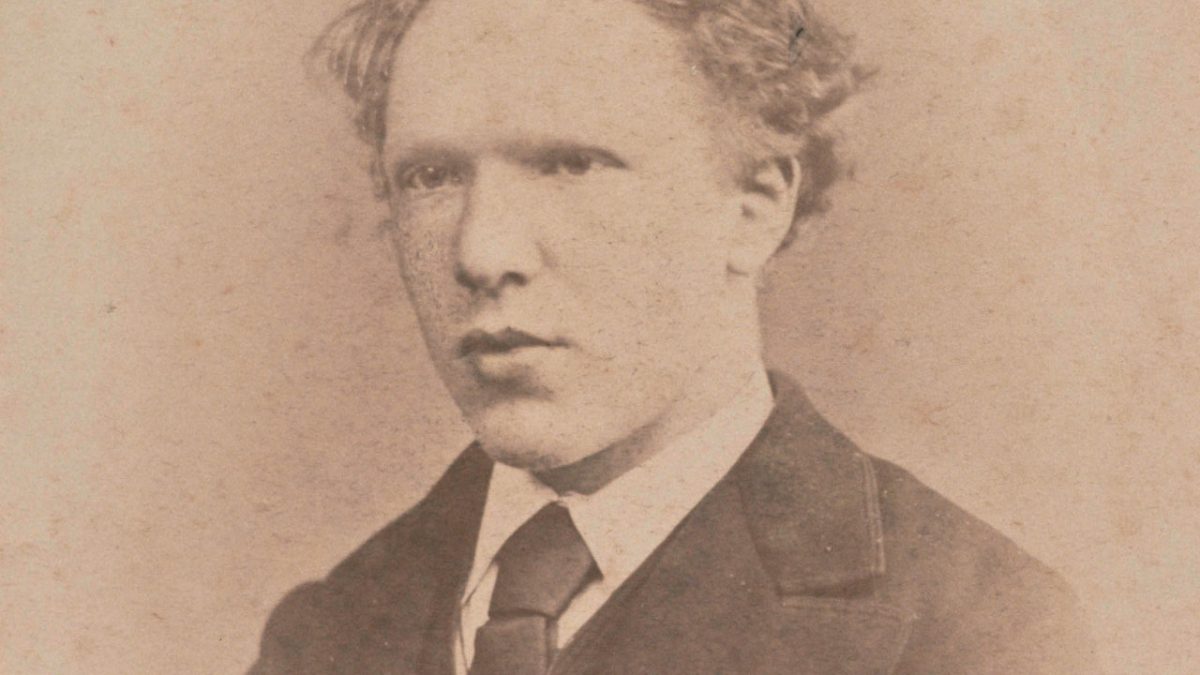
Vincent van Gogh (Vincent Willem van Gogh, 30 March 1853 to 29 July 1890) was a Dutch Post-Impressionist painter whose bold colour and emotional intensity made him one of the most influential artists in the history of Western art. He produced about 2,100 artworks in little more than a decade, including around 860 oil paintings, most of them in the last two years of his life. He struggled with his mental health and died at the age of 37. This biography follows his life, his work and his legacy.
Vincent van Gogh at a Glance
| Full name | Vincent Willem van Gogh |
| Born | 30 March 1853, Zundert, Netherlands |
| Died | 29 July 1890, Auvers-sur-Oise, France (aged 37) |
| Profession | Painter and draughtsman |
| Movement | Post-Impressionism |
| Best-known works | The Starry Night, Sunflowers, The Potato Eaters, Bedroom in Arles |
| Brother | Theo van Gogh, art dealer and lifelong supporter |
| Museum | Van Gogh Museum, Amsterdam (opened 1973) |
Early Life in the Netherlands
Van Gogh was born in Zundert, in the south of the Netherlands, the eldest surviving son of Theodorus van Gogh, a pastor in the Dutch Reformed Church, and Anna Cornelia Carbentus. He had a brother of the same name who was stillborn a year earlier, and he grew up with five siblings, among them Theo, who became his closest friend and confidant. As a young man he worked for the art dealers Goupil and Cie in The Hague, London and Paris, but he was dismissed in 1876. In April 1876 he returned to England to take unpaid work as a supply teacher in a boarding school in Ramsgate. He then worked as a teacher and a bookseller and decided to become a preacher.
From Preacher to Artist
In 1879 Van Gogh was working as a missionary among coal miners in the Borinage, a mining region of Belgium, where he lived in poverty and was criticised by church authorities for his extreme commitment to the people he served. After this setback, he decided in 1880 to become an artist. Theo supported him with money for the rest of his life, and the letters between the brothers, hundreds of which survive, are one of the best sources on the artist's thinking. He studied briefly in Brussels and The Hague and taught himself by copying prints and drawings. His correspondence with Theo, which began in his younger years and lasted for the rest of his life, is the most comprehensive source on his thinking and his friendship with his brother.
The Dutch Period
His early works were dark in tone and subject. In Nuenen, in the Netherlands, he painted peasants and weavers, and in 1885 he completed The Potato Eaters, which shows a family eating by lamplight and is often regarded as the most important work of his Dutch period. In late 1885 he moved to Antwerp, where he saw the paintings of Rubens and became interested in Japanese prints.
Paris and the Discovery of Colour
In 1886 Van Gogh moved to Paris to live with Theo. He met artists including Camille Pissarro, Henri de Toulouse-Lautrec, Paul Gauguin and Émile Bernard, and studied the Impressionists and the Neo-Impressionists. His palette became brighter, and he began to use shorter brushstrokes and bolder contrasts. He painted portraits, still lifes and views of the city, among them a series of self-portraits. In the two years he spent in the city his work changed from the dark palette of the Dutch period to the vivid colour for which he is now known.
Arles, the Yellow House and Gauguin
In February 1888 Van Gogh left Paris for Arles in the south of France, attracted by the light and the landscape. He rented a house, known as the Yellow House, and dreamed of founding a community of artists there. During this period he painted Sunflowers, The Night Café, Bedroom in Arles and The Yellow House. In October 1888 Paul Gauguin joined him, but the two argued, and in December Van Gogh suffered a mental crisis in which he cut off part of his own left ear. He was hospitalised, and Gauguin left Arles. Van Gogh suffered from psychotic episodes and delusions, and although he worried about his mental stability he often neglected his physical health, did not eat properly and drank heavily.
Saint-Rémy and The Starry Night
In May 1889 Van Gogh voluntarily entered the asylum at Saint-Paul-de-Mausole, near Saint-Rémy-de-Provence. Despite the periods of illness, he continued to paint, and in June 1889 he completed The Starry Night, a view from his window at dawn, with a swirling sky above a village. The painting is now in the Museum of Modern Art in New York, and it is probably the best known of all his works. He also painted olive groves, cypresses and irises during this time.
Auvers-sur-Oise and Death
In May 1890 Van Gogh left the asylum and moved to Auvers-sur-Oise, north of Paris, to be near Dr Paul Gachet. He painted prolifically, completing dozens of works in the last weeks of his life, among them Wheatfield with Crows. On 27 July 1890 he shot himself in the chest and returned to his lodging, where he died two days later, on 29 July, with Theo at his side. He was 37 years old. Van Gogh was buried on 30 July in the municipal cemetery of Auvers-sur-Oise, and his brother Theo, who survived him by only six months, died on 25 January 1891. In 1914 Theo.s widow had his body moved from Utrecht to be re-buried beside Vincent at Auvers.
Legacy and Recognition
During his lifetime Van Gogh was little known. After his death, his sister-in-law Johanna van Gogh-Bonger, Theo's widow, worked to promote his work and to publish his letters, and exhibitions in the 1890s and early 1900s established his reputation. His paintings later influenced the Expressionists and the Fauves, and the artist has become a symbol of the misunderstood genius. The Van Gogh Museum in Amsterdam, which opened in 1973, houses the largest collection of his work, and the Kröller-Müller Museum in the Netherlands holds another major group. Theo's death in January 1891 removed Vincent's most vocal and well-connected champion, and Johanna suddenly had to look after several hundred paintings, letters and drawings, as well as her infant son, Vincent Willem van Gogh. She arranged for the publication of some of the brothers' letters, a few of which appeared in 1906 and 1913, with the majority published in 1914, and the letters have been described as having a "diary-like intimacy". His reputation began to grow in the early twentieth century, when elements of his style were taken up by the Fauves and the German Expressionists. Several of his works, including Portrait of Dr Gachet, Portrait of Joseph Roulin and Irises, have sold for more than 100 million US dollars in today's money. His paintings now sell for very large sums at auction, a fact that contrasts sharply with the poverty of his own life.