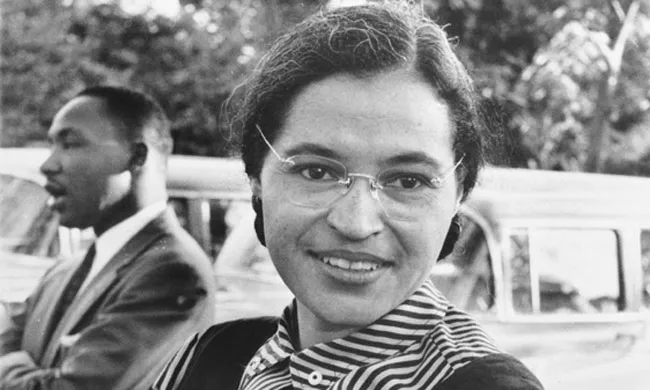
Rosa Parks (Rosa Louise McCauley, 4 February 1913 to 24 October 2005) was an American civil rights activist who became known as "the mother of the civil rights movement". Her arrest in Montgomery, Alabama, on 1 December 1955, for refusing to give up her seat on a bus to a white passenger, helped to spark the Montgomery bus boycott, a campaign that lasted more than a year and brought the Reverend Martin Luther King Jr. to national attention. She died in Detroit at the age of 92. This biography follows her life and legacy.
Rosa Parks at a Glance
| Birth name | Rosa Louise McCauley |
| Born | 4 February 1913, Tuskegee, Alabama, United States |
| Died | 24 October 2005, Detroit, Michigan (aged 92) |
| Profession | Seamstress and civil rights activist |
| Best known for | Refusing to give up her bus seat on 1 December 1955 |
| Honours | Presidential Medal of Freedom (1996), Congressional Gold Medal (1999) |
| Spouse | Raymond Parks (married 1932; he died in 1977) |
| Organisation | National Association for the Advancement of Colored People (NAACP) |
Early Life in Alabama
Rosa McCauley was born in Tuskegee, Alabama, to Leona, a teacher, and James McCauley, a carpenter and mason, in a segregated South. She transferred to Booker T. Washington Junior High School, a segregated public school, and then attended a laboratory school set up by the Alabama State Teachers College for Negroes, but she dropped out to care for her ailing grandmother and mother. On 18 December 1932 she married Raymond Parks, whom she described as the first real activist she had met, admiring his opposition to racial prejudice.
Activism Before 1955
After their marriage Rosa and Raymond became involved in the case of the Scottsboro Boys, nine Black youths falsely accused of rape, hosting fundraising meetings at their home. In 1933, with encouragement from Raymond, she completed her high school education, at a time when only 7% of Black people in Alabama held a high school diploma. From 1941 she worked at Maxwell Air Force Base, which was fully integrated, so that she could take public transit alongside her white colleagues on base. Parks joined the Montgomery chapter of the NAACP in 1943, and she became its secretary, encouraged by the NAACP activist E. D. Nixon. She tried to register to vote three times beginning in 1943 and succeeded in 1945, and as secretary she began investigating the gang rape of Recy Taylor, a Black woman. She was not simply a tired seamstress who acted on impulse; she had years of experience in the struggle for equal rights. In 1941 she had begun working at Maxwell Air Force Base, and she had found the experience of riding transit on equal terms there a sharp contrast with the segregation she met when she returned home.
The Arrest
On 1 December 1955, Parks boarded a city bus in Montgomery after a day at work. Under the city's segregation laws, Black passengers were required to give up their seats to white passengers if the white section was full. When the driver asked her and three other Black passengers to give up their seats, the others complied, but Parks refused. She was taken to Montgomery city hall, where she filled out her arrest forms, and was then taken to the city jail. She was later fined. She later said: "No, the only tired I was, was tired of giving in." She was 42.
The Montgomery Bus Boycott
After Nixon approached her to be a test case, Parks consulted her family and, despite concerns about violent retaliation, agreed, and the attorney Fred Gray agreed to represent her. The Women's Political Council president Jo Ann Robinson, working with two students at Alabama State College, produced 35,000 leaflets announcing a one-day boycott of Montgomery buses on 5 December 1955, the day of Parks's trial. Council members distributed the leaflets throughout the Black community, and Nixon enlisted several members of the local Black clergy, including Martin Luther King Jr., the pastor of Dexter Avenue Baptist Church, where a planning meeting was held on 2 December. Plans were drawn up for alternative transport, including carpooling networks and collaboration with local taxi drivers, and many Black pastors announced the boycott in their churches on Sunday 4 December.
On the day of the trial bus ridership was low, and many Black residents walked or carpooled. Almost 500 Black Montgomerians attended the hearing. Parks pleaded not guilty, and she was found guilty of violating state law and fined 10 dollars plus 4 dollars in court fees. A new organisation, the Montgomery Improvement Association, was then formed, and King was elected as its president. The boycott lasted 381 days, finally concluding after segregation on buses was deemed unconstitutional in the court case Browder v. Gayle.
Life After the Boycott
Parks handled telephone communications at Fred Gray's office during the boycott, and the leaders faced harassment, ostracism and various legal obstacles. After the boycott ended Parks experienced financial hardship and health problems, and in 1957 she relocated to Detroit, Michigan. She continued to advocate for civil rights, supporting people such as John Conyers, Angela Davis and Nelson Mandela, and she attended the 1965 Selma to Montgomery marches. In 1987 she co-founded the Rosa and Raymond Parks Institute for Self Development with Elaine Eason Steele.
Honours
In 1996 President Bill Clinton awarded Parks the Presidential Medal of Freedom, and in 1999 Congress awarded her the Congressional Gold Medal, its highest civilian honour. She received many other awards, including the Martin Luther King Jr. Award from the Capitol Press Club in 1968 and, in 1979, the NAACP's Spingarn Medal, which cited her "quiet courage and determination" in refusing to relinquish her seat.
Death and Legacy
Parks died on 24 October 2005 at her home in Detroit, at the age of 92. She was honoured with public viewings and memorial services in three cities: Montgomery, Washington, where she lay in state in the United States Capitol rotunda, and Detroit, where she was interred at Woodlawn Cemetery. Her act of refusal on a Montgomery bus is remembered as a turning point in the civil rights movement, and her example, of ordinary courage combined with careful organisation, has inspired activists around the world. She was the first Black American to be memorialised in the National Statuary Hall.