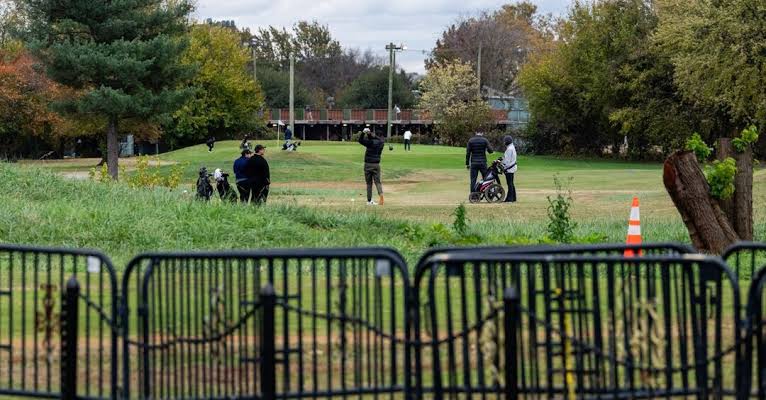
A federal judge has temporarily blocked the Trump administration's closure of East Potomac Golf Links, a historic public golf course and park in Washington DC, in a ruling that came just before the closure was due to begin. US District Judge Ana Reyes, who has overseen a months-long challenge to President Donald Trump's plans for the park, said in a 30-page decision issued on Saturday that the administration cannot close either the park or the course, although it is not required to actively manage them. Mr Trump had said the course would be closed from 15 November for 15 months of renovations. After the ruling, NPR reported, the president blasted the judge for halting his project and said he would appeal.
Judge Reyes was blunt about the government's justification. She found that the administration's reasons for the proposed closure were pretextual and that the government had violated at least two federal laws "to meet an arbitrary deadline". "The government proposes to close a historic park, daily enjoyed by Washingtonians of all stripes, indefinitely," she wrote. She said the closure "runs counter to the public interest in utilising national parkland", adding that the government had not "plausibly identified any harm it would suffer from a temporary restraining order that preserves the status quo pending further proceedings". A coalition of advocacy and legal groups that represents the plaintiffs, including Democracy Forward and the Democracy Defenders Fund, said it was "grateful that the court has stopped the government from unlawfully closing East Potomac Park and depriving people of this priceless piece of American history and wonderful recreation space".
The president's case rests on the condition of the site and on his ambitions for it. Mr Trump, an avid golfer who owns more than a dozen courses, has called the 106-year-old course "Trash Island" and said his plans will create "one of the Best and Most Spectacular Golf Courses anywhere in the World". In a post on Truth Social he described the existing course as "old, broken, dilapidated and of no further use or effect", with "falling, dangerous and disease-infested trees" and "a collapsing and hazardous seawall". He has said the renovated course would be "open to the Public while, at the same time, designed to the Highest Level of Golf and able to hold World Class Tournaments". The project forms part of a wider effort to reshape the US capital, which includes a new White House ballroom and a 250-foot-tall arch, according to the BBC. A golfer who plays there regularly conceded to the BBC that the course could use a "facelift", though he thought the president's description a "gross overstatement".
The case against the closure rests on who uses the course and how the government has handled the process. East Potomac sits two miles (3km) south of the White House and is one of three public courses run by the National Park Service in the capital. It is open to all and does not require a membership, and its facilities are more modest than the luxury private courses with which the president is associated, offering food-court-style dining rather than white tablecloth restaurants. A 70-year-old golfer who has played there for 15 years told the BBC he pays $29 (£21.65) for 18 holes and that there is "no place in the whole DMV" where one can play a nice 18 holes for that price. Another regular, Jourdain Yardan, who plays twice a week, said a closure, even a temporary one, would be a "huge dent" in the culture of the course, and he worried that "big league, big golfers" would also mean "big prices". The plaintiffs say federal law requires a fair and public process before such a change.
The legal fight dates back to February, when the DC Preservation League and others sued over redevelopment plans for the park. It escalated in October when the National Park Service began to cut down hundreds of trees without notifying Judge Reyes until 15 hours before work was due to begin, on a holiday weekend. After the trees were cut, she ordered the administration to stop tree removal until at least 26 October and to give her three business days' notice before making any other permanent changes. In a 70-page ruling in late October, she extended that order and barred further alterations to the course without ten days' notice while the lawsuit proceeds. The administration has told the court that it intends to appeal that ruling, according to CBS News, the BBC's US partner. Mr Trump nonetheless announced that the course would close for 15 months from 15 November and shared a rendering of the redesign.
The judge has also opened a separate inquiry into the conduct of the government's lawyers. At a hearing on Friday 30 October she said she would investigate whether Justice Department attorneys "have made misrepresentations to the court and otherwise violated ethical rules", including whether the late notice about the tree removal was "done in bad faith" and whether lawyers failed to correct previously false statements or withheld information. Government lawyers had confirmed to her that week that the course would be closed for renovations after telling her earlier that there were no plans to shut it. The hearing included an exchange in which Associate Attorney General Stanley Woodward, the number three official at the Justice Department, responded to a question about whether the Secretary of the Interior was involved by asking what she meant by "involved", prompting the judge to read the definition from a dictionary. She said she would carry out the inquiry with a special master, an independent third party appointed by the court.
For the administration, the case is a test of how far a president can go in reshaping federal land without following the processes that apply to others. The judge's finding that the government violated at least two federal laws suggests that the dispute is about procedure as much as golf: whether agencies provided the required notice, followed the required public steps and told the court the truth. Supporters of the president may argue that a course in poor condition deserves investment, and that the courts should not stand in the way of a plan to improve a public asset. Opponents answer that the same goal can be pursued with public consultation and without closing the park for more than a year. The ruling does not decide the question permanently, since it is a temporary measure that preserves the status quo while the case continues.
What happens next depends on the appeal and on the inquiry by the special master. If the appeals court takes a different view, the administration could close the park as planned; if it does not, the case will go on in Judge Reyes's courtroom, where the plaintiffs say they are "eager to continue to argue this case". For the golfers who use the course every week, the practical effect of the ruling is that the first tee remains open for now, at the price they are used to. For the capital, the dispute has become a symbol of a larger debate about who owns Washington's public spaces and how decisions about them should be made. And for the courts, it has become a reminder that even a project as simple as a golf course renovation has to pass through the same legal tests as any other government action.