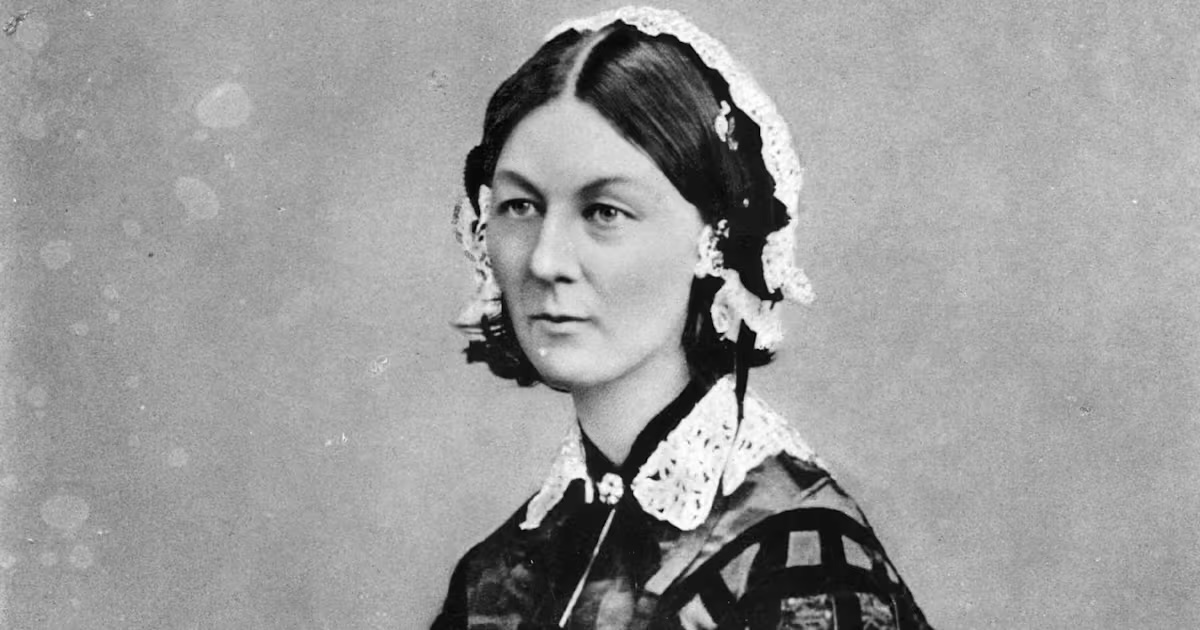
Florence Nightingale (12 May 1820 to 13 August 1910) was an English social reformer, statistician and the founder of modern nursing. She came to prominence while serving as a manager and trainer of nurses during the Crimean War, in which she organised care for wounded soldiers at Constantinople, and she became an icon of Victorian culture as "The Lady with the Lamp" making ward rounds at night. In 1860 she laid the foundation of professional nursing with the establishment of her nursing school at St Thomas' Hospital in London. This biography follows her life and work.
Florence Nightingale at a Glance
| Full name | Florence Nightingale |
| Born | 12 May 1820, Florence, Grand Duchy of Tuscany (now Italy) |
| Died | 13 August 1910 (aged 90) |
| Profession | Nurse, social reformer and statistician |
| Best known for | Nursing during the Crimean War; founding modern nursing |
| Nickname | The Lady with the Lamp |
| School | Nightingale training school at St Thomas' Hospital, London (1860) |
| Named in her honour | The Nightingale Pledge, the Florence Nightingale Medal and International Nurses Day (12 May) |
Early Life
Nightingale was born on 12 May 1820 at Villa Colombaia, near the Porta Romana in Florence, where her parents, William Edward Nightingale and Frances "Fanny" Smith, were staying during a European tour. Like her older sister Frances Parthenope, who had been named partly after the Greek settlement on the site of Naples, she was named after her birthplace. The family returned to England in 1821, and after 1825, when William Nightingale bought Embley Park in Hampshire, the family divided its time chiefly between Embley and Lea Hurst in Derbyshire, with some time in London. Her father taught the daughters much of their later instruction himself, and their curriculum included French, German, Italian, Latin, Greek, mathematics, constitutional history, grammar, composition, English literature and music. In 1838 William took the family on another European tour, during which Florence met the English-born Parisian hostess Mary Clarke, who treated her as an intellectual equal and who reportedly said that, if forced to choose, she would rather be "a galley-slave" than a woman.
A Calling to Nursing
On 7 February 1837, at the age of 16, Nightingale experienced what she later described as the first of several calls from God to service, though the call did not specify what form that service should take. It took several years for her vocation to focus on nursing, and resistance from her mother and sister delayed her attempts to act on it. She rejected the expected role for a woman of her status to become a wife and mother, and she educated herself in the art and science of nursing in the face of opposition from her family and the restrictive social code. Her most persistent suitor was the politician and poet Richard Monckton Milnes, but after a nine-year courtship she rejected him, convinced that marriage would interfere with her calling. In Rome in 1847 she met Sidney Herbert, a politician who had been Secretary at War, and the two became lifelong friends. Travelling as far as Greece and Egypt, she rescued a little owl in Athens and named it Athena, and she often carried the owl in her pocket until it died shortly before she left for the Crimea.
The Crimean War
Nightingale's most famous contribution came during the Crimean War, when reports reached Britain of the horrific conditions for the wounded at the military hospital at Scutari, on the Asiatic side of the Bosporus opposite Constantinople. On 21 October 1854 she and a staff of 38 women volunteer nurses, with 15 Catholic nuns, were sent to the Ottoman Empire under the authorisation of Sidney Herbert, and she arrived at Selimiye Barracks in Scutari early in November. Her team found that poor care was being delivered to wounded British soldiers by overworked medical staff in the face of official indifference. Medicines were in short supply, hygiene was being neglected and mass infections were common, many of them fatal. During her first winter at Scutari, 4,077 British soldiers died there, and ten times more soldiers died from illnesses such as typhus, typhoid, cholera and dysentery than from battle wounds. After Nightingale sent a plea to The Times, the British government commissioned Isambard Kingdom Brunel to design a prefabricated hospital that could be built in England and shipped to the Dardanelles, and the result was Renkioi Hospital, which had a death rate less than one tenth of that of Scutari. The government also sent out a Sanitary Commission in March 1855, almost six months after Nightingale had arrived, which flushed out the sewers and improved ventilation, and death rates were sharply reduced. Nightingale herself implemented handwashing in the hospital where she worked, but she never claimed credit for the fall in the death rate.
The Lady with the Lamp and the Debate Over Her Record
Nightingale gave nursing a favourable reputation and became an icon of Victorian culture, especially in the persona of "The Lady with the Lamp". Some recent commentators have asserted that her achievements in the Crimean War were exaggerated by the media at the time, and the BBC released documentaries in 2001 and 2008 that were critical of her performance. The Nightingale scholar Lynn McDonald has dismissed these criticisms as "often preposterous", arguing that they are not supported by primary sources. Critics agree, however, on the importance of her later work in professionalising nursing roles for women.
Nursing School and Reform
In 1860 she laid the foundation of professional nursing with the establishment of her nursing school at St Thomas' Hospital in London, the first secular nursing school in the world, which is now part of King's College London. Her social reforms included improving healthcare for all sections of British society, advocating better hunger relief in India, helping to abolish prostitution laws that were harsh for women and expanding the acceptable forms of female participation in the workforce.
Statistics
Nightingale was an innovator in statistics, and she represented her analysis in graphical forms so that conclusions could be drawn more easily from data. She is famous for her use of the polar area diagram, also called the Nightingale rose diagram, which is equivalent to a modern circular histogram or pie chart and is still regularly used in data visualisation.
Writings
She was a prodigious and versatile writer. In her lifetime much of her published work was concerned with spreading medical knowledge, and some of her tracts were written in simple English so that they could be understood by people with poor literary skills. Much of her writing, including her extensive work on religion and mysticism, has only been published posthumously.
Legacy
Nightingale died on 13 August 1910. The Nightingale Pledge taken by new nurses and the Florence Nightingale Medal, the highest international distinction a nurse can achieve, are named in her honour, and International Nurses Day is celebrated every year on her birthday.