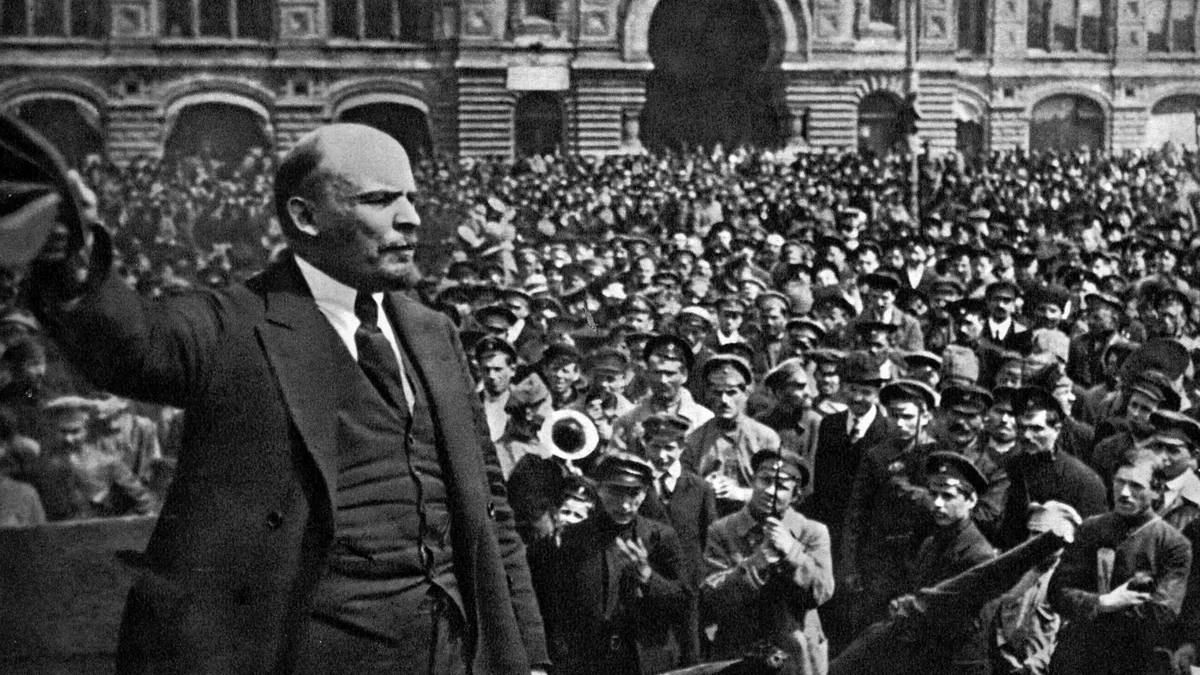
The October Revolution, also known as the Great October Socialist Revolution in Soviet historiography, was the second of two revolutions in Russia in 1917. It was led by Vladimir Lenin's Bolsheviks as part of the broader Russian Revolution of 1917 to 1923. It began with an insurrection in Petrograd, now Saint Petersburg, on 7 November 1917, which was 25 October in the Julian calendar then used in Russia, and it was the precipitating event of the Russian Civil War. The initial stage of the revolution, which involved the assault on Petrograd, occurred largely without casualties.
Why "October" in November
Although the revolution occurred in November in the Gregorian calendar, it is most commonly known as the October Revolution because Russia still used the Julian calendar at the time. The event is sometimes known as the November Revolution, after the Soviet Union modernised its calendar in 1918. It has also been known as the Bolshevik Revolution and the Communist Revolution, and Western observers have called it the Bolshevik coup.
The February Revolution
The October Revolution followed and capitalised on the February Revolution earlier in 1917, which had toppled Tsar Nicholas II and led to the creation of the Russian Provisional Government. The Provisional Government, led by Alexander Kerensky, took power after Grand Duke Michael, the younger brother of Nicholas II, declined to take it. During this time urban workers began to organise into councils, called soviets, in which revolutionaries criticised the Provisional Government and its actions.
A Government in Crisis
The Provisional Government was weak and riven by internal dissension, and it remained unpopular, especially because it continued to fight in the First World War. It ruled with an iron fist throughout mid-1917, including killing hundreds of protesters in the July Days. A nationwide crisis affected social, economic and political relations. Disorder in industry and transport had intensified, and difficulties in obtaining provisions had increased. Industrial production in 1917 had fallen by over 36 per cent compared with 1914, and in the autumn as much as 50 per cent of all enterprises in the Urals, the Donbas and other industrial centres were closed down, leading to mass unemployment. At the same time the cost of living increased sharply, and real wages fell to about 50 per cent of what they had been in 1913. By October 1917 Russia's national debt had risen to 50 billion roubles, of which more than 11 billion roubles were owed to foreign governments, and the country faced the threat of financial bankruptcy. The government declared the Russian Republic on 1 September (14 September in the new calendar).
Strikes, Peasants and Soldiers
After his arrival in Petrograd on 3 April 1917, Lenin issued his April Theses, which called on the Bolsheviks to take over the Provisional Government and end the war. Through the summer, working-class Russians increasingly spoke of their lack of confidence in the government, as shortages of food and supplies grew, and in September and October there were mass strikes by workers in Moscow and Petrograd, miners in the Donbas, metalworkers in the Urals, oil workers in Baku, textile workers and railroad workers on 44 railway lines. In those months alone more than a million workers took part in strikes, and in many factories the workers took control over production and distribution through factory committees. By October peasant uprisings were common, and by autumn the peasant movement against the landowners had spread to 482 of 624 counties, or 77 per cent of the country. In September the garrisons in Petrograd, Moscow and other cities, the Northern and Western fronts, and the sailors of the Baltic Fleet declared through their elected body, Tsentrobalt, that they did not recognise the authority of the Provisional Government. Soldiers' wives also played a key role in the unrest: from 1914 to 1917 almost half of healthy men were sent to war, many women became heads of households, and when government allowances were late and too small they sent masses of appeals that went largely unanswered and joined "subsistence riots".
The Bolsheviks Prepare
The far-left Bolsheviks were deeply unhappy with the government and began spreading calls for a military uprising. On 10 October (23 October in the new calendar) the Petrograd Soviet, led by Leon Trotsky, voted to back a military uprising. On 24 October (6 November) the government closed numerous newspapers and closed Petrograd in an attempt to forestall the revolution, and minor armed skirmishes ensued.
The Uprising
The next day a full-scale uprising erupted as a fleet of Bolshevik sailors entered the harbour and tens of thousands of soldiers rose up in support of the Bolsheviks. Bolshevik Red Guards under the Military-Revolutionary Committee began to occupy government buildings. In the early morning of 26 October (8 November) they captured the Winter Palace, the seat of the Provisional Government in Petrograd, then the capital of Russia.
Civil War
The revolution was not universally recognised, and the country descended into civil war, which lasted until late 1922 and led to the creation of the Soviet Union.
A Contested Legacy
The historiography of the event has varied. The victorious Soviet Union viewed it as a validation of its ideology and the triumph of the working class over capitalism. Western observers, on the other hand, saw it as a totalitarian coup that used the democratic Soviet councils only until they were no longer useful. The revolution inspired many cultural works and ignited communist movements globally. October Revolution Day was a public holiday in the Soviet Union, marking its key role in the founding of the state, and many communist parties around the world still celebrate it.
Why It Matters
The October Revolution created the first state in the world led by a Marxist party and set in motion a political experiment that shaped the twentieth century. It determined the course of the war in Russia, inspired and divided movements around the world and became one of the poles around which the Cold War was organised. Whether it is understood as the triumph of the working class or as a seizure of power by a small party, there is no doubt that it changed the course of world history.