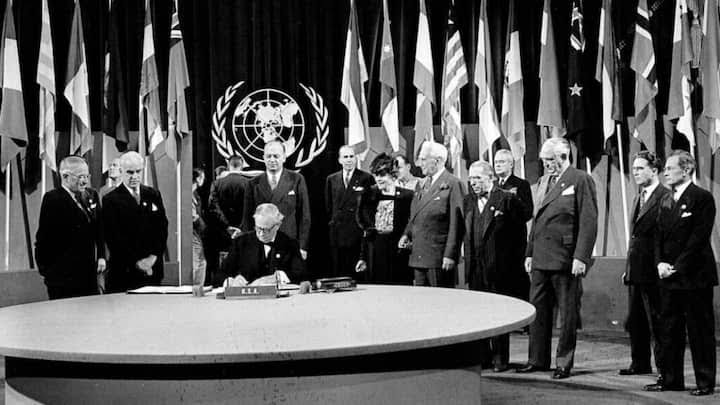
The history of the United Nations has its origins in the Second World War, beginning with the Declaration of St James's Palace. Taking up the Wilsonian mantle in 1944 and 1945, US President Franklin D. Roosevelt pushed as his highest post-war priority the establishment of a United Nations to replace the defunct League of Nations. Roosevelt planned that it would be controlled by the United States, the Soviet Union, the United Kingdom and China, and he expected that these "Big Four" would resolve all major world problems in the powerful Security Council. Since then the UN's aims and activities have expanded to make it the archetypal international body of the early twenty-first century.
Earlier Experiments in Cooperation
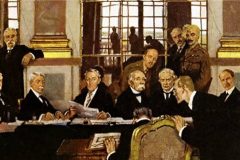
The first international organisations were created to enable countries to cooperate on specific matters. The International Telegraph Union was founded in 1865 and the Universal Postal Union was established in 1874, and both are now specialised agencies of the United Nations. In 1899 the Hague Convention established the Permanent Court of Arbitration, which began work in 1902. The predecessor of the UN, the League of Nations, was conceived after the First World War and established in 1919 under the Treaty of Versailles "to promote international cooperation and to achieve peace and security". The International Labour Organization, also now a UN specialised agency, was created under the Treaty of Versailles as an affiliated agency of the League.
The Wartime Path
The origin of the UN lies in a series of conferences and declarations made by the Allies of the Second World War. On 12 June 1941 representatives of the United Kingdom, Canada, Australia, New Zealand and the Union of South Africa, together with the exiled governments of Belgium, Czechoslovakia, Greece, Luxembourg, the Netherlands, Norway, Poland and Yugoslavia and a representative of General de Gaulle of France, met in London and signed the Declaration of St James's Palace, expressing a vision for a post-war world order. It was the first step towards the founding of the United Nations. At the Atlantic Conference on 9 to 12 August 1941, President Roosevelt and Prime Minister Winston Churchill set out this vision in more detail in the Atlantic Charter.
The Name "United Nations"
Roosevelt first suggested using the name "United Nations" for the Allies of the Second World War to Churchill during the latter's three-week visit to the White House in December 1941. Churchill agreed and cited Lord Byron's use of the phrase in the poem Childe Harold's Pilgrimage, which referred to the Allies at the Battle of Waterloo in 1815. The 1942 Declaration by United Nations was drafted by Roosevelt, Churchill and Roosevelt's aide Harry Hopkins at the White House on 29 December 1941. The first official use of the term was on 1 and 2 January 1942, when 26 governments signed the Declaration. One major change from the Atlantic Charter was the addition of a provision for religious freedom, which Stalin approved after Roosevelt insisted, and by early 1945 a further 21 states had signed.
The San Francisco Conference
The United Nations Conference on International Organization, commonly known as the San Francisco Conference, was a convention of delegates from 50 Allied nations that took place towards the end of the war, from 25 April to 26 June 1945. The delegates reviewed and rewrote the Dumbarton Oaks agreements of the previous year, and the conference resulted in the Charter of the United Nations, which was opened for signature on 26 June, the last day of the conference. The conference was held at various locations, primarily the War Memorial Opera House, and the Charter was signed at the Herbst Theatre in the Veterans Building. A square adjacent to the Civic Center, called UN Plaza, commemorates the conference.
The Big Four and the Veto
The idea of the "Four Policemen" was Roosevelt's vision in which the United States, the United Kingdom, the Soviet Union and China would lead the post-war international order. These countries, with the addition of France, would assume the permanent seats on the Security Council. At a conference in Malta in February 1945 it was proposed that the permanent members should have veto power, and this was adopted shortly afterwards at the Yalta Conference.
Who Was Invited
A total of 46 countries were invited to San Francisco, all of which had declared war on Germany and Japan and signed the Declaration by United Nations. The conference directly invited four additional countries: Denmark, which had just been liberated from Nazi occupation, Argentina, and the Soviet republics of Belarus and Ukraine. The participation of these countries was not without controversy. The Soviet Union opposed Argentine membership, arguing that Argentina had supported the Axis powers during the war, and several Latin American countries opposed the inclusion of Belarus and Ukraine unless Argentina was admitted. In the end Argentina was admitted with American support. Poland, although it had signed the Declaration by United Nations, did not attend because there was no consensus on the formation of the post-war Polish government, and a space was left blank for its signature. A new Polish government was formed after the conference, on 28 June, and signed the Charter on 15 October, which made Poland one of the founding countries.
The Opening
On 25 April 1945 the conference began in San Francisco. About 850 delegates, with their advisers and staff and the secretariat, attended, a total of 3,500 people, along with 2,500 representatives of the media and observers from numerous organisations and societies. President Roosevelt, who was due to host the conference, had died on 12 April 1945, and the delegates held a commemorative ceremony for him in the Cathedral Grove of Muir Woods National Monument. The Governor of California, Earl Warren, set the tone for the conference when he said that "understanding of one another's problems is the greatest assurance of peace".
The Charter Takes Effect
The Charter came into force when it had been ratified by the five permanent members of the Security Council, by a majority of the other signatory countries, and when they had notified the US Department of State of their ratifications, which happened on 24 October 1945.
Why It Matters
The United Nations became the main forum in which governments of nearly every country meet, negotiate and, sometimes, agree on common action. Its creation reflected the lesson of two world wars, that peace and security could not be left to the competition between states, and it established principles, institutions and agencies that have shaped international law, humanitarian work and diplomacy for eight decades. At the same time the veto given to the five permanent members, the very feature that made the Charter acceptable to the great powers in 1945, has been the source of many of the criticisms of the organisation since then.