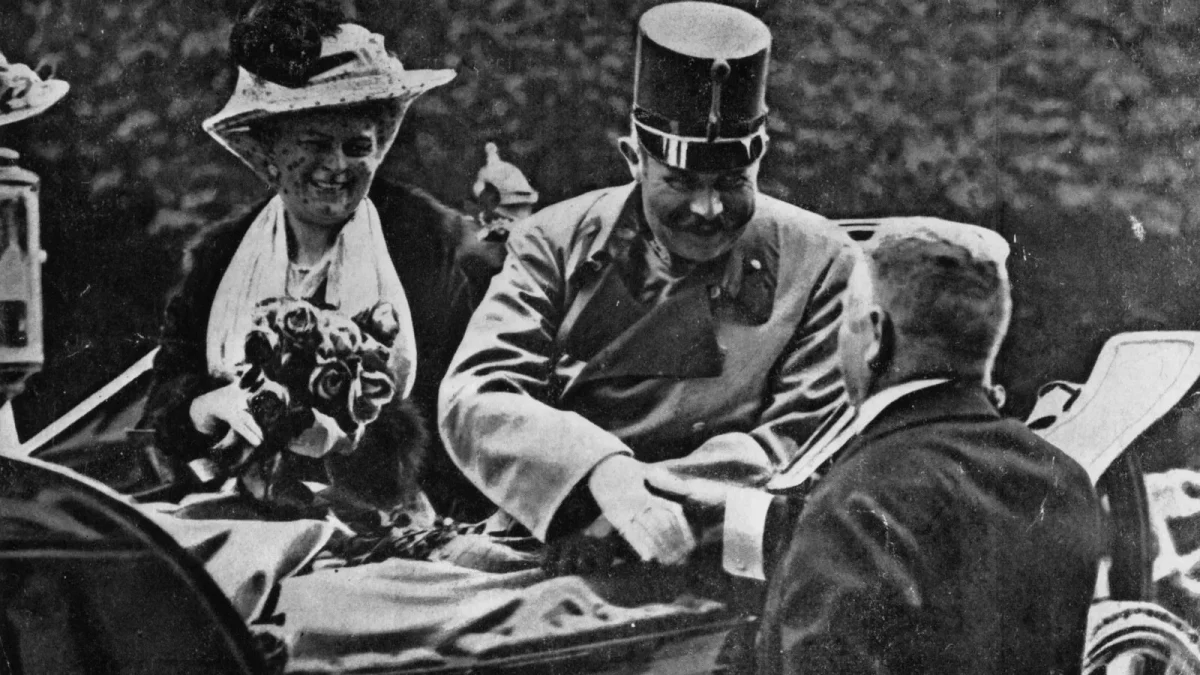
Archduke Franz Ferdinand of Austria, heir presumptive to the Austro-Hungarian throne, and his wife, Sophie, Duchess of Hohenberg, were assassinated by the Bosnian Serb student Gavrilo Princip in Sarajevo on 28 June 1914. They were shot at close range while being driven through the capital of Bosnia and Herzegovina, which Austria-Hungary had formally annexed in 1908. The assassination was one of the key events that led to the First World War.
The Conspirators
Princip was one of six Bosnian assassins, with Muhamed Mehmedbasic, Vaso Cubrilovic, Nedeljko Cabrinovic, Cvjetko Popovic and Trifko Grabez, coordinated by Danilo Ilic. All but one were Bosnian Serbs and members of a revolutionary movement later known as Young Bosnia. Their political objective was to free Bosnia and Herzegovina of Austro-Hungarian rule and to establish a common South Slav, or "Yugoslav", state. Five of the six were under 20 years old at the time, the exception being Mehmedbasic, who was 26 or 27. Although the group was dominated by Bosnian Serbs, four were Bosnian Croats, one was a Bosnian Muslim, and all of them were Austro-Hungarian citizens; none was from Serbia.
Help From Serbia
The assassination team was helped by the Black Hand, a Serbian secret nationalist group. Support came from Dragutin Dimitrijevic, chief of the military intelligence section of the Serbian general staff, as well as from Major Vojislav Tankosic and Rade Malobabic, a Serbian intelligence agent. Tankosic provided bombs and pistols to the assassins and trained them in their use, and they were given access to the same clandestine network of safe houses and agents that Malobabic used to infiltrate weapons and operatives into Austria-Hungary.
The Background
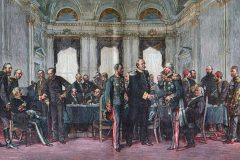
Under the 1878 Treaty of Berlin, Austria-Hungary received the mandate to occupy and administer the Ottoman province of Bosnia, while the Ottoman Empire kept official sovereignty. The same treaty gave official recognition to the Principality of Serbia as a fully sovereign state. In May 1903 Royal Serbian Army officers led by Dragutin Dimitrijevic stormed the Serbian Royal Palace and killed King Alexander I Obrenovic and Queen Draga. The conspirators installed Peter I of the House of Karadjordjevic as the new king, and the new dynasty was more nationalist, friendlier to Russia and less friendly to Austria-Hungary. Over the next decade, disputes between Serbia and its neighbours erupted, including a customs dispute with Austria-Hungary beginning in 1906, known as the "Pig War", the Bosnian crisis of 1908 to 1909, in which Serbia protested at the annexation of Bosnia and Herzegovina, and the two Balkan Wars of 1912 and 1913, in which Serbia acquired Macedonia and Kosovo from the Ottoman Empire.
The Day
The day of the assassination, 28 June (15 June in the Julian calendar), is the feast of St Vitus, which in Serbia is called Vidovdan and commemorates the 1389 Battle of Kosovo against the Ottomans, at which Sultan Murad I was assassinated in his tent by a Serb. According to the programme of the visit, at 10:00 the motorcade was to leave the barracks for the town hall by way of the Appel Quay. Security arrangements within Sarajevo were limited. The local military commander, General Michael von Appel, proposed that troops line the intended route but was told that it was not necessary. Princip decided to take up a position near the Latin Bridge, in front of Schiller's Delicatessen, a building that now houses the Museum of Sarajevo 1878 to 1918, and at this point the first and second cars of the Archduke's motorcade suddenly turned right into the street where he was waiting.
Anti-Serb Violence
Anti-Serb rioting broke out in Sarajevo and other places within Austria-Hungary in the hours after the assassination, and continued until the military restored order. Countrywide anti-Serb demonstrations were organised, particularly in what is now Bosnia and Herzegovina and Croatia, and they were encouraged by Oskar Potiorek, the Austro-Hungarian governor of Bosnia and Herzegovina. The first demonstrations, led by followers of Josip Frank, were held in Zagreb in the early evening of 28 June, and the following day the demonstrations in Sarajevo became so violent that they could be described as a pogrom. Two Serbs were killed on the first day, and around 1,000 houses, shops, schools and other institutions owned by Serbs were razed or pillaged, while the police and local authorities did nothing to stop it. The writer Ivo Andric called it the "Sarajevo frenzy of hate". When Emperor Franz Joseph was told of the assassination, he said that it was "a relief from a great worry".
The Trials
The trial was held from 12 to 23 October, with the verdict and sentences announced on 28 October 1914. The defendants were charged with conspiracy to commit high treason involving official circles in the Kingdom of Serbia, because that crime, unlike conspiracy to commit simple murder, carried a maximum sentence of death. The assassins and the key members of the clandestine network were tried in Sarajevo in October 1914, and in total 25 people were indicted. Princip was found guilty of murder and high treason but, being too young to be executed, was sentenced to 20 years in jail. The four other attackers also received jail terms, and five of the older prisoners were sentenced to be hanged. Members of the Black Hand were arrested and tried before a Serbian court in Salonika in 1917 on charges of high treason that were later widely regarded as fabricated, and three of its leaders were executed. Much of what is known about the assassination comes from these two trials and related records.
From Assassination to World War
The assassination precipitated the July Crisis, which led Austria-Hungary to declare war on Serbia and mobilise the part of its army that would face the already mobilised Serbian army, on 28 July 1914. Under a secret treaty of 1892, Russia and France were obliged to support each other, and the alliances that had divided Europe into two armed blocs drew the great powers into a wider war within days.
Why It Matters
The assassination in Sarajevo is one of the most famous moments in modern history because it was the spark that set off a war of unprecedented scale. It did not make the war inevitable, but it brought into the open the rivalries, alliances and military plans that had been building for years. Princip's legacy was re-evaluated after the breakup of Yugoslavia, and public opinion of him in the successor states remains largely divided along ethnic lines, which shows that the memory of the event is still contested more than a century later.