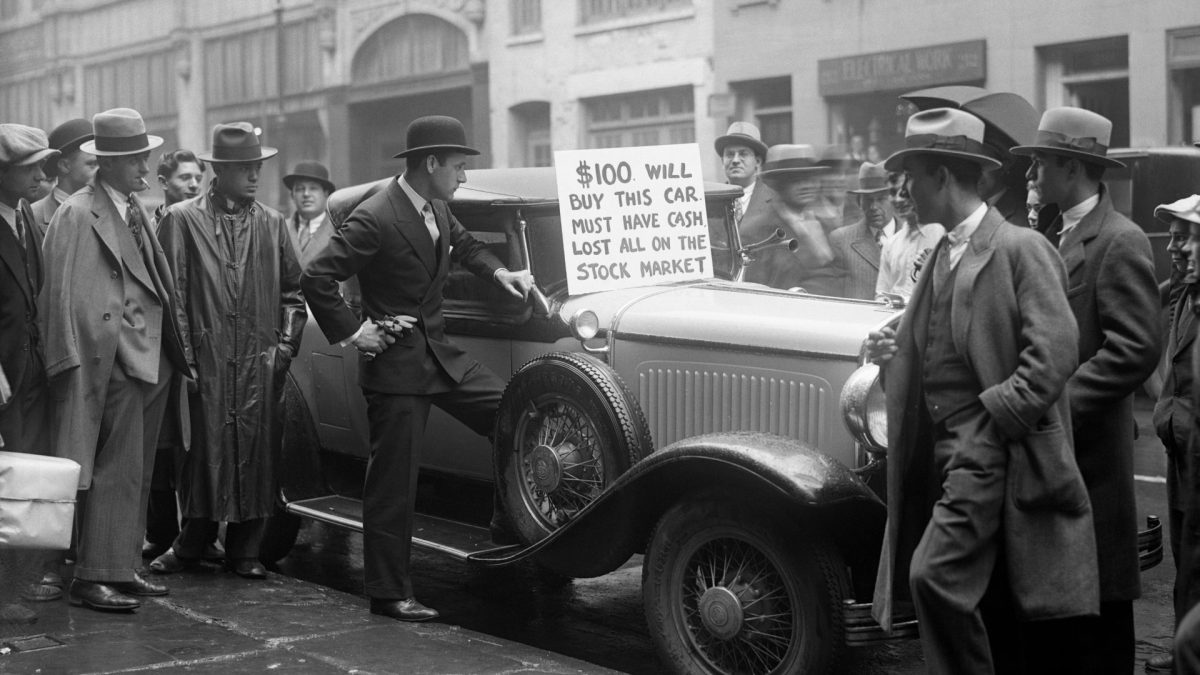
The Wall Street crash of 1929, also known as the Great Crash, was a major stock market crash in the United States that began in October 1929 with a sharp fall in prices on the New York Stock Exchange. It triggered a rapid erosion of confidence in the American banking system and marked what would later cascade into the worldwide Great Depression, which lasted until the United States entered the Second World War on 8 December 1941. It was the most devastating crash in the country's history. It is most associated with 24 October 1929, known as "Black Thursday", when a record 12.9 million shares were traded on the exchange, and 29 October 1929, "Black Tuesday", when some 16.4 million shares were traded.
The Roaring Twenties
The decade after the First World War and the recession of 1920 to 1921, the "Roaring Twenties", has been regarded by scholars as an era defined by wealth, luxury and excess. Building on post-war optimism, rural Americans migrated to the cities in vast numbers, hoping for a more prosperous life amid the growing expansion of the industrial sector. Much of the profit of the decade of industrial expansion was invested in speculation, including in stocks. Many members of the public, disappointed by the low interest rates offered on their bank deposits, committed their relatively small sums to stockbrokers. The stock market had been on a nine-year run that saw the Dow Jones Industrial Average increase in value tenfold, peaking at 381.17 on 3 September 1929.
Warning Signs
By 1929 the American economy was showing signs of trouble. The agricultural sector was depressed because of overproduction and falling prices, forcing many farmers into debt, and manufacturers of consumer goods had unsellable output because of low wages and therefore low purchasing power. Factory owners cut production and fired staff, reducing demand even further. Declines in the money supply caused by Federal Reserve decisions were beginning to have a severely contractionary effect on output. Steel production declined, construction was sluggish, automobile sales went down and consumers were building up large debts because of easy credit. On 25 March 1929, after the Federal Reserve warned of excessive speculation, a small crash occurred as investors began selling stocks rapidly, exposing the shaky foundation of the market. Two days later the banker Charles E. Mitchell announced that his company, National City Bank, would provide 25 million dollars in credit to stop the market's slide, which brought a temporary halt to the crisis. Despite these problems, and market breaks in March and May 1929, stocks resumed their advance in June, and the Dow gained more than 20 per cent between June and September.
The Break
Despite these trends, investors continued buying shares in parts of the economy where output was falling and unemployment was rising, pushing stock prices far above their underlying value. By September 1929 more experienced shareholders realised that prices could not continue to rise and began to get rid of their holdings, which caused share values to stall and then fall, encouraging more to sell. As investors panicked, the selling became frenzied.
Black Thursday and Black Tuesday
After Black Thursday, leading bankers joined forces to buy stock at prices above the market value, a strategy used during the Panic of 1907. This encouraged a brief recovery before Black Tuesday. Further action failed to halt the fall, which continued until 8 July 1932. By then the stock market had lost some 90 per cent of its pre-crash value.
Margin and Bubble
The crash followed a speculative boom that had taken hold in the late 1920s. During the latter half of the decade steel production, building construction, retail turnover, car registrations and even railway receipts advanced from record to record, and the combined net profits of 536 manufacturing and trading companies rose by 36.6 per cent in the first six months of 1929 compared with 1928. These figures set off a crescendo of speculation that led hundreds of thousands of Americans to invest heavily in the stock market, and many borrowed money to buy more stock. By August 1929 brokers were routinely lending small investors more than two-thirds of the face value of the stocks they were buying, and over 8.5 billion dollars was out on loan, more than the entire amount of currency in circulation in the United States. The rising share prices encouraged more people to invest in the hope that they would rise further, which created a bubble. Because of margin buying, investors stood to lose large sums if the market turned down or even if it failed to advance quickly enough, and the average price-to-earnings ratio of the S&P Composite stocks was 32.6 in September 1929, clearly above historical norms.
The Response: Regulation
Congress responded to the events by passing the Banking Act of 1933, known as the Glass-Steagall Act, which separated commercial and investment banking. It also passed the Securities Act of 1933 and the Securities Exchange Act of 1934, which created the US Securities and Exchange Commission, authorised the creation of its disclosure regulations and prohibited the market manipulation, insider trading and speculative investing practices that had preceded the crash. Stock exchanges also introduced a practice of suspending trading when prices fell rapidly, in order to limit panic selling.
In 1932 the US Senate established the Pecora Commission to study the causes of the crash, and the following year Congress passed the Glass-Steagall Act. The one-day crash of Black Monday, 19 October 1987, when the Dow fell 22.6 per cent, was worse in percentage terms than any single day of 1929, although the combined 25 per cent decline of 28 and 29 October 1929 was larger and remains the worst two-day decline.
A Continuing Debate
Scholars disagree about the role of the crash in the Great Depression. Some argue that the price swings were not by themselves severe enough to trigger a major collapse of the financial system. Others contend that the crash, combined with other economic problems in the United States in the 1920s, should be understood as one stage of a broader business cycle affecting capitalist economies.
Why It Matters
The crash of 1929 became the symbol of the dangers of unregulated speculation and of the way in which a financial shock can spread through a whole economy and across borders. It led to a new framework of financial regulation in the United States, and the Great Depression that followed shaped politics, economic thinking and social policy for a generation. Its lessons about leverage, confidence and the role of public authorities in financial markets are still cited whenever a new bubble or market panic emerges.