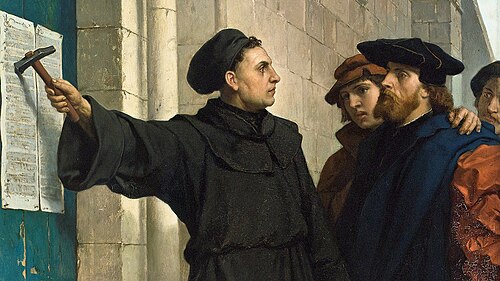
The Ninety-five Theses, or Disputation on the Power and Efficacy of Indulgences, is a list of propositions for an academic disputation written in 1517 by Martin Luther, then a professor of moral theology at the University of Wittenberg in Germany. The Theses are retrospectively considered to have launched the Protestant Reformation and the birth of Protestantism, although various quasi-Protestant or proto-Protestant groups had existed previously.
What Luther Challenged
The Theses aired contemporary theological misgivings about the theory and practice of indulgences and their relation to repentance, penance and papal authority. This was triggered by Catholic clergy who were selling plenary indulgences, certificates that were supposed to reduce the punishment in purgatory required for sins committed by the saved purchasers or their loved ones. In the Theses Luther claimed that the repentance required by Christ for the forgiveness of sins involves inner spiritual repentance and not merely external sacramental confession. He argued that indulgences led Christians to avoid true repentance and sorrow for sin, in the belief that they could forgo it by obtaining an indulgence, and that they discouraged Christians from giving to the poor and performing other acts of mercy. Although Luther claimed that his positions on indulgences accorded with those of Pope Leo X, the Theses challenged a fourteenth-century papal bull stating that the pope could use the treasury of merit and the good deeds of past saints to forgive the temporal punishment for sins. They were framed as propositions to be argued in debate, not necessarily as Luther's own opinions, and he later set out his views in the Explanations of the Disputation Concerning the Value of Indulgences.
How Indulgences Worked
In the Roman Catholic Church, which was practically the only Christian church in Western Europe at the time, indulgences were part of the economy of salvation. In this system, when Christians sin and confess, they are forgiven and no longer stand to receive eternal punishment in hell, but they may still be liable to temporal punishment, which could be satisfied by the penitent performing works of mercy. If the temporal punishment was not satisfied during life, it needed to be satisfied in purgatory, a place believed by Catholics to exist between heaven and hell, and an indulgence could lessen it. Under abuses of the system, clergy benefited by selling indulgences, and the pope gave official sanction in exchange for a fee. This led to the popular saying, "As soon as the coin in the coffer rings, the soul from purgatory springs". Theologians at the University of Paris criticised the saying late in the fifteenth century. Earlier critics of indulgences had included John Wycliffe, Jan Hus and Johannes von Wesel. Political rulers also had an interest in controlling indulgences, because local economies suffered when money for indulgences left a territory, and rulers often sought to receive a portion of the proceeds or prohibited indulgences altogether, as Duke George did in Luther's Electoral Saxony.
The 1515 Indulgence
In 1515 Pope Leo X granted a plenary indulgence intended to finance the construction of St Peter's Basilica in Rome. It would apply to almost any sin, including adultery and theft, and all other indulgence preaching was to cease for the eight years in which it was offered. Johann Tetzel was commissioned to preach and offer the indulgence in 1517, and his campaign in cities near Wittenberg drew many Wittenbergers to travel there to buy indulgences, since sales had been prohibited in Wittenberg and other Saxon cities.
Luther's Concerns
Luther had preached as early as 1514 against the abuse of indulgences and the way they cheapened grace instead of requiring true repentance. He became especially concerned in 1517, when his parishioners, returning from buying Tetzel's indulgences, claimed that they no longer needed to repent and change their lives to be forgiven. After hearing what Tetzel had said in his sermons, Luther began to study the issue more carefully and contacted experts. He wrote a Treatise on Indulgences, apparently in early autumn 1517, and he contacted church leaders by letter, including his superior Hieronymus Schulz, Bishop of Brandenburg, on or before 31 October, when he sent the Theses to Archbishop Albert of Brandenburg.
The Content
The first thesis states: "When our Lord and Master Jesus Christ said, 'Repent,' he willed the entire life of believers to be one of repentance." In the first few theses Luther develops the idea of repentance as the Christian's inner struggle with sin and not the external system of sacramental confession. Theses 5 to 7 state that the pope, whom Luther called the Vicar of Christ on earth, can only release people from the punishments that he has administered himself or through the church's system of penance, and not from the guilt of sin.
Posting and Printing
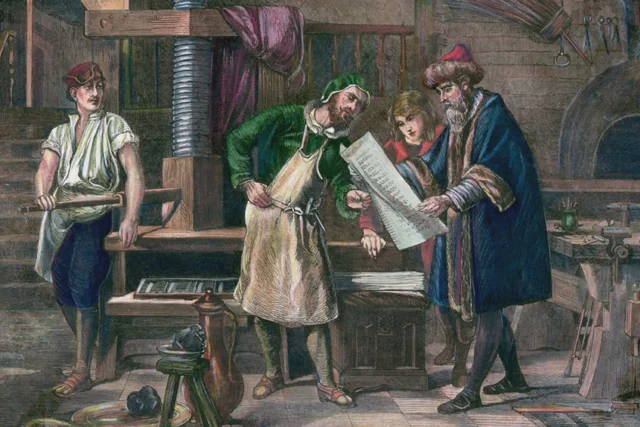
The Theses were printed by the university press and publicly posted. Philip Melanchthon, who first mentioned the posting, said only that it was on the door of All Saints' Church, and he claimed that Luther posted them on 31 October, but this conflicts with several of Luther's own statements, and Luther always claimed that he brought his objections through proper channels. It is possible that he did not post the Theses to the church door until mid-November, or at all. In any case the Theses were well known among the Wittenberg intellectual elite soon after Luther sent them to Albert. They were copied and distributed, and the Latin text was printed as a four-page pamphlet in Basel and as placards in Leipzig and Nuremberg, so that several hundred copies were printed in Germany in 1517. Kaspar Nutzel of Nuremberg translated them into German later that year.
The Reaction
Albert seems to have received Luther's letter with the Theses around the end of November. He asked theologians at the University of Mainz for their opinion, and his advisers recommended that Luther be prohibited from preaching against indulgences, so he asked the Roman Curia to take such action. In Rome Luther was immediately perceived as a threat, and in February 1518 Pope Leo asked the head of the Augustinian Hermits, Luther's religious order, to persuade him to stop spreading his ideas about indulgences.
Why It Matters
The Ninety-five Theses became a landmark because they turned a specific complaint into a challenge to the authority and theology of the medieval church. Combined with the new technology of the printing press, they spread across Europe, and they led to a break in Western Christianity that transformed religion, politics and society. The date on which Luther sent the Theses to the archbishop, 31 October 1517, is still remembered as the beginning of the Reformation, and the debate about indulgences, repentance and authority that it began helped to shape the modern world.