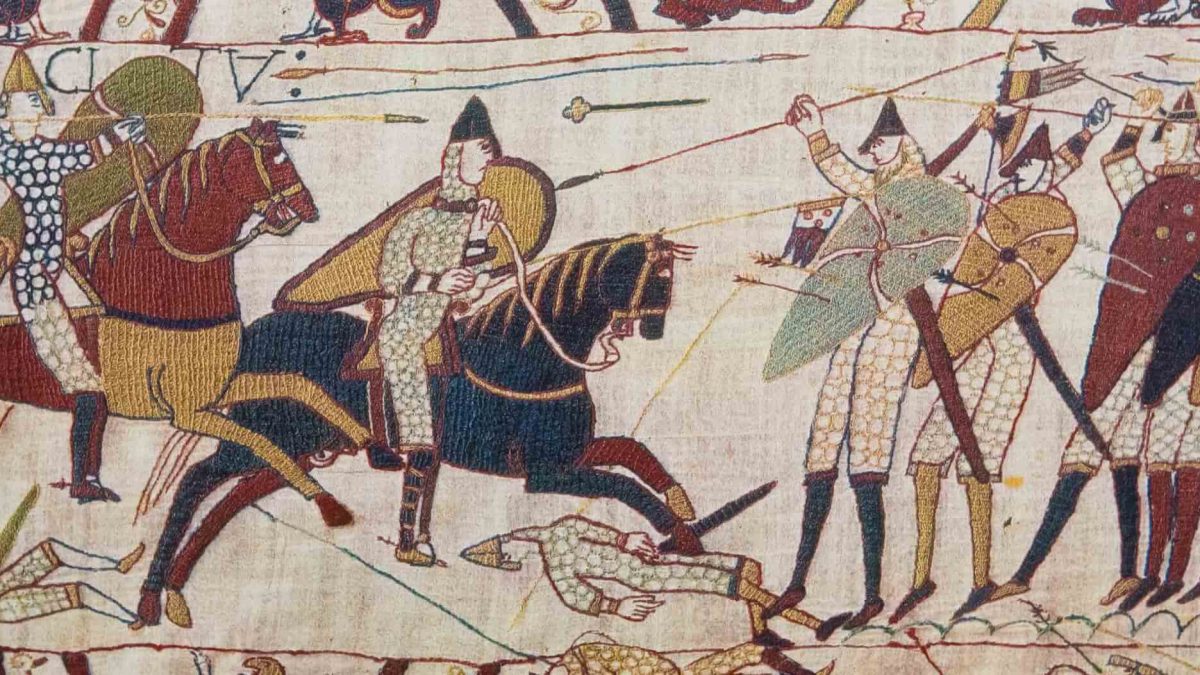
The Battle of Hastings was fought on 14 October 1066 between the Norman-French army of William, Duke of Normandy, and an English army under the Anglo-Saxon king Harold Godwinson. It began the Norman Conquest of England. The battle took place approximately 7 miles (11 km) north-west of Hastings, close to the present-day town of Battle in East Sussex, and it was a decisive Norman victory.
A Succession Crisis
The background to the battle was the death of the childless King Edward the Confessor in January 1066, which set up a struggle for the succession among several claimants to his throne. In 911 the Carolingian ruler Charles the Simple had allowed a group of Vikings to settle in Normandy under their leader Rollo, and their settlement proved successful: they quickly adapted to the local culture, renounced paganism, converted to Christianity and intermarried with the local population. In 1002 King Ethelred II married Emma, the sister of Richard II, Duke of Normandy, and their son Edward the Confessor spent many years in exile in Normandy before succeeding to the English throne in 1042. This led to the establishment of a powerful Norman interest in English politics, as Edward drew heavily on his former hosts for support, bringing in Norman courtiers, soldiers and clerics and appointing them to positions of power, particularly in the Church. Edward was childless and in conflict with the formidable Godwin, Earl of Wessex, and his sons, and he may also have encouraged the ambitions of Duke William.
Three Claimants
Edward's death on 5 January 1066 left no clear heir. His immediate successor was Harold Godwinson, Earl of Wessex, the richest and most powerful of the English aristocrats and the son of Godwin. Harold was elected king by the Witenagemot and crowned by Ealdred, the Archbishop of York, although Norman propaganda claimed that the ceremony was performed by Stigand, the uncanonically elected Archbishop of Canterbury. Harold was at once challenged by two powerful neighbouring rulers. William claimed that he had been promised the throne by Edward and that Harold had sworn to agree to this. Harald Hardrada, King of Norway, also contested the succession, on the basis of an agreement between his predecessor Magnus the Good and the earlier English king Harthacnut that if either died without an heir the other would inherit both England and Norway. William and Hardrada immediately set about assembling troops and ships for separate invasions.
The Northern Invasion
In early 1066 Harold's exiled brother Tostig raided south-eastern England with a fleet recruited in Flanders, later joined by ships from Orkney. He was driven back to his ships by Edwin, Earl of Mercia, and Morcar, Earl of Northumbria, and withdrew to Scotland, where he spent the middle of the year recruiting new forces. Hardrada invaded northern England in early September with a fleet of more than 300 ships carrying perhaps 15,000 men, augmented by Tostig's forces. The Norwegians occupied York after defeating a northern English army under Edwin and Morcar on 20 September at the Battle of Fulford. Hardrada and Tostig were in turn defeated by Harold at the Battle of Stamford Bridge on 25 September, and their deaths left William as Harold's only serious opponent.
William Lands
While Harold and his forces were recovering, William landed his invasion force in the south of England at Pevensey on 28 September and established a beachhead for his conquest of the kingdom. Harold was forced to march south swiftly, gathering forces as he went. The English army was organised along regional lines, with the fyrd, or local levy, serving under a local magnate, whether earl, bishop or sheriff. For every five hides of land one man was supposed to serve, and England as a whole could furnish about 14,000 men for the fyrd when it was called out, usually for two months. The king also had personal armsmen, the housecarls, who formed the backbone of the royal forces.
William's Preparations
William assembled a large invasion fleet and an army from Normandy and the rest of France, including large contingents from Brittany and Flanders. He spent almost nine months on his preparations, since he had to assemble a fleet from nothing. According to some Norman chronicles he also secured diplomatic support, and the most famous claim is that Pope Alexander II gave a papal banner as a token of support, although it appears only in the account of William of Poitiers and not in more contemporary narratives. In April 1066 Halley's Comet appeared in the sky and was widely reported throughout Europe, and contemporary accounts connected it with the succession crisis in England. William mustered his forces at Saint-Valery-sur-Somme and was ready to cross the Channel by about 12 August, but the crossing was delayed, either by unfavourable weather or to avoid interception by the powerful English fleet. After landing, his men built a wooden castle at Hastings, from which they raided the surrounding area, and further fortifications were built at Pevensey. The exact numbers of William's force are unknown: a contemporary document claims 776 ships, which may be inflated, and contemporary writers' figures for the army, between 14,000 and 150,000, are highly exaggerated. Modern estimates include 7,000 to 8,000 men, including 1,000 to 2,000 cavalry, and 10,000 to 12,000 men. The army consisted of about one-half infantry, one-quarter cavalry and one-quarter archers or crossbowmen.
The Armies
The numbers present at the battle are unknown, as even modern estimates vary considerably. The composition of the forces is clearer: the English army was composed almost entirely of infantry and had few archers, whereas only about half of the invading force was infantry, and the rest was split equally between cavalry and archers. Harold appears to have tried to surprise William, but scouts found his army and reported its arrival, and William marched from Hastings to the battlefield to confront Harold.
The Battle
The battle lasted from about 9 am to dusk. Early efforts by the invaders to break the English battle lines had little effect, so the Normans adopted the tactic of pretending to flee in panic and then turning on their pursuers. Harold's death, probably near the end of the battle, led to the retreat and defeat of most of his army. Casualty figures are difficult to assess, but some historians estimate that 2,000 invaders died along with about twice that number of Englishmen.
The Conquest
After further marching and some skirmishing, William was crowned king on Christmas Day 1066. There continued to be rebellions and resistance to his rule, but Hastings effectively marked the culmination of his conquest of England. William founded a monastery at the site of the battle, and the high altar of the abbey church is said to mark the spot where Harold died.
Why It Matters
The Battle of Hastings is among the best-known dates in English history. It replaced the Anglo-Saxon ruling class with a Norman one, tied England to the politics of France for centuries and began a transformation of the language, law, architecture and land ownership of the country. It also shows how a single day could decide a succession that had been contested by three rulers in the space of a few weeks.