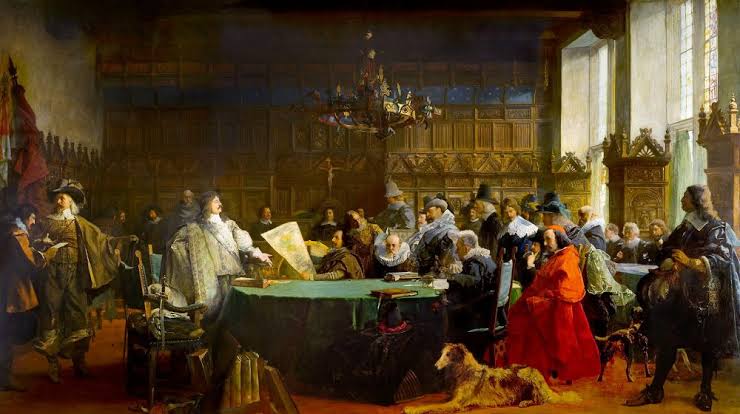
The Peace of Westphalia is the collective name for two peace treaties signed in October 1648 in the Westphalian cities of Osnabruck and Munster. They ended the Thirty Years' War of 1618 to 1648 and brought peace to the Holy Roman Empire, closing a calamitous period of European history that killed between 4.5 and 8 million people. Ferdinand III, Holy Roman Emperor, the kingdoms of France and Sweden and their respective allies among the princes of the Holy Roman Empire took part in the treaties.
A Long and Complex Negotiation
The negotiation process was lengthy and complex. Talks took place in two cities because each side wanted to meet on territory under its own control. A total of 109 delegations arrived to represent the belligerent states, but not all delegations were present at the same time. Two treaties were signed to end the war in the Empire: the Treaty of Munster and the Treaty of Osnabruck. They ended the Thirty Years' War in the Holy Roman Empire, in which the Habsburgs, who ruled Austria and Spain, and their Catholic allies fought on one side, against the Protestant powers, Sweden and certain Holy Roman principalities, allied with France, which was Catholic but strongly anti-Habsburg.
A Continent Exhausted
Europe had been battered by both the Thirty Years' War and the overlapping Eighty Years' War, which began about 1568, with heavy costs in money and lives. The Eighty Years' War was a prolonged struggle for the independence of the Protestant-majority Dutch Republic, supported by Protestant-majority England, against Catholic-dominated Spain and Portugal. The Thirty Years' War was the most deadly of the European wars of religion and was centred on the Holy Roman Empire. It developed into four phases and involved a large number of domestic and foreign players, siding with either the Catholic League or the Protestant Union, later the Heilbronn League. The Peace of Prague of 1635 ended most of the religious aspects of the war, and the rivalry between France and the Habsburgs gained prominence. With between 4.5 and 8 million dead in the Thirty Years' War alone, and decades of constant warfare, the need for peace became increasingly clear.
Two Cities
Peace negotiations between France and the Habsburg emperor began in Cologne in 1636, but were initially blocked by Cardinal Richelieu of France, who insisted on the inclusion of all his allies. In Hamburg in December 1641 Sweden, France and the Holy Roman Empire negotiated a preliminary peace. The main negotiations took place in the neighbouring cities of Munster and Osnabruck in Westphalia, both of which were kept as neutral and demilitarised zones. In Munster the talks were between the Holy Roman Empire and France, as well as between the Dutch Republic and Spain, who on 30 January 1648 signed a separate peace treaty ending the Eighty Years' War that was not part of the Peace of Westphalia. Munster had been a strictly Catholic community since 1535, and only Catholic worship was permitted there. Sweden preferred to negotiate with the Empire in Osnabruck, which was controlled by Protestant forces and was a city of both Lutheran and Catholic worship.
The Delegations
The peace negotiations had no exact beginning or end, because the 109 delegations never met in a plenary session. Delegations arrived between 1643 and 1646 and left between 1647 and 1649, and the largest number of diplomats was present between January 1646 and July 1647. Delegations were sent by 16 European states, by 66 Imperial States representing the interests of 140 Imperial States, and by 27 interest groups representing 38 groups. The French delegation was headed by Henri II d'Orleans, Duke of Longueville, the Swedish delegation by Count Johan Oxenstierna and the Imperial delegation by Count Maximilian von Trautmansdorff. The papal nuncio in Cologne, Fabio Chigi, and the Venetian envoy, Alvise Contarini, acted as mediators.
Territorial Settlements
In the settlement France received Alsace, with the exception of Strasbourg, its bishopric and Mulhouse, and the city of Pignerol near the Spanish Duchy of Milan. Sweden received an indemnity of five million thalers, which it used primarily to pay its troops, and it also received Western Pomerania, Wismar and the Prince-Bishoprics of Bremen and Verden as hereditary fiefs, which gave it a seat and a vote in the Imperial Diet. The wording of the treaties was, however, ambiguous in places: the city of Bremen had claimed Imperial immediacy to escape incorporation into Swedish Bremen-Verden, and Sweden launched the Swedish-Bremen wars in 1653 and 1654 in a failed attempt to take it. The treaty did not decide the border between Sweden and Brandenburg in the Duchy of Pomerania, and although the parties settled on a border in 1653, the underlying conflict continued. Bavaria kept the Palatinate's vote in the Electoral College, which it had been granted when the Elector Palatine Frederick V was placed under the imperial ban in 1623, and the Prince Palatine, Frederick's son, was given a new eighth electoral vote.
Westphalian Sovereignty
Several scholars of international relations have identified the Peace of Westphalia as the origin of principles crucial to modern international relations, collectively known as Westphalian sovereignty. However, some historians argue against this, suggesting that such views emerged during the nineteenth and twentieth centuries in relation to concerns about sovereignty at that time. Whether or not the Peace of Westphalia was a critical juncture, narratives about it have profoundly shaped international legal and political thought in the centuries since.
The Two Treaties
The peace settlement consisted of two separate treaties: the Treaty of Munster, between the Holy Roman Emperor and France with their respective allies, and the Treaty of Osnabruck, between the Emperor and Sweden with their respective allies. Much of the settlement focused on reorganising the Holy Roman Empire, the main battleground of the war. A common idea is that Emperor Ferdinand III was stripped of power and that this power was given to the rulers of the Imperial estates, but modern research challenges how far his power was diminished: he still kept significant power in the Imperial Diet, and central authority was maintained through institutions such as the Aulic Council. Westphalia guaranteed the right to practise any of the recognised denominations, Catholicism, Lutheranism and Calvinism, and the last was finally given legal recognition as an official religion. The independence of the Dutch Republic, which practised religious tolerance, also provided a safe haven for European Jews. The Swiss Confederacy was represented by Johann Rudolf Wettstein, while the Portuguese delegations did not take part, as Spain threatened to withdraw from all negotiations, largely because of the still-ongoing Portuguese Restoration War.
Why It Matters
The Peace of Westphalia ended one of the deadliest wars in European history and set a pattern for the conferences through which later peace settlements were negotiated, bringing many states together in a single process. It also became a symbol: for many writers it marks the moment when the modern system of independent states began, and the debate over whether that is true is itself a lesson in how historical turning points are constructed.