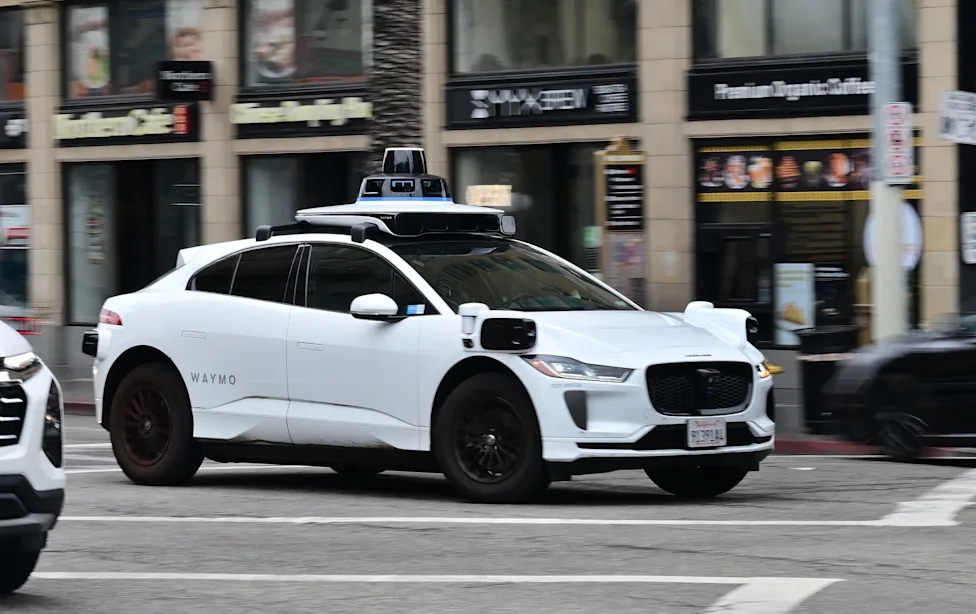
Waymo has paused its driverless taxi services on freeways across the United States after California temporarily banned the ride-hailing platform from the state's highways over safety concerns. A spokesperson for the company, a subsidiary of Alphabet, Google's parent company, said Waymo has "temporarily restricted commercial freeway rides in all markets where we operate that service", but is "continuing freeway testing with trained autonomous specialists behind the wheel". The suspension was put in place last week, according to the spokesperson, who did not say how long it will last. The move is a notable setback for a company that has become the most visible face of driverless transport in American cities.
The decision follows two incidents in California in the first week of November. On 6 November, video captured on a San Francisco highway went viral, showing a Waymo vehicle speeding toward and attempting to pass two police cars whose lights were flashing in a deliberate effort to slow traffic behind a slow-moving construction truck. The California Department of Motor Vehicles (DMV) also cited an incident on 5 November in which three Waymo vehicles drove into a construction zone in the San Francisco Bay Area, on US Route 101 south of San Francisco. Waymo said the construction zone incident did not result in injuries or collisions. DMV spokesman Jonathan Groveman added that "similar incidents" had occurred on 18 May.
The regulator's language was strong. The DMV said that "Waymo's driverless freeway operations pose an imminent hazard to public safety due to recurring incursions by its vehicles into active construction zones where construction workers, vehicles and equipment are present." The ban took effect on 11 November, and it will remain in place until Waymo demonstrates that it has taken effective corrective actions to address the deficiencies behind the restrictions. For a technology company, that standard is demanding: it requires evidence, not simply a software update, and it leaves the timeline in the hands of the state.
Waymo's response has been to cast the suspension as caution rather than concession. The spokesperson said it would allow the company to "evaluate our performance" following the incidents in California and that safety is its priority. The company also said it is working with state officials "diligently and responsibly to resume freeway operations". Extending the pause beyond California is significant, because it suggests Waymo concluded that the problem could not be treated as a California-specific issue. Along with California, driverless vehicles will stop highway services in Phoenix, Austin and Miami, according to Al Jazeera, while Waymo continues to offer rides on city streets in areas including Las Vegas, Dallas and Denver.
The company's defence rests on its safety numbers. Waymo completes half a million trips each week and says it has demonstrated a 95 percent reduction in serious crashes compared with human-driven vehicles. The BBC notes that data on Waymo's website suggests its cars are involved in 95% fewer crashes resulting in serious injury than human drivers. These are the company's own figures, and the incidents in question did not cause injuries or collisions, which supports the argument that the system behaved safely overall. Supporters of autonomous vehicles argue that regulators should weigh the wider safety record rather than a few unusual events, given how many human-driven crashes happen on freeways every day.
The regulator's counter-argument is about pattern and context. A statistical advantage over human drivers does not excuse a vehicle that repeatedly enters construction zones where workers are on foot, or that tries to pass police cars that are deliberately slowing traffic. These are situations in which human drivers are expected to follow instructions that are not always marked in ways a machine easily reads, such as flashing lights, cones and temporary lane shifts. The DMV's description of "recurring incursions" implies a systematic weakness, and regulators are generally more concerned about repeated failures of one type than about the overall average.
There is also a history. In May, Waymo recalled thousands of its self-driving cars in the US over a software issue that could allow vehicles to drive into flooded roads, and in the same month multiple Waymo cars were spotted driving around a cul-de-sac in Atlanta in the early hours of the morning. Each episode on its own was minor, but together they feed a perception that the technology still has edge cases to resolve. Waymo operates driverless taxis in 15 US cities, though freeway rides were available in only a handful of them, including San Francisco, Los Angeles and Miami, which limits the immediate effect on riders even as it affects the company's reputation.
The global ambitions add to the stakes. The company has been testing its vehicles in London since 2016 and has plans to expand into Munich and Madrid in 2027. Regulators in those cities will have noticed that a leading operator has paused a major service after a safety finding. For European authorities, who tend to be more cautious on autonomous vehicles than some American states, the California episode is likely to reinforce demands for clear evidence, reporting and procedures before approving highway operations.
Passengers and local officials are likely to ask a practical question: what does the pause change day to day? For most riders, very little, since Waymo says its driverless taxis can continue to operate on regular city streets and freeway rides were offered in only a handful of its markets. For the company, the change is more strategic. Freeways shorten airport and cross-town trips, and offering them was a sign that the service could handle higher speeds and denser traffic than a downtown grid. Withdrawing the feature in every market, even temporarily, therefore removes one of the clearest demonstrations of how far the technology has advanced, and it hands critics a concrete example when they argue that driverless cars are being deployed faster than regulators can assess them.
The next steps are straightforward but uncertain. Waymo must show California's DMV that it has fixed how its vehicles handle active construction zones, and the regulator will decide when the ban ends. In the meantime, the company continues to test on freeways with trained specialists behind the wheel, which allows it to gather data without carrying paying passengers. How quickly freeway rides return will be an important signal of whether regulators think driverless cars can handle the most complex environments, or whether the technology must prove itself in smaller steps.