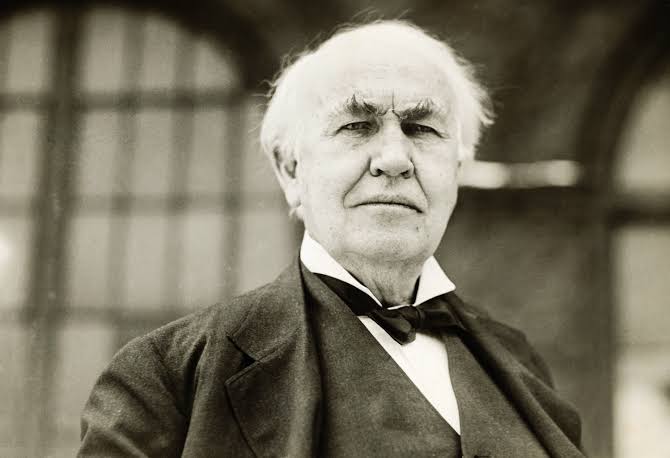
Thomas Alva Edison (11 February 1847 to 18 October 1931) was an American inventor and businessman known for his work on the incandescent light bulb, the phonograph, electric power distribution and early motion pictures. The merger of the Edison General Electric Company and the competitor Thomson-Houston Electric Company resulted in the formation of General Electric. Edison registered 1,093 patents in the United States. This biography follows his life and work.
Thomas Edison at a Glance
| Full name | Thomas Alva Edison |
| Born | 11 February 1847, Milan, Ohio, United States |
| Died | 18 October 1931 (aged 84) |
| Profession | Inventor and businessman |
| Patents | 1,093 US patents |
| Best-known work | Phonograph, incandescent lighting system, motion picture camera |
| Nickname | The Wizard of Menlo Park |
| First patent | Electric vote recorder, US patent 90,646, granted 1 June 1869 |
Early Life
Edison was born in Milan, Ohio, in 1847 and grew up in Port Huron, Michigan, after the family moved there in 1854. He was the seventh and last child of Samuel Ogden Edison Jr. and Nancy Matthews Elliott. He was taught reading, writing and arithmetic by his mother, a former school teacher, and attended school for only a few months, but was an inquisitive child who learned most things by reading on his own. A book his mother gave him, A School Compendium of Natural and Experimental Philosophy, inspired him to tinker and learn about electricity. He developed hearing problems at the age of 12, which the historian Paul Israel attributed to a bout of scarlet fever and recurring untreated middle-ear infections. He was completely deaf in one ear and barely hearing in the other, and as an adult he believed that his hearing loss helped him to avoid distraction and concentrate more easily on his work.
News Butcher and Telegrapher
Edison began his career as a news butcher, selling newspapers, candy and vegetables on trains running from Port Huron to Detroit. By the age of 13 he made a profit of about 50 dollars a week, which he spent on supplies for electrical and chemical experiments. He founded the Grand Trunk Herald, which he sold with his other papers, and it ran for 24 issues and had 500 subscribers. As a boy he and a neighbour built a small telegraph line, and he learned the skill by sitting in with telegraph operators. From 1863 to 1869 he held a succession of night-shift telegraphy jobs across Ontario, Michigan, Kentucky, Ohio and Massachusetts, working as a Western Union employee on the Associated Press bureau news wire. In Boston, between 1867 and 1869, he made some money from inventing a stock ticker, and his first patent was for the electric vote recorder, granted on 1 June 1869.
New York and Menlo Park
Edison moved to New York City in 1869. By the age of 29 he owned a telegraph recorder factory in Newark with over a hundred employees. Built in 1876 in Raritan Township, now Edison Township, with money from the sale of his quadruplex telegraph, Menlo Park was the first industrial laboratory concerned with creating knowledge and then controlling its application. He expanded, developing Menlo Park, now considered the first industrial research laboratory, and he became known as "The Wizard of Menlo Park". He drove his staff extremely hard and worked himself and his associates to exhaustion. He rose to international fame with the invention of the phonograph, which took many years to turn into a commercial success, and later he built a larger research laboratory in West Orange, New Jersey.
The Electric Light and the War of the Currents
Edison first gained wider notice in 1877 with his invention of the phonograph. As a telegrapher he had long imagined a device that could record incoming messages and replay them. On 4 November 1879 he filed for a US patent for an electric lamp using "a carbon filament or strip coiled and connected to platina contact wires", which was granted on 27 January 1880. On 4 September 1882 his 600 kW steam-powered generating station on Pearl Street in New York City, which provided 110 volts of direct current, was switched on. In 1878 Edison began working on an electrical lighting system that he hoped would replace the common gas lamp. Going from an electric light bulb to the modern electric grid took decades of invention, investment and influence, and Edison and his colleagues designed and built a nation of light bulbs, generators and electric distribution systems. Competition with Westinghouse's alternating current system forced Edison to yield, and the merger of his company with Thomson-Houston resulted in the creation of General Electric. At the same time he created a mining company, which was never profitable and nearly bankrupted him.
Films, Cement and Other Ventures
In 1891 Edison built a Kinetoscope, a peep-hole viewer that was installed in penny arcades, where people could watch short, simple films. As his role in the illumination business declined, Edison established a cement company and began work on a motion picture camera, which went from an invention to the first movie production studio. He ran several companies that produced batteries, movies, musical records and phenol, and his last obsession was the search for domestic rubber production. He travelled around the United States and Europe promoting his innovations, and during this period he met Mina, who became his second wife.
Family
On 25 December 1871, at the age of 24, Edison married 16-year-old Mary Stilwell, whom he had met two months earlier and who worked in one of his shops. They had three children, but Edison was neglectful, and she died in 1884, at the age of 29. He had three children with Mina, and was again neglectful, but during their adulthood he began to take more interest in his sons and they eventually worked for him. His son Charles took over the business when he died. He had troubled relationships with his children for the rest of his life.
Health and Death
In addition to acute health problems from handling toxic and radioactive chemicals during his experiments, Edison faced a lifelong battle against diabetes. He worked vigorously until his death on 18 October 1931, at the age of 84.
Legacy
Edison's greatest invention may have been the industrial research laboratory itself, in which teams of researchers worked on problems to order. His phonograph, lighting system and motion picture work helped to create the modern entertainment and electrical industries, and his 1,093 patents remain a record that few have matched.