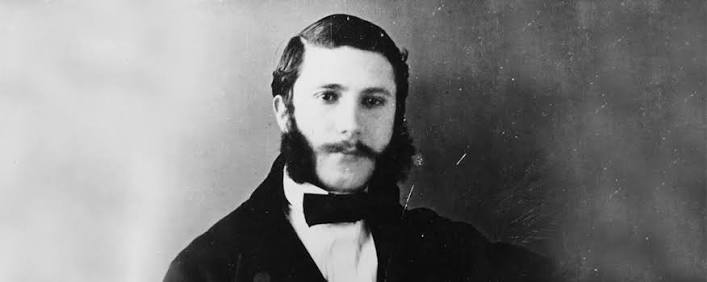
Henry Dunant (8 May 1828 to 30 October 1910), born Jean-Henri Dunant, was a Swiss humanitarian, businessman, social activist and co-founder of the Red Cross. His humanitarian efforts won him the first Nobel Peace Prize in 1901. After witnessing the aftermath of the Battle of Solferino in 1859, he proposed a neutral organisation to care for wounded soldiers, an idea that led to the Red Cross and the First Geneva Convention. This biography follows his life, his fall into poverty and his late recognition.
Henry Dunant at a Glance
| Full name | Jean-Henri Dunant, known as Henry or Henri Dunant |
| Born | 8 May 1828, Geneva, Switzerland |
| Died | 30 October 1910, Heiden, Switzerland (aged 82) |
| Profession | Businessman, humanitarian and social activist |
| Known for | Co-founding the Red Cross; inspiring the Geneva Convention |
| Key book | A Memory of Solferino (1862) |
| Nobel Prize | Peace, 1901 (shared with Frédéric Passy) |
| Parents | Jean-Jacques Dunant and Antoinette Dunant-Colladon |
| Memorial | World Red Cross and Red Crescent Day on 8 May |
Early Life in Geneva
Dunant was born in Geneva in 1828, the first son of the businessman Jean-Jacques Dunant and Antoinette Dunant-Colladon. His family was devoutly Calvinist and had significant influence in Geneva society, and his parents stressed the value of social work. His father helped orphans and parolees, while his mother worked with the sick and the poor. Dunant grew up during a period of religious awakening, and at 18 he joined the Geneva Society for Almsgiving. The following year, with friends, he founded the Thursday Association, a loose band of young men who met to study the Bible and help the poor. He also spent much of his free time visiting prisoners. On 30 November 1852 he founded the Geneva chapter of the YMCA.
In 1849, at 21, Dunant left the Collège de Genève because of poor grades and began an apprenticeship with a money-changing firm, where he later stayed on as a bank employee. In 1853 he visited Algeria, Tunisia and Sicily on assignment for a company with colonies near Sétif, and he wrote his first book, An Account of the Regency in Tunis, published in 1858. In 1856 he created a business to operate in foreign colonies and, after being granted a land concession in French-occupied Algeria, set up a corn-growing and trading company. The land and water rights were not clearly assigned, and the colonial authorities were not cooperative.
The Battle of Solferino
In 1859 Dunant decided to appeal directly to the French emperor Napoleon III, who was in Lombardy with his army in the war against Austria. He arrived in Solferino on the evening of 24 June 1859, the day of a battle between the two sides. Forty thousand wounded, dying and dead remained on the battlefield, and there appeared to be little attempt to provide care. Shocked, Dunant took the initiative to organise the civilian population, especially the women and girls, to assist the injured and sick soldiers. They lacked materials, so he organised the purchase of supplies and helped set up makeshift hospitals. He persuaded the people to care for the wounded without regard to which side they had fought on.
A Memory of Solferino
After returning to Geneva early in July, Dunant wrote a book about his experiences, which he titled Un Souvenir de Solférino, or A Memory of Solferino. It was published in 1862 in an edition of 1,600 copies, printed at his own expense. In it he described the battle, its costs and the chaos afterwards, and he developed the idea that in future a neutral organisation should exist to care for wounded soldiers. He sent the book to many leading political and military figures in Europe and travelled around the continent promoting his ideas.
Founding the Red Cross
The president of the Geneva Society for Public Welfare, the jurist Gustave Moynier, made the book the subject of a meeting on 9 February 1863. The society created a five-person committee to explore Dunant's proposals, with Dunant, Moynier, the Swiss general Henri Dufour and the doctors Louis Appia and Théodore Maunoir as members. Their first meeting, on 17 February 1863, is considered the founding date of what became the International Committee of the Red Cross. Moynier and Dunant increasingly disagreed: Moynier considered Dunant's idea of neutrality for care providers unworkable, while Dunant, the idealist, kept advocating it.
In October 1863, 14 states took part in a meeting in Geneva organised by the committee. A year later, on 22 August 1864, a diplomatic conference organised by the Swiss government led to the signing of the First Geneva Convention by 12 states. Dunant was in charge of organising accommodation for the attendees.
Bankruptcy and Years in Obscurity
Dunant's businesses in Algeria had suffered. In April 1867 the bankruptcy of the financial firm Crédit Genevois led to a scandal involving him, and he declared bankruptcy. In deeply Calvinist Geneva the outcry was loud, and on 25 August 1867 he resigned as secretary of the committee and on 8 September was removed from it entirely. He was condemned by the Geneva Trade Court in 1868 for deceptive practices in the bankruptcies, and his family and many friends, who had invested in the firm, were also badly affected. In 1868 he was expelled from the YMCA, and he left Geneva and never returned.
He moved to Paris, where he lived in meagre conditions but continued to pursue humanitarian plans. During the Franco-Prussian War he founded a relief society, and he argued for disarmament negotiations and an international court to mediate conflicts. Later he worked for the creation of a world library, an idea that echoes later projects such as UNESCO. He lived in poverty, moving between Stuttgart, Rome, Corfu, Basel and Karlsruhe, and eventually settled in the Swiss village of Heiden. He was nearly forgotten by the movement he had started.
Rediscovery and the Nobel Peace Prize
In September 1895 Georg Baumberger, the chief editor of a St Gallen newspaper, wrote an article about the Red Cross founder, whom he had met on a walk in Heiden a month earlier. It was reprinted throughout Europe and struck a chord, and Dunant received renewed attention and support, including a note from Pope Leo XIII. In 1897 his friend Rudolf Müller wrote a book on the origins of the Red Cross that stressed Dunant's role. In 1901 Dunant was awarded the first Nobel Peace Prize for his role in founding the International Red Cross Movement and initiating the Geneva Convention. The prize was shared with the French pacifist Frédéric Passy. The official congratulations from the International Committee finally represented his rehabilitation. He never spent any of the prize money, which was placed in a Norwegian bank to prevent his creditors from reaching it, and he reserved it for bequests to people who cared for him and for charity.
Final Years
In 1903 Dunant was given an honorary doctorate by the medical faculty of the University of Heidelberg. He lived in the nursing home in Heiden until his death. In his final years he suffered from depression and paranoia about pursuit by his creditors and by Moynier, and on some days he insisted that the cook first taste his food. He died on 30 October 1910, and his last words were reported as "Where has humanity gone?" According to his wishes he was buried without ceremony in the Sihlfeld Cemetery in Zurich. In his will he donated funds to ensure that a free bed in the Heiden nursing home would always be available to a poor local citizen, and left money to friends and charities in Norway and Switzerland.
Legacy
His birthday, 8 May, is celebrated as World Red Cross and Red Crescent Day. The former nursing home in Heiden now houses the Henry Dunant Museum, and the Henry Dunant Medal is the highest decoration of the International Red Cross and Red Crescent Movement. In 2014 the second-highest peak in Switzerland was renamed Dunantspitze in his honour. The Red Cross and Red Crescent movement, now present in nearly every country, rests on his insistence that people who suffer in war deserve care regardless of which side they are on.