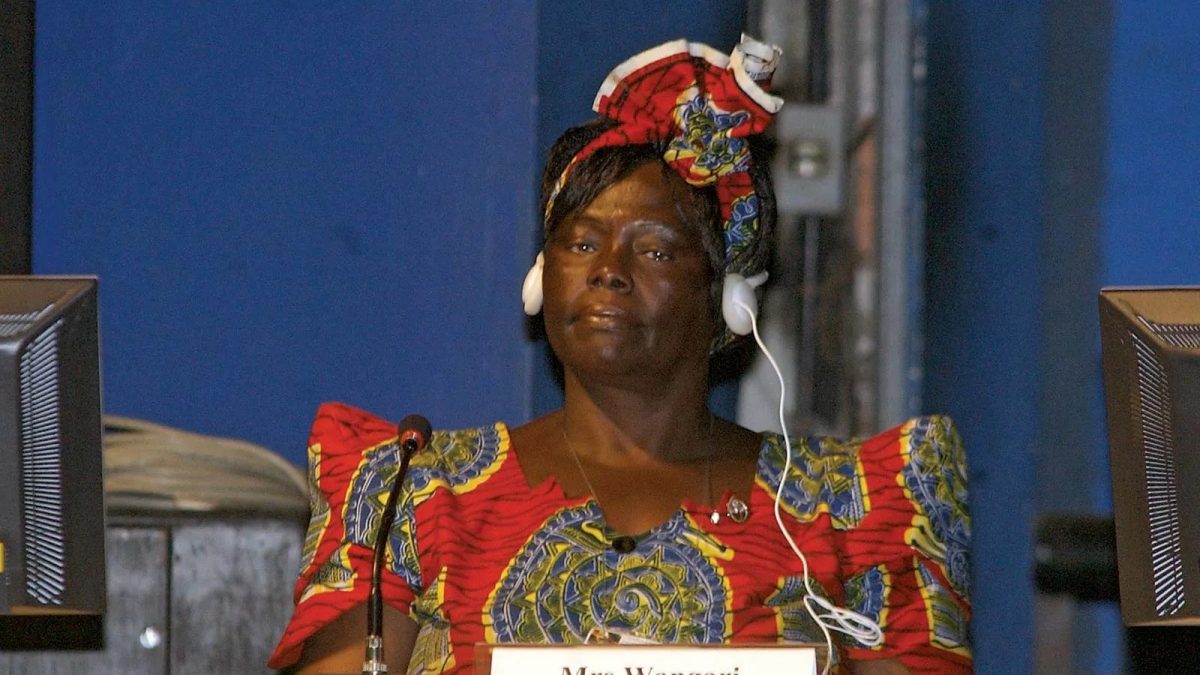
Wangari Maathai (1 April 1940 to 25 September 2011) was a Kenyan social, environmental and political activist who founded the Green Belt Movement, an organisation focused on planting trees, environmental conservation and women's rights. In 2004 she became the first African woman to win the Nobel Peace Prize. She was also the first woman in East and Central Africa to earn a doctorate, and she served in Kenya's parliament and government. This biography follows her life, her activism and her legacy.
Wangari Maathai at a Glance
| Full name | Wangarĩ Muta Maathai |
| Born | 1 April 1940, Ihithe, Nyeri District, Kenya |
| Died | 25 September 2011, Nairobi (aged 71) |
| Profession | Environmental activist, academic and politician |
| Known for | Founding the Green Belt Movement (1977) |
| Nobel Prize | Peace, 2004, the first African woman to win it |
| Education | Mount St Scholastica College (BS 1964); University of Pittsburgh (MS); University of Nairobi (PhD) |
| Political office | Member of parliament for Tetu; assistant minister for environment (2003 to 2005) |
| Husband | Mwangi Mathai (divorced 1979) |
Early Life in Nyeri
Wangarĩ Maathai was born on 1 April 1940 in the village of Ihithe in the Nyeri District in the central highlands of colonial Kenya. Her family was Kikuyu, the most populous ethnic group in Kenya. Around 1943 the family moved to a white-owned farm in the Rift Valley near Nakuru, where her father had found work, and late in 1947 she returned to Ihithe with her mother so that she could go to school. At eleven she moved to St Cecilia's Intermediate Primary School, a boarding school at the Mathari Catholic Mission in Nyeri, where she became fluent in English and converted to Catholicism.
As the end of colonial rule approached, Kenyan politicians including Tom Mboya proposed ways to make education in Western nations available to promising students. John F. Kennedy, then a senator, agreed to fund such a programme, which became known as the Kennedy Airlift. Maathai was one of some 300 Kenyans selected to study in the United States in September 1960. She studied biology at Mount St Scholastica College in Atchison, Kansas, earned a Bachelor of Science degree in 1964, and then took a master's degree at the University of Pittsburgh, where she first saw environmental restoration at work as local campaigners pushed to clean up the city's air.
Returning to Kenya
When Maathai returned to Kenya she found that a university job she had been offered had been given to someone else, which she believed was because of gender and tribal bias. After a two-month job search she was offered a position as a research assistant at the University of Nairobi's new department of veterinary anatomy. She studied for her doctorate at the University of Giessen in Germany and at LMU Munich, and she eventually became the first woman in East and Central Africa to receive a PhD, from the University of Nairobi. She became a senior lecturer in anatomy in 1975, chair of the Department of Veterinary Anatomy in 1976 and associate professor in 1977, and she was the first woman in Nairobi appointed to any of these positions. She campaigned for equal benefits for women on the university staff.
The Green Belt Movement
Maathai's husband, Mwangi Mathai, won a parliamentary seat after promising to find jobs for the unemployed, and the promise led her to connect environmental restoration to employment. In 1977, speaking to the National Council of Women of Kenya about the first UN Habitat conference, she proposed more tree planting, and on 5 June 1977, World Environment Day, the council marched to Kamukunji Park in Nairobi and planted seven trees in honour of community leaders. This was the first event of the Green Belt Movement. Maathai encouraged the women of Kenya to plant tree nurseries, and the movement grew into a network that planted trees, restored land and trained women, while stressing the importance of communities taking responsibility for their own needs. Funding expanded after a UN women's conference was held in Nairobi, and the movement spread outside Kenya.
Personal Costs
Maathai and her husband separated in 1977 and he filed for divorce in 1979. In court he reportedly said she was too strong-minded for a woman, and the judge ruled in his favour. The divorce was costly, and Maathai found it hard to support her family on her university wages, so she took a job with the UN's Economic Commission for Africa that required extensive travel and sent her children to live with their father. In 1979 she ran for chairperson of the National Council of Women of Kenya and lost by three votes, though she was overwhelmingly chosen as vice-chairman. In 1982 a court ruled her ineligible to run for the parliamentary seat for Nyeri, and she had resigned her university post to campaign.
Confronting the Government
By the later 1980s the single-party government of President Daniel arap Moi opposed the Green Belt Movement's democratic positions. In October 1989 Maathai learned of a plan to build a 60-storey complex in Uhuru Park in Nairobi, intended to house the headquarters of the ruling party and a large statue of the president. She wrote letters of protest, and the government called her a crazy woman and said that she was one of the ignorant few. Ground was broken on 15 November 1989.
In January 1992 Maathai learned that her name was on a list of people targeted for assassination, and she barricaded herself in her home before being arrested. On 28 February 1992, while on bail, she took part in a hunger strike at a corner of Uhuru Park, which they named Freedom Corner, to press for the release of political prisoners. After four days police forcibly removed the protesters, and Maathai and three others were knocked unconscious and hospitalised. The attack drew international attention. She also protested against plans to privatise parts of the Karura Forest in 1998 and 1999, and she was arrested again in 2001.
Parliament and the Nobel Peace Prize
Kenya's first multi-party election was held in 1992, and Maathai campaigned for a united opposition. After the opposition defeated the ruling party in December 2002, she won the Tetu constituency seat with 98 percent of the vote and in January 2003 became assistant minister for environment and natural resources, serving until November 2005. In 2004 the Nobel Committee awarded her the Peace Prize for her contribution to sustainable development, democracy and peace. She was the first African woman to receive it, and the committee said she had stood up courageously against the former oppressive regime in Kenya. Earlier honours included the Right Livelihood Award in 1984 and the Goldman Environmental Prize in 1991.
Later Life
After a trip to Japan in 2005 Maathai became a proponent of the Japanese waste-reduction idea of mottainai. She was elected the first president of the African Union's Economic, Social and Cultural Council in 2005 and was appointed a goodwill ambassador for an initiative to protect the Congo Basin forest ecosystem. In August 2006 she planted a tree with the then US senator Barack Obama in Uhuru Park in Nairobi. She lost her seat in the December 2007 election, and she wrote several books, including Replenishing the Earth in 2010.
Controversy
A Kenyan newspaper reported that Maathai had claimed HIV/AIDS was deliberately created by Western scientists. She denied making the allegations, but the newspaper stood by its report. In a 2004 interview she said she had no idea who created AIDS. The episode remains a part of her record that critics have cited, and it is included here alongside the achievements for which she is better known.
Death and Legacy
Wangari Maathai died on 25 September 2011 of complications of ovarian cancer while receiving treatment at a Nairobi hospital. She was 71. Her life showed how environmental protection, democracy and women's rights can be tied together, and she remains an inspiration for people who have campaigned for forests, for land and for fair elections. The Green Belt Movement she began with seven trees in a Nairobi park continues, and the Billion Tree Campaign is associated with her name.