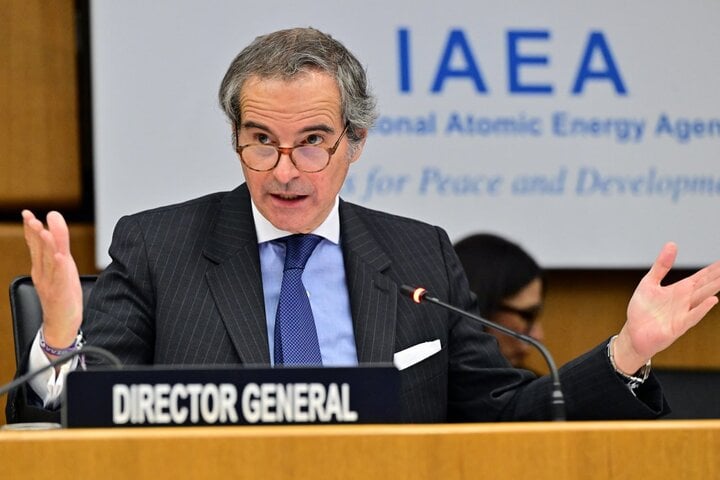
International Atomic Energy Agency (IAEA) chief Rafael Grossi is eyeing the position of United Nations secretary-general amid a tense race to replace Antonio Guterres. The Argentinian nominee finished second in the latest UN Security Council straw poll, behind Costa Rica's Rebeca Grynspan, with nine "encourage" and four "discourage" votes, and eight candidates are still in the contest. Grossi, 65, has earned admiration and criticism in equal measure during his time at the IAEA, a tenure defined by hands-on crisis diplomacy in active war zones but also by accusations of partisanship, levelled especially by Iran. The race is coming down to the wire, because Guterres must leave his post on 31 December.
The case for Grossi rests on his record as a pragmatic crisis manager. Appointed director general of the UN nuclear watchdog in 2019, he has been in the front row at moments of international tension, including personally leading inspection teams to Ukraine's Zaporizhzhia and Chornobyl nuclear power plants after Russia's full-scale invasion in 2022. Jan Wouters, professor of international law and international organisations at KU Leuven in Belgium, said Grossi has "transformed the technical watchdog into a highly visible, proactive, diplomatic actor," elevating the agency's global profile through constant shuttle diplomacy and direct engagement with world leaders. In Ukraine, Wouters said, by focusing on technical safety rather than territorial sovereignty, Grossi brokered eight localised ceasefires between Russia and Ukraine to allow critical plant repairs.
His agenda adds to the appeal for some governments. Grossi has called on world leaders to have the "courage to reform" the institution and lead it into a new era, and his emphasis is on cutting red tape and overlapping mandates. Ezequiel Jimenez Martinez, an adjunct professor at the Pompeu Fabra law faculty in Barcelona, said Grossi is seen as close to both Argentine President Javier Milei and US President Donald Trump, and as someone who could usher in a UN agenda aligned with their foreign policies. In practice, he said, that would mean a shrinking of the UN structure, including merging agencies and reorienting the body around security rather than development. For a body whose budget has been squeezed, a candidate who promises efficiency can sound attractive.
The case against him begins with arithmetic and vetoes. To be elected, a candidate needs at least nine votes in favour from the 15-member Security Council while avoiding a veto from any of its five permanent members: China, France, Russia, the United States and the United Kingdom. The 193-member General Assembly then has to sign off on the final choice. While none of the permanent members has publicly announced a preference, the South China Morning Post reported that Beijing has ruled out Grossi for being too close to Washington and would instead back Grynspan. Analysts say China and Russia are unlikely to back a candidate so closely aligned with the United States, and Jimenez Martinez said Grossi's very active role has angered Russia, which sees him as having overstepped his position as agency head.
Iran is another opponent, even though it holds no seat on the Council. Tehran's foreign ministry spokesman, Esmaeil Baghaei, accused the IAEA this month of being overly influenced by the United States and European countries in its "one-sided and biased reporting about Iran's peaceful nuclear programme." The agency's work on Iran is the most contentious part of Grossi's record. The IAEA has estimated that Iran was holding 440.9kg of uranium enriched to up to 60 percent before the June 2025 Israeli and US attacks on Iran's nuclear facilities. Uranium must be enriched to 90 percent to become weapons-grade, but the process becomes quick at 60 percent, and the agency says the stockpile would be enough, if enriched further, to build 10 nuclear weapons. Jimenez Martinez suggested Grossi can withstand the criticism because the majority of IAEA governors agree with his approach, and that it is unlikely to change many Council votes.
Grossi's most serious liability may be the support he is perceived to enjoy. Milei has framed international institutions as threats to national sovereignty and individual liberty, describing the UN itself as "useless" and its diplomats as "fatally arrogant parasites". Since being elected in 2023 he has reignited a longstanding dispute with the United Kingdom over the Falkland Islands, and has told UN delegates that the principle of self-determination should not apply to the islands' population. The Trump administration, for its part, has withdrawn from key UN agencies, slashed funding and bypassed the body when launching the war on Iran in February. A candidate backed by those two governments risks being read as a champion of their agenda rather than as a steward of the UN Charter.
Style and values will also count. Alvina Hoffmann, senior lecturer in diplomatic studies at SOAS University of London, said Grossi is seen as a candidate whose emphasis is on improving the system and cutting overlapping mandates, rather than addressing structural drivers of inequality. She added that his focus on personal leadership, confidential negotiations and preventive diplomacy, rather than public declarations or condemnations, might come at the expense of calling out violations of international law at a time when it is increasingly under attack. Observers say technical ability alone is unlikely to put him much ahead, since candidates must also be seen as defenders of the Charter, international law and human rights instruments.
Then there is the question of who gets to lead. By the tradition of geographical rotation, the post should next go to a Latin American, which both Grossi and Grynspan satisfy. Five women are running, and public and civil society pressure to elect the first woman to the post is at an all-time high. Ben Donaldson, an adviser to the 1 for 8 Billion campaign, said that while the choice should be based on merit, merit "is not inconsistent with gender considerations," and noted that General Assembly resolutions say due regard should be given to gender balance in senior UN leadership. The organisation has never appointed a woman in its 80-year existence, a record that campaigners say contrasts with its own commitments to equality.
With Guterres due to leave in six weeks, the next straw polls will matter. A second-place finish with nine encouraging votes is respectable, but the colour-coded ballots that later reveal vetoes are the ones that decide races of this kind, and Grossi's closeness to Washington makes a veto from Beijing or Moscow a real possibility. His supporters say a proven negotiator in war zones is what a fractured world needs. His critics say a secretary-general seen as a proxy for two governments hostile to the institution cannot defend it. Which argument carries more weight with the Council will be clear before the year ends.