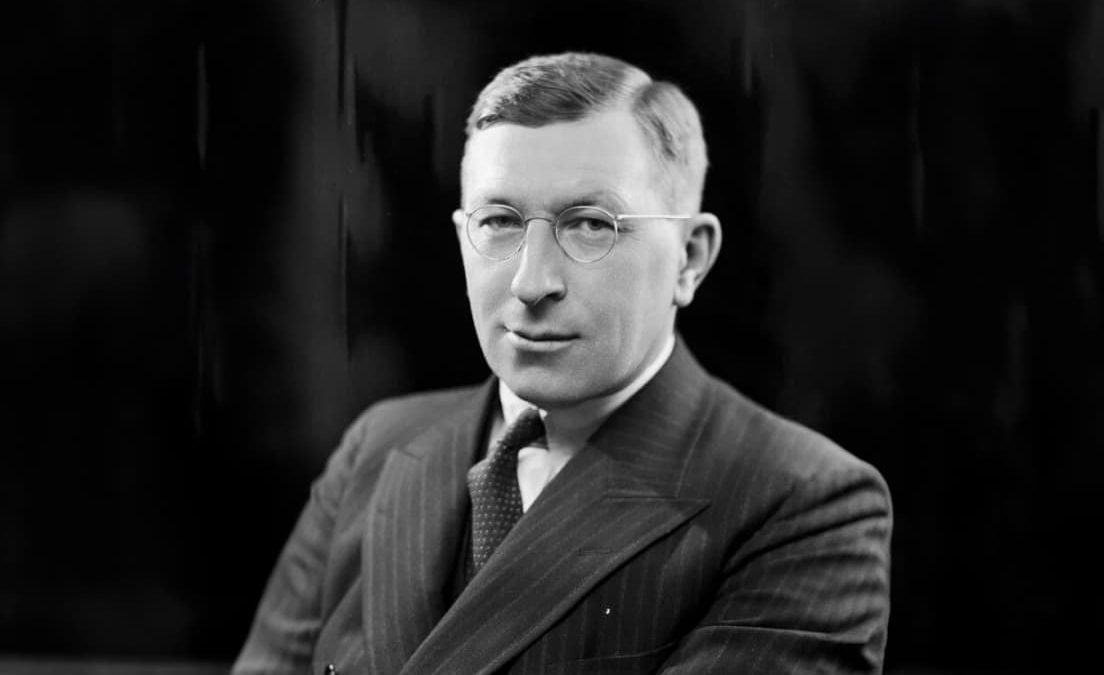
Sir Frederick Grant Banting (14 November 1891 to 21 February 1941) was a Canadian pharmacologist, orthopedist and field surgeon. For his co-discovery of insulin and its therapeutic potential, he was awarded the Nobel Prize in Physiology or Medicine with John Macleod. Banting and his student Charles Best isolated insulin at the University of Toronto in the laboratory of the Scottish physiologist John Macleod. When Banting and Macleod received the 1923 Nobel Prize, Banting shared his award and its money with Best. At 32 he is the youngest laureate in his field. This biography follows his life, his discovery and his legacy.
Frederick Banting at a Glance
| Full name | Sir Frederick Grant Banting |
| Born | 14 November 1891, near Alliston, Ontario, Canada |
| Died | 21 February 1941, Musgrave Harbour, Newfoundland |
| Profession | Physician, surgeon and medical researcher |
| Known for | Co-discovering insulin (1921 to 1922) |
| Nobel Prize | Physiology or Medicine, 1923, shared with John Macleod |
| Co-worker | Charles Best |
| Wives | Marion Robertson (married 1924) and Henrietta Ball (married 1937) |
| Memorial | Banting House, London, Ontario (National Historic Site since 1997) |
Childhood on a Farm
Banting was born on 14 November 1891 in his family's farmhouse, about two miles from Alliston, Ontario, the youngest of five children of William Thompson Banting, a farmer, and Margaret Grant, the daughter of a mill manager. The family was financially stable. Farm life largely defined his boyhood. He felt excluded from his siblings, all several years older, and he was a shy, asocial boy who tired easily at school. A cousin who first met him in 1901 recalled that they sat together in a swing for an hour and that he did not say one word. His parents hoped that he would find a vocation in the Methodist ministry.
He passed examinations in July 1910 after repeated attempts, and wrote on his university application that he wished to be a teacher, although he also hoped to become a doctor. He enrolled at the University of Toronto, where he failed his first year but decided to continue in medicine. In medical school he worked diligently, and with the lack of language courses his grades improved to about a B average. He was also a successful rugby player.
The First World War
At the outbreak of the First World War Banting tried to enlist the day after Canada's declaration of war, and again in October, but was refused twice because of poor vision. In his third year of medical school he joined the Royal Canadian Army Medical Corps in 1915. He graduated on 9 December 1916 and, after thirteen months assisting a surgeon at Granville Hospital, was transferred to France in June 1918. With the 44th Battalion, he served at the Battle of Cambrai in 1918, where his life was saved by a patient, an amputee sergeant, who shot a German soldier who had entered his aid post. Later he was struck by shrapnel from an exploding shell, which ended his frontline duty.
The Idea for Insulin
After the war he completed his surgical training in Toronto and, unable to gain a place on the hospital staff, set up a practice in London, Ontario. On 1 November 1920, he had to give a talk on the pancreas to a class at the University of Western Ontario and read reports by other scientists that suggested that diabetes resulted from a lack of a hormone secreted by the islets of Langerhans. An article published in 1920 described experimental closure of the pancreatic duct, which caused the cells that make trypsin, an enzyme that breaks down insulin, to deteriorate but left the islets intact. Banting realised that this procedure might allow the hormone to be extracted without being destroyed.
The Discovery
Banting approached John Macleod at the University of Toronto, who gave him laboratory space and the assistance of a student, Charles Best. As the experiments proceeded, the quantities of extract required could no longer be obtained by operating on living dogs. In November 1921 Banting thought of obtaining insulin from the pancreas of fetal calves, which he collected from a slaughterhouse, and found the extracts to be just as potent as those from dogs. By December 1921 he had also succeeded in extracting insulin from adult cattle. The discovery transformed diabetes from a fatal disease into a manageable one.
The Nobel Prize
Banting and Macleod were jointly awarded the 1923 Nobel Prize in Physiology or Medicine. Banting split his half of the prize money with Best, and Macleod split the other half with James Collip. In 1923 the Government of Canada granted Banting a lifetime annuity to continue his work. He was appointed Senior Demonstrator in Medicine at the University of Toronto in 1922, and the next year he was elected to the new Banting and Best Chair of Medical Research, endowed by the Legislature of Ontario.
Later Research
In 1938 his interest in aviation medicine led him to take part in research with the Royal Canadian Air Force on the physiological problems of pilots flying high-altitude combat aircraft. During the Second World War he investigated problems such as blackout, helped Wilbur Franks to invent the G-suit to stop pilots from blacking out in turns or dives, and worked on treating mustard gas burns, even testing the gas and antidotes on himself. In 1927 he travelled to the Arctic with the painter A. Y. Jackson, and on his return made public remarks about the effect of the fur trade on indigenous people, saying that for over 100,000 dollars of fox skins the Inuit had not received 5,000 dollars of goods. The Hudson's Bay Company called his remarks false and slanderous, and Banting did not retract them.
Painting and Family
Banting developed an interest in painting around 1921 and became friends with Group of Seven artists A. Y. Jackson and Lawren Harris, with whom he shared a love of the rugged Canadian landscape. At the time of his death he was one of Canada's best-known amateur painters. He married twice. His first marriage, to Marion Robertson in 1924, produced one child, and ended in divorce in 1932, and in 1937 he married Henrietta Ball.
Death and Legacy
In February 1941 Banting died of wounds and exposure after the crash of a Lockheed aircraft in which he was a passenger, at Musgrave Harbour, Newfoundland, after both engines failed after departing from Gander. He was 49. His name is remembered in the annual Banting Lectures on diabetes and in the Banting and Best Department of Medical Research at the University of Toronto. Banting House in London, Ontario, was declared a National Historic Site of Canada in 1997 and houses a museum of the history of insulin. Millions of people with diabetes live because of the research he began in a borrowed laboratory.