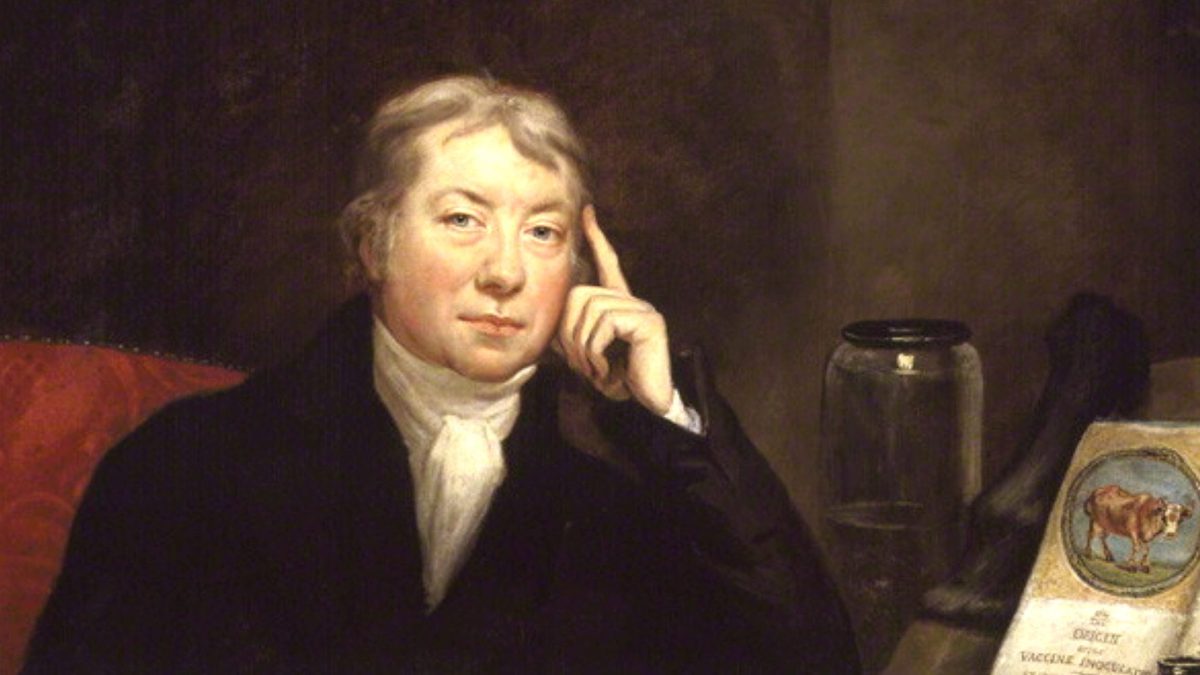
Edward Jenner (17 May 1749 to 26 January 1823) was an English physician and scientist who pioneered the concept of vaccines and created the smallpox vaccine, the world's first vaccine. The terms vaccine and vaccination come from Variolae vaccinae, "pustules of the cow", the term he devised for cowpox. He is often called the father of immunology, and his work is said to have saved more lives than any other man's. In Jenner's time, smallpox killed around 10 percent of the global population, and as many as 20 percent in towns and cities where infection spread more easily. This biography follows his life, his experiment and his legacy.
Edward Jenner at a Glance
| Full name | Edward Jenner |
| Born | 17 May 1749, Berkeley, Gloucestershire, England |
| Died | 26 January 1823, Berkeley (aged 73) |
| Profession | Physician and scientist |
| Known for | Smallpox vaccine; study of the cuckoo's nesting behaviour |
| Key date | 14 May 1796, first inoculation of James Phipps |
| Wife | Catherine Kingscote (married 1788) |
| Children | Edward Robert, Catherine Fitzhardinge and Robert Fitzhardinge |
| Honours | Fellow of the Royal Society (1788); physician extraordinary to King George IV (1821) |
Early Life in Berkeley
Edward Jenner was born on 17 May 1749 in Berkeley, Gloucestershire, the eighth of nine children. His father, the Reverend Stephen Jenner, was the vicar of Berkeley, and so Jenner received a strong basic education. He attended school in Wotton-under-Edge and in Cirencester. During this time he was inoculated against smallpox by variolation, a procedure that had a lifelong effect on his general health. At 13 he was apprenticed for seven years to Daniel Ludlow, a surgeon in Chipping Sodbury, where he gained most of the experience he needed to become a surgeon himself.
In 1770, at the age of 21, he became an apprentice in surgery and anatomy under the surgeon John Hunter at St George's Hospital in London. Hunter gave Jenner the advice attributed to William Harvey, "Don't think; try", and the two remained in correspondence about natural history. By 1773 Jenner was back in his native countryside, where he became a successful family doctor and surgeon with premises at Berkeley. He obtained his MD from the University of St Andrews in 1792.
The Cuckoo and the Royal Society
Jenner was elected a fellow of the Royal Society in 1788 after publishing a careful study of the nesting cuckoo, which combined observation, experiment and dissection. He described how a newly hatched cuckoo pushes its host's eggs and chicks out of the nest, contrary to the belief that the adult cuckoo did it. He also found that the baby cuckoo has a depression in its back, absent after about 12 days, which helps it cup the eggs and other chicks. His findings were published in the Philosophical Transactions of the Royal Society in 1788, and they were not entirely believed until later observers confirmed them, which convinced Charles Darwin to revise a later edition of On the Origin of Species. His grounding in animal biology helped him recognise how disease could cross between species.
The Invention of the Vaccine
Smallpox inoculation, known as variolation, had been imported to Britain in 1721 by Lady Mary Wortley Montagu after she observed it in Constantinople. It could produce a much milder disease than natural smallpox, but it was not safe. Others, including the Dorset farmer Benjamin Jesty in 1774, had already noticed that cowpox could protect against smallpox, but it was Jenner's work that made the procedure widely understood.
Jenner postulated that the pus in the blisters of sufferers of cowpox, a disease similar to smallpox but much less virulent, protected them from smallpox. On 14 May 1796 he tested his hypothesis by inoculating James Phipps, the eight-year-old son of his gardener. He scraped pus from cowpox blisters on the hands of Sarah Nelmes, a milkmaid who had caught cowpox from a cow called Blossom, and inoculated Phipps through two small cuts on his arm. The boy developed a fever and some uneasiness, but no full-blown infection. On 1 July 1796 Jenner injected Phipps with smallpox material, the routine method of immunisation at the time, and again no disease followed. As the American physician Donald Hopkins wrote, Jenner's unique contribution was not that he inoculated a few people with cowpox but that he then proved they were immune to smallpox, and that the protective material could be passed from person to person.
Publication and Acceptance
Jenner successfully tested his hypothesis on 23 additional subjects, including his own 11-month-old son Robert. In 1798 he published his Inquiry into the Variolae Vaccinae, known as the Cow Pox. The medical establishment deliberated at length over his findings before accepting them, but eventually vaccination spread. In 1802 Parliament granted him 10,000 pounds for his work on vaccination, and five years later it granted a further 20,000 pounds after the Royal College of Physicians confirmed its widespread efficacy. In 1840 the British government banned variolation and provided vaccination using cowpox.
The success of the discovery soon spread around Europe. The Spanish Balmis Expedition of 1803 to 1806 carried the vaccine to the Americas, the Philippines, Macao and China, and Jenner wrote that he did not imagine the annals of history furnished an example of philanthropy so noble and so extensive. Napoleon, who was at war with Britain, had all his French troops vaccinated, awarded Jenner a medal, and at Jenner's request released two English prisoners of war.
Later Life
Jenner was elected a foreign honorary member of the American Academy of Arts and Sciences in 1802 and a foreign member of the Royal Swedish Academy of Sciences in 1806. In 1803 he became president of the Jennerian Society in London, which promoted vaccination to eradicate smallpox. In 1821 he was appointed physician extraordinary to King George IV, and he was also made mayor of Berkeley and a justice of the peace. His continuing work on vaccination prevented him from continuing his ordinary medical practice. He also continued to study natural history, and in 1823, the last year of his life, he presented his observations on the migration of birds to the Royal Society.
Family
Jenner married Catherine Kingscote in March 1788; she died of tuberculosis in 1815. He may have met her while he and other fellows were experimenting with balloons, because his trial balloon descended into Kingscote Park, owned by her father. They had three children: Edward Robert, who lived from 1789 to 1810; Catherine Fitzhardinge, who lived from 1794 to 1833; and Robert Fitzhardinge, who lived from 1797 to 1854 and was inoculated with the cowpox vaccine by his father when he was 11 months old.
Death
Jenner was found in a state of apoplexy on 25 January 1823 with his right side paralysed. He did not recover and died the next day, apparently of a second stroke, at the age of 73. He was buried in the family vault at the Church of St Mary in Berkeley. A few days before he died he told a friend that he was not surprised that men were not grateful to him, but that he wondered that they were not grateful to God for the good which He had made him the instrument of conveying to his fellow creatures.
Legacy
In 1980 the World Health Organization declared smallpox an eradicated disease. It was the result of coordinated public health efforts, but vaccination was an essential component,. Jenner's vaccine laid the foundation for contemporary immunology. In 2002 he was named in the BBC's list of the 100 Greatest Britons, and in 1999 the Royal Mail featured him in its World Changers stamp issue alongside Charles Darwin, Michael Faraday and Alan Turing. His house in Berkeley is now a museum, which holds, among other things, the horns of the cow Blossom, and the Jenner Institute at the University of Oxford continues vaccine research today. The word vaccine itself is his lasting monument.