Ukrainian officials have accused Russia of targeting rescue and recovery workers at the site of one of the deadliest single attacks of the war, two weeks after a "double-tap" strike on the village of Komyshuvakha, close to the front line, killed at least 72 people. According to the investigation published by BBC Verify, Ukraine says Russia carried out two attacks in succession on a humanitarian aid centre on 2 November, including the use of what it said was a 3,000kg (6,600lb) aerial bomb on a shelter where residents had fled for safety. With the State Emergency Service of Ukraine, known as the DSNS, saying the toll had risen to at least 72, the attack has become the second deadliest single incident of the war.
The BBC's reconstruction begins with a Telegram message. Local people headed to the shelter area on 2 November after being told by a local Telegram group that aid would be distributed between 10:00 and 12:00 local time. Ukrainian authorities say an initial strike at 09:45 hit buildings above ground and killed one woman. Bodycam footage released by Ukrainian police in edited segments and analysed by BBC Verify shows people trying to free a casualty from the rubble before declaring that she had died. Throughout the footage, warnings of an impending second strike can be heard on police radios with increasing urgency, until people are instructed to run to the underground shelter. The same footage, taken around an hour after the first attack, goes on to show people sitting in the shelter. As they wait in silence, a large explosion is heard and the video goes dark. Later aftermath video shows bodies being recovered from a large crater directly above the shelter, with twisted iron and rubble from the structure visible beneath the surface.
Independent experts told BBC Verify that the evidence is consistent with a specific weapon. Trevor Ball, a bomb disposal expert at the intelligence firm Armament Research Services, said that the crater seen in the footage was consistent with the damage and depth left by a FAB-3000, a 3,000kg Russian bomb capable of destroying underground structures. Chris Proops, a former investigator with the UK National Crime Agency, said the scale of the damage matched the size of that bomb. Both men confirmed that verified photographs of munition fragments, obtained by BBC Verify from Ukrainian authorities, show part of a guidance kit compatible with the FAB-3000, which increases the weapon's accuracy and allows it to be released from a greater distance from the target.
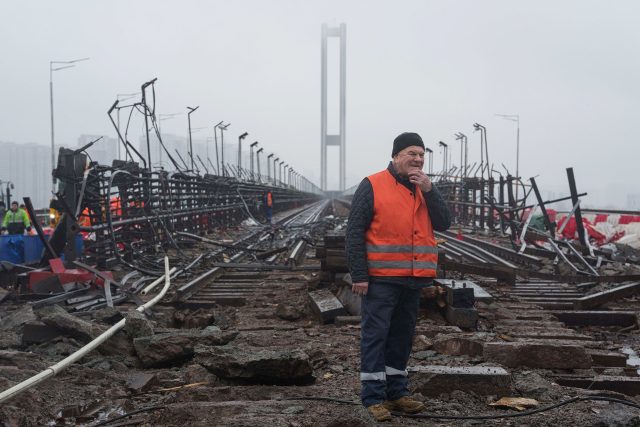
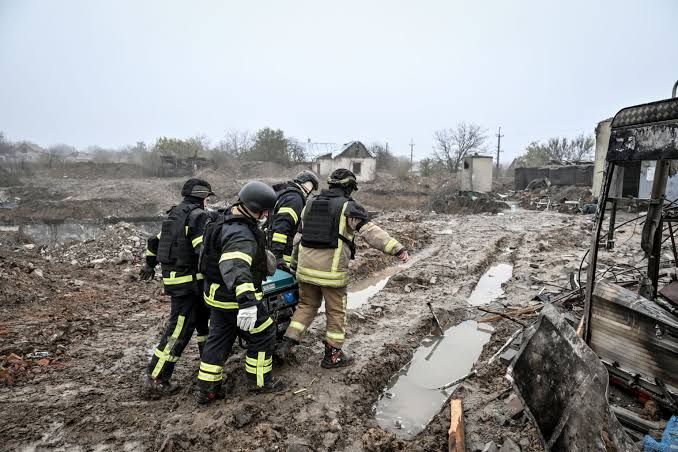
The new accusation concerns what happened afterwards. Ukrainian officials say Russia kept striking the area while search and rescue was under way. Verified images posted in the days after the attack show damage to emergency vehicles and excavation equipment at the site. The DSNS told BBC Verify that there were multiple Russian strikes during the rescue and that three police officers, four workers and two rescue dogs were injured, while five vehicles were damaged during the operation, which has now concluded. BBC Verify also confirmed videos shared by Ukrainian police that show rescue workers shouting "drone, drone" and running for cover on the day after the attack, with a group seen treating a victim.
An SBU intelligence officer investigating the incident, who asked to be identified only as Oleksiy, said the rescue vehicles were "clearly marked" and accused Russia of "deliberately destroying humanitarian equipment". He said crews worked under constant threat. "The enemy knows perfectly well that what is being carried out there is essentially a humanitarian operation to search for the dead," he said. He added that the village's infrastructure and the people who still live in Komyshuvakha are being systematically targeted by drones and bombs, and he accused Russian forces of "outright terror against civilians, against peaceful residents" in an effort to make life on the front line impossible.
Russia has not answered the specific allegations. BBC Verify said it asked the Russian Ministry of Defence for comment about the Komyshuvakha attacks and had not received a response. A general statement released by the ministry on 2 November said it had targeted energy and transport infrastructure used by the Ukrainian military across the country. The BBC noted that there are no military or industrial facilities in Komyshuvakha, although the village is close to a key route used for Ukrainian troop movements, supplies and evacuations, and that it had previously been reported struck by Russian forces on 28 October. Funerals for victims have been held almost daily, including for locals who worked to administer aid distribution, people who came to collect aid, and soldiers who officials say arrived to help with the rescue.
The legal question is whether the attacks amount to war crimes, and the experts the BBC consulted were clear about the framework. Ben Saul, professor of international law at the University of Sydney, said that if Russia knowingly attacked rescue workers, it committed a war crime, and that the strike on the shelter "appears to be either a deliberate attack on civilians or civilian objects – a war crime – or an indiscriminate attack – also a war crime". Samuel Moyn, a professor at Yale University, said "directly targeting rescuers or their equipment is a gross violation of international humanitarian law", adding that precautions must be taken to ensure strikes target combatants and not others. Those assessments are the opinions of the experts quoted, and the question of intent in this particular case has not been established by any court.
Double-tap strikes, in which a second attack hits the same location after emergency workers and bystanders have gathered, have been a recurring concern for human rights monitors in several conflicts, which is why the pattern described in Komyshuvakha is treated seriously by lawyers. The BBC's account matters for another reason: it relies on verified video, expert analysis of fragments and a crater, and a timeline built from police bodycam footage, rather than on claims from either government alone. Verification of this kind does not settle who gave the order, but it narrows the room for dispute about what weapon was used, where, and when.
The incident also illustrates what daily life looks like in villages near the front. Residents of Komyshuvakha were relying on aid distribution organised through a local messaging group, and they were told to take shelter underground when a second strike was anticipated. Those instructions, heard on police radios in the bodycam footage, show that the authorities expected another attack, yet the shelter itself did not survive a bomb of this size. That detail has prompted obvious questions about how civilians in frontline settlements can be protected when aid distribution points and shelters are within range of heavy guided munitions, and it adds urgency to calls for evacuation from areas close to the front.
For now, the immediate priority is the families who lost relatives and the people who remain in the village. The death toll of at least 72 may still be revised, as the DSNS has already raised it once. The accusation that rescuers were targeted will likely be raised by Ukraine in international forums, and investigators from several countries are already documenting alleged violations in the war. What the BBC Verify investigation adds is a verified evidentiary record of a two-stage attack on civilians and of dangers faced by those who tried to dig them out, a record that could matter long after the shelling stops.