David Bowie (8 January 1947 to 10 January 2016) was an English singer, songwriter and actor, regarded as among the most influential musicians of the 20th century. Known for his frequent reinvention and visual presentation, he was often called the "chameleon of rock". Born David Robert Jones in Brixton, London, he rose to fame with "Space Oddity" in 1969, became a global star as Ziggy Stardust in 1972, and released his final album, Blackstar, two days before his death in 2016. This biography follows his life, music and legacy.
David Bowie at a Glance
| Full name | David Robert Jones, known as David Bowie |
| Born | 8 January 1947, Brixton, London, England |
| Died | 10 January 2016, New York City (aged 69) |
| Profession | Singer, songwriter and actor; also a painter and writer |
| Best-known albums | The Rise and Fall of Ziggy Stardust and the Spiders from Mars, Low, "Heroes", Let's Dance, Blackstar |
| Spouses | Angie Barnett (1970 to 1980) and Iman (1992 until his death) |
| Children | Duncan Jones and Alexandria "Lexi" Zahra Jones |
| Honours | Six Grammy Awards, four Brit Awards, Rock and Roll Hall of Fame (1996) |
Early Life in London
David Robert Jones was born on 8 January 1947 in Brixton, London. His mother, Margaret Mary "Peggy" (née Burns), was a waitress at a cinema in Royal Tunbridge Wells, and his father, Haywood Stenton "John" Jones, from Doncaster, was a promotions officer for the children's charity Barnardo's. The family lived at 40 Stansfield Road in the borough of Lambeth, and in 1953 they moved to Bickley and then Bromley Common, before settling in Sundridge Park in 1955.
Bowie attended Stockwell Infants School until he was six and acquired a reputation as a gifted and single-minded child, and also a defiant brawler. He studied art, music and design before starting a music career in 1962. He released a string of unsuccessful singles with local bands and a self-titled solo album, and he immersed himself in avant-garde theatre, mime and commedia dell'arte under Lindsay Kemp, which taught him the creation of personae that would define his career.
Space Oddity and Ziggy Stardust
Bowie's first success came in 1969 with "Space Oddity", a UK number-five single from his self-titled second album. In 1969 he also helped run a folk club at the Three Tuns pub in Beckenham, which became the Beckenham Arts Lab. His major commercial breakthrough came in 1972, during the glam rock era, with the Ziggy Stardust character and the album The Rise and Fall of Ziggy Stardust and the Spiders from Mars.
In 1974 he changed direction and adopted a new persona, Halloween Jack, for Diamond Dogs. The soul-influenced Young Americans (1975) was followed by Station to Station (1976), in which he adopted the Thin White Duke persona and took his music towards art rock, electronica and ambient sound. Each of these changes was deliberate: Bowie treated style, costume and character as part of the music.
The Berlin Years
In August 1976 Bowie and Iggy Pop moved to West Berlin to rid themselves of their drug addictions and escape the spotlight. His interest in German krautrock and the ambient work of Brian Eno led to the first of three albums, co-produced with Tony Visconti, known as the Berlin Trilogy: Low (1977), recorded in France; "Heroes" (1977), which featured guitarist Robert Fripp; and Lodger (1979). Low was completed in November 1976 but left unreleased for three months, because RCA did not see it as commercially viable. On its release in January 1977 it yielded the UK number-three single "Sound and Vision" and reached number two on the UK album chart.
The trilogy is now widely regarded as one of the most adventurous periods in popular music, a time when a major star used his commercial standing to explore experimental sounds.
Let's Dance, Tin Machine and Later Work
Bowie achieved his greatest commercial success with Let's Dance in 1983. From 1988 to 1992 he fronted the hard rock band Tin Machine, and he resumed his solo career in 1993, experimenting with industrial, jungle and drum and bass. He retired from touring in 2004, and his last live performance was at a charity event in 2006. He returned from a decade-long recording hiatus on 8 January 2013, his 66th birthday, with the announcement of The Next Day and the single "Where Are We Now?". The album, recorded in secret between 2011 and 2012, debuted at number one in the UK and was the fastest-selling album of 2013 at the time.
His final studio album, Blackstar, was released two days before his death and was analysed as a powerful farewell to his fans.
Acting, Art and Business
Outside music, Bowie was recognised for his acting, preferring smaller parts and cameos to leading roles. His best-known films include The Man Who Fell to Earth (1976), Merry Christmas, Mr. Lawrence (1983), Labyrinth (1986), Twin Peaks: Fire Walk with Me (1992), Basquiat (1996) and The Prestige (2006). He was also a painter and writer and an art collector. He created the first modern celebrity bond, the "Bowie Bonds", and through his website BowieNet he was one of the first artists to engage with fans directly through the internet.
Records and Awards
During his lifetime Bowie's record sales were estimated at over 100 million worldwide, making him one of the best-selling musicians of all time. He achieved eleven UK number-one albums, including Aladdin Sane (1973) and Scary Monsters (and Super Creeps) (1980), and had UK or US number-one singles with "Space Oddity", "Fame", "Ashes to Ashes", "Under Pressure" (with Queen), "Let's Dance" and "Dancing in the Street" (with Mick Jagger). He received six Grammy Awards and four Brit Awards, and he was inducted into the Rock and Roll Hall of Fame in 1996.
Family and Personal Life
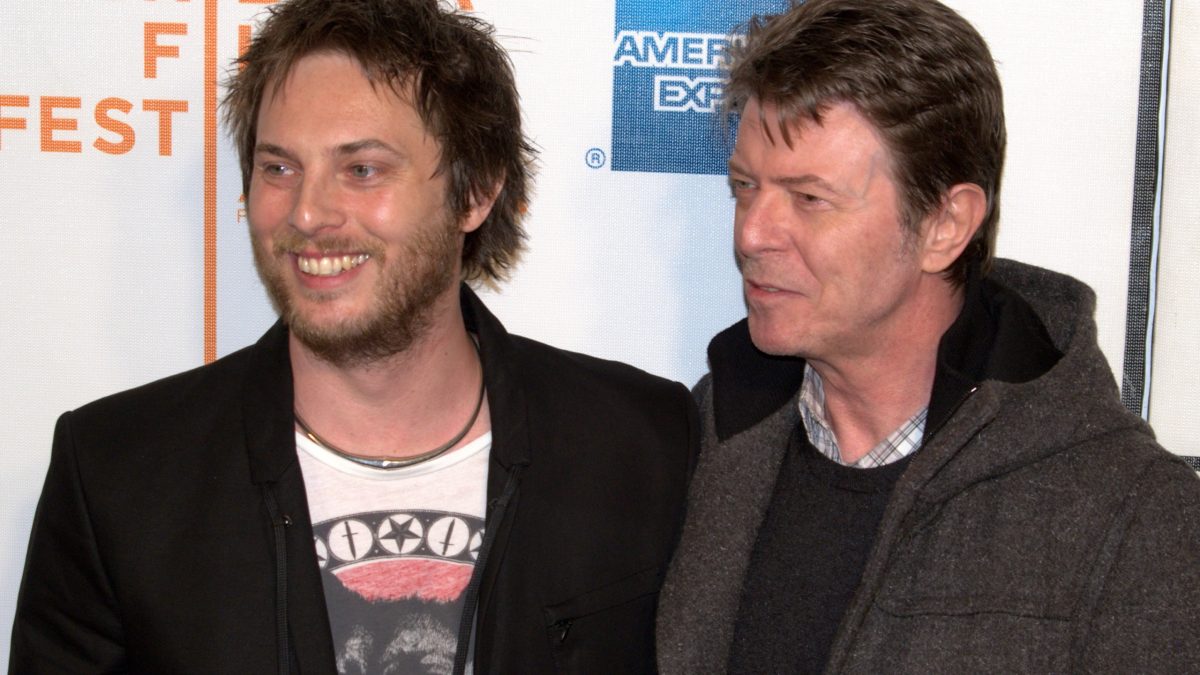
Bowie married Mary Angela Barnett (Angie) on 19 March 1970 in Bromley. Their son Duncan, born on 30 May 1971, was at first known as Zowie. The marriage was an open one, and the couple divorced on 8 February 1980. Bowie met the Somali-American model Iman in October 1990, and they married in a private ceremony in Lausanne on 24 April 1992. They had one daughter, Alexandria "Lexi" Zahra Jones, born on 15 August 2000, and lived mainly in New York City and London.
Death
Bowie died of liver cancer in his New York City apartment on 10 January 2016. He had been diagnosed 18 months earlier but had not made his condition public. His producer Tony Visconti wrote that "his death was no different from his life, a work of art" and that he had made Blackstar as "his parting gift". Fans gathered at impromptu shrines in Brixton, Berlin, Los Angeles and New York. Bowie had insisted on no funeral, and according to his death certificate he was cremated; as he wished in his will, his ashes were scattered in a Buddhist ceremony in Bali.
Legacy
Bowie is generally regarded as one of the most influential musicians ever. Alexis Petridis of The Guardian wrote that by 1980 he was "the most important and influential artist since the Beatles", and Billboard's Joe Lynch argued that he "influenced more musical genres than any other rock star". His constant reinvention, from glam rock to electronica, showed later generations of artists that identity, image and sound could be part of the same creative work.