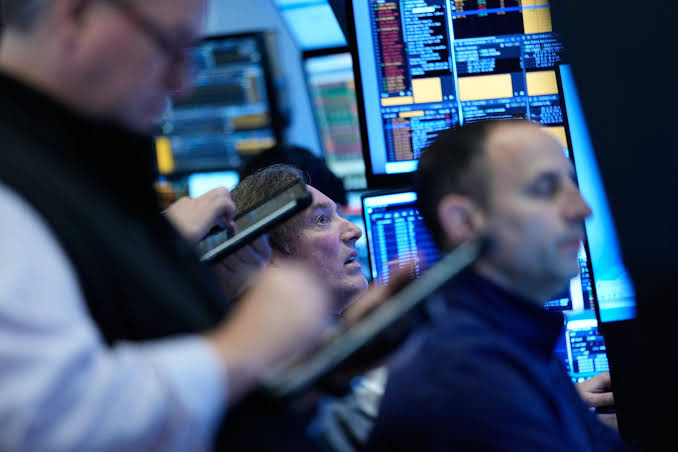
A sharp sell-off in technology stocks dragged markets down around the world on Friday, pushing two of Wall Street's main indexes into correction territory and testing the debut of the first frontier artificial intelligence company to go public. Anthropic's shares dropped back towards their initial price after a soaring first day on the Nasdaq, as concerns about the speed and size of AI investment combined with company-specific worries at some of the market's biggest names. The turmoil, which followed earlier falls during the week, has revived fears of a bubble in AI-related shares.
The numbers were stark. The S&P 500 closed down 3.7%, the Dow Jones Industrial Average fell 1.9%, and the tech-heavy Nasdaq Composite plunged 5.3%. Both the S&P 500 and the Dow were pushed into correction territory, a point at which an index is trading at 10% or more below a recent high. Even so, all three indexes remained higher than a year ago, a reminder that the recent drop follows a long period of gains. The question for investors is whether this is a healthy reset or the start of something more serious.
At the centre of attention was Anthropic, whose stock market debut on the Nasdaq on Thursday was seen as a crucial test for the industry and was largely viewed as a success. Trading opened at $111.50 before easing to close the day up 17% at $97.17, compared with an initial public offering price of $83. On Friday, the shares fell, dropping at one point by more than 12% to about $85, close to the IPO price, and closed down 8.5%, reversing half of the previous day's gains. Analysts said volatility was to be expected in the first days or even weeks, since Anthropic was the first frontier AI firm to go public and so had no direct peers to compare it with.
Some observers have noted similarities with Elon Musk's SpaceX, which at the time of its debut in June was the largest IPO on record, and whose shares experienced large swings in their first few weeks of trading. Ed Moya, a strategist at market intelligence firm AlphaSense, said Anthropic's blockbuster IPO did not appear to have restored confidence in the broader AI market. While AI demand was still very strong, he told the BBC, investors were trying to answer the question of how much they were willing to pay for that growth. "As we've gone through the past few weeks, it seems that there's been more risks that have surfaced," he said.
The underlying anxiety is about the scale of spending. More than $1 trillion has been spent in the last year alone by a small handful of major tech companies on AI, which has led to ongoing concerns of a financial bubble. Investors want to know whether those investments will pay off, and when. Moya said Wall Street is trying to shift from rewarding growth at any price to demanding stronger cash flow and a clearer path to profitability. That change in mood is important, because many AI companies are spending heavily on chips and data centres long before they generate comparable revenues.
Politics also played a part. Investors were spooked by the Democrats' resounding win in the US midterms in early November, which sparked fears of a reduction in AI development. The prospect of a more sceptical Congress, with power to hold hearings and shape legislation, has added a layer of uncertainty to a sector that has benefited from a favourable policy environment. The extent of any change is unclear, but markets tend to react to the possibility of tighter oversight well before laws are written.
Individual companies added to the pressure. Nvidia shares plummeted by 13.7% by the close of trade, following reports from Reuters, which the BBC said it had not confirmed, that the company was being investigated by the US Securities and Exchange Commission over its accounting practices. Elon Musk's firms Tesla and SpaceX both fell by more than 7.6%, with SpaceX shares hit after it announced a bond sale to finance what the company said was the largest purchase of Nvidia chips on record. Meta closed down more than 5% and Amazon was down more than 4%, while Apple and Alphabet experienced smaller falls.
The sell-off was not confined to the United States. Europe's main stock markets, which contain fewer technology stocks, also took a hit. Germany's Dax index closed down 2.6%, France's CAC 40 fell 1.9% and the UK's FTSE 100 ended trading 1% lower. The smaller declines in Europe reflect its different sector mix, but they show how closely linked global markets are, and how a shock on Wall Street or in Asia can quickly spread.
Asia felt the pain earlier in the day. Tech-heavy Asian markets saw steep falls, with South Korea's Kospi and Japan's Nikkei 225 indexes closing down about 5%. Shares in memory chip makers SK Hynix and Kioxia, in Tokyo Electron and in other technology firms such as Samsung Electronics suffered losses. Taiwan's stock market dropped about 6% on Friday, taking its weekly fall to more than 17%, which was reported to be its biggest weekly fall since 1990. Those economies are heavily dependent on semiconductors and on the AI supply chain, so they are especially sensitive to worries about demand.
Context matters when interpreting the moves. Corrections of 10% or more are a normal, if uncomfortable, part of market cycles, and they do not necessarily lead to a deeper downturn. The fact that the major US indexes are still higher than they were a year ago suggests that investors have not abandoned the AI story entirely. What has changed is the tone: from enthusiasm to scrutiny. Companies that cannot show a clear route to profit may find it harder to raise money, while those with strong earnings and cash flow may weather the storm better.
For ordinary savers, the consequences could be felt through retirement accounts and pension funds, which hold large positions in the biggest technology companies. Because a handful of firms account for a large share of the major US indexes, their swings can have an outsized effect on portfolios. That concentration is one reason why analysts keep a close eye on any sign that the AI boom is faltering.
The coming days will be revealing. Investors will look for evidence on whether the SEC reports about Nvidia are borne out, how the new Congress approaches AI policy, and whether Anthropic's shares settle near the IPO price or find fresh momentum. Earnings reports and statements from central banks will also shape the mood. For now, the message from Friday's trading is that the market is no longer willing to give technology companies the benefit of the doubt, and that the next phase of the AI boom will be judged by profits rather than promises.