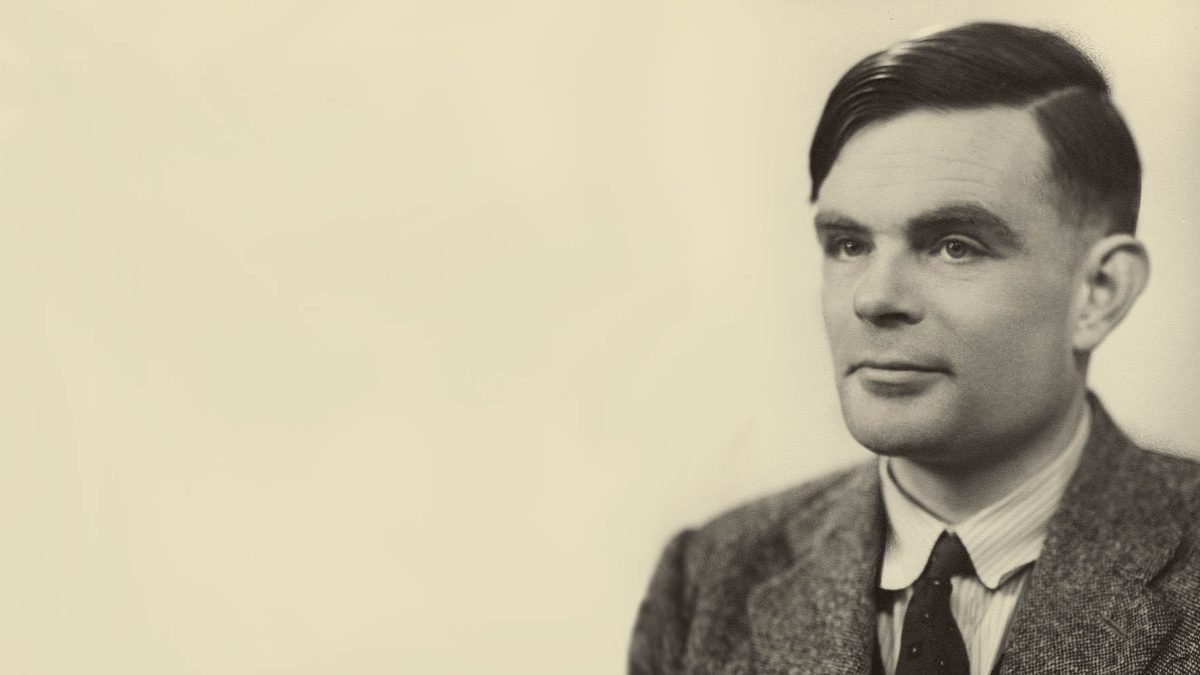
Alan Mathison Turing (23 June 1912 to 7 June 1954) was a British mathematician, logician and computer scientist who is widely considered the father of theoretical computer science and artificial intelligence. During the Second World War he played a leading role in the breaking of German ciphers at Bletchley Park, work that is credited with shortening the war. He was prosecuted in 1952 for homosexual acts, which were then illegal in Britain, and died in 1954 at the age of 41. This biography follows his life and work.
Alan Turing at a Glance
| Full name | Alan Mathison Turing |
| Born | 23 June 1912, Maida Vale, London, England |
| Died | 7 June 1954, Wilmslow, Cheshire, England (aged 41) |
| Profession | Mathematician, logician, cryptanalyst and computer scientist |
| Education | King's College, Cambridge; PhD at Princeton University (1938) |
| Best known for | The Turing machine, wartime codebreaking, the Turing test |
| Honours | Fellow of the Royal Society (1951); Order of the British Empire (1946) |
| Posthumous recognition | Government apology (2009), royal pardon (2013), Turing Law (2017) |
| Namesake | The Turing Award, the highest honour in computer science |
Early Life and Education
Turing was born in Maida Vale, London, while his father, Julius Mathison Turing, was on leave from his position with the Indian Civil Service in British India. In 1926, at the age of 13, he went to Sherborne School, an independent boarding school in Dorset. At Sherborne he formed a close friendship with a fellow student, Christopher Morcom, Christopher Morcom, who died in February 1930.
Cambridge and the Turing Machine
Turing studied mathematics at King's College, Cambridge, and was elected a fellow of the college in 1935, at the age of 22. In 1936 he published the paper "On Computable Numbers, with an Application to the Entscheidungsproblem", which introduced the idea of the abstract device now known as the Turing machine. The 36-page paper was delivered for publication in May 1936 and appeared in two parts, in November and December of that year. The machine, which reads and writes symbols on a tape according to a table of rules, provided a precise definition of what it means for a problem to be computable, and it is the foundation of modern computer science. He then went to Princeton University, where he completed a PhD under the logician Alonzo Church in 1938.
Bletchley Park and the Enigma Cipher
In September 1939, when Britain went to war with Germany, Turing reported to the Government Code and Cypher School at Bletchley Park. He led Hut 8, the section responsible for breaking German naval Enigma messages, and he made major contributions to the electromechanical machine known as the bombe, which was used to find the settings of the Enigma machines. The work allowed the Allies to read German naval communications and helped them to protect the Atlantic convoys. Many historians say that the codebreaking effort at Bletchley Park shortened the war, and Turing was awarded the Order of the British Empire in 1946, although his work remained secret for decades.
Early Computers and the Turing Test
After the war Turing worked at the National Physical Laboratory in London, where he produced a design for the Automatic Computing Engine, one of the first designs for a stored-program computer. In 1948 he moved to the University of Manchester, where he worked on early computers. In 1950 he published "Computing Machinery and Intelligence", which asked the question "Can machines think?" and proposed what is now called the Turing test, in which a machine is judged intelligent if a human judge cannot reliably tell its responses from those of a person. In 1951 and early 1952 he made a number of BBC radio appearances to discuss the subject. He was elected a Fellow of the Royal Society in 1951.
Prosecution
In 1952 Turing was arrested after he reported a burglary at his home and acknowledged a relationship with a man. His house in Wilmslow had been burgled on 23 January 1952, and during the investigation he acknowledged a sexual relationship with the man involved. Homosexual acts were then a criminal offence in Britain, and he was convicted of gross indecency. Given a choice between prison and probation conditional on hormone treatment, he accepted the treatment, a form of chemical castration. The conviction cost him his security clearance and his work with the government on cryptography.
Death
Turing's sense of loss at the death of Morcom, who died of complications of bovine tuberculosis, was deep, and the friendship is often described as an important influence on him. Turing died on 7 June 1954 at his home in Wilmslow, Cheshire, two weeks before his 42nd birthday. An inquest ruled that he had died by suicide through cyanide poisoning, and an apple was found by his bed, a detail that has given rise to legends. His brother John, on the advice of Turing.s psychiatrist, accepted that an accidental death would be difficult to establish.
Apology, Pardon and Recognition
In 2009 the British prime minister Gordon Brown made an official public apology on behalf of the government for the way Turing had been treated. In December 2013 Queen Elizabeth II granted him a royal pardon. In 2017 the Policing and Crime Act, known informally as the Turing Law, pardoned other men convicted of acts that are no longer offences. The Association for Computing Machinery created the Turing Award in 1966, and it is regarded as the highest honour in computer science. The Bank of England 50 pound note carrying his portrait was first released on 23 June 2021, his birthday. The 2014 film The Imitation Game brought his story to a wide audience. The 2017 law went on to secure pardons for 75,000 other men and women, and in a 2019 BBC series the audience voted Turing the greatest scientist of the twentieth century.
Legacy
The intelligence from the broken ciphers, known as Ultra, proved helpful in the Battle of the Atlantic. Turing's ideas underpin both the theory of computation and the modern debate about artificial intelligence. The Turing machine remains the standard model of computation, and the Turing test continues to be discussed whenever a new generation of machines appears to converse like a person. His life is also remembered as a reminder of the human cost of prejudice, and of the debt that modern society owes to a man who was punished by the state he had helped to protect.