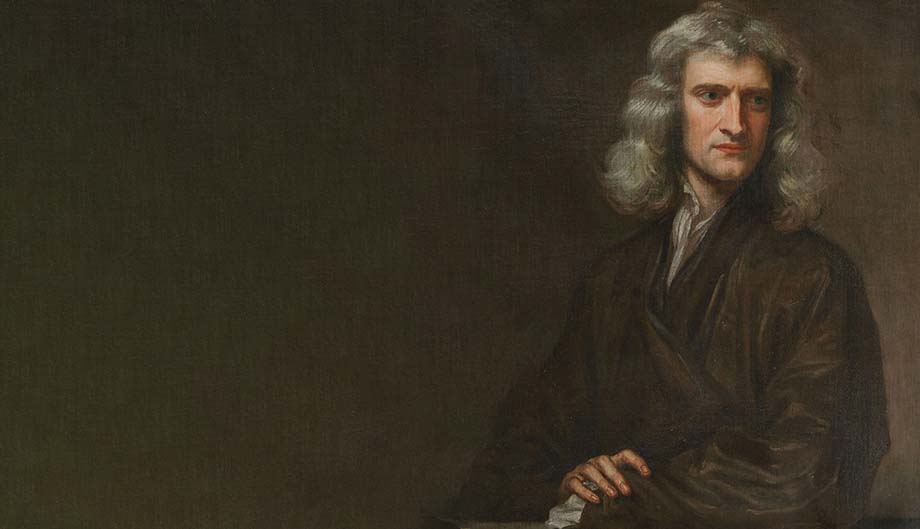
Isaac Newton (4 January 1643 to 31 March 1727, new style) was an English mathematician, physicist, astronomer and theologian who was a key figure in the Scientific Revolution. His book Philosophiæ Naturalis Principia Mathematica, first published in 1687, set out the laws of motion and universal gravitation and established classical mechanics. He also made major contributions to optics and, with Gottfried Wilhelm Leibniz, to calculus. This biography follows his life and work.
Isaac Newton at a Glance
| Full name | Sir Isaac Newton |
| Born | 4 January 1643 (25 December 1642, old style), Woolsthorpe, Lincolnshire, England |
| Died | 31 March 1727 (20 March 1726, old style), aged 84 |
| Profession | Mathematician, physicist, astronomer and theologian |
| Best-known works | Principia (1687) and Opticks (1704) |
| Positions | Lucasian Professor at Cambridge; Master of the Mint; President of the Royal Society |
| Honour | Knighted in 1705 |
Early Life and Education
Newton was born in Woolsthorpe in Lincolnshire, England. He studied at Trinity College, Cambridge, and became a fellow there. In the plague years of 1665 and 1666, when the university closed, he worked at home on early versions of ideas about calculus, optics and gravitation. He became Lucasian Professor of Mathematics at Cambridge in 1669.
Optics and the Reflecting Telescope
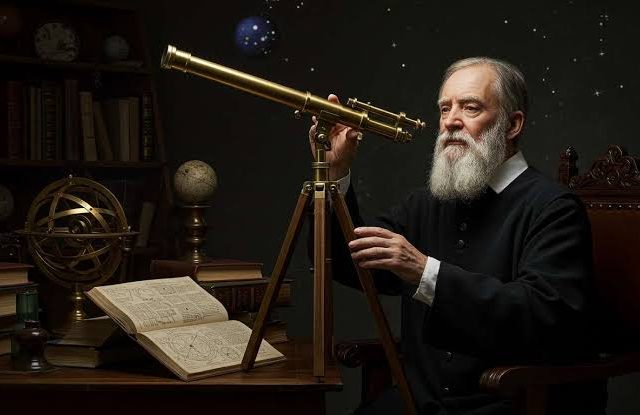
Newton built the first reflecting telescope and developed a theory of colour based on the observation that a prism separates white light into the colours of the visible spectrum. His work on light was collected in Opticks, published in 1704. He also formulated an empirical law of cooling and made the first theoretical calculation of the speed of sound.
The Principia
In the Principia Newton formulated the laws of motion and universal gravitation. He used his mathematical description of gravity to derive Kepler's laws of planetary motion and to account for tides, the trajectories of comets and the precession of the equinoxes. He showed that the motion of objects on Earth and of celestial bodies could be explained by the same principles, which removed doubt about the heliocentric model of the solar system. His laws remained the dominant scientific view for centuries until they were superseded by the theory of relativity, and they still serve as sufficient approximations for low speeds and weak gravitational fields.
Calculus and the Dispute with Leibniz
Newton developed calculus years before Leibniz but shares credit with him for formulating infinitesimal calculus, and the question of priority led to a long dispute between the two men and their supporters. Newton's mathematics also included the generalisation of the binomial theorem to any real number and the classification of most cubic plane curves.
Public Life
Newton became a public figure later in life. He was appointed to the Royal Mint, where he served as Warden and then Master, and he was elected President of the Royal Society, a post he held until his death. Queen Anne knighted him in 1705. His work on the Mint included overseeing the recoinage and tackling counterfeiting.
Alchemy and Theology
Alongside his scientific work, Newton spent much time on alchemy, theology and history. He wrote extensively on these subjects, and historians see these interests as part of the same effort to understand the order of the world, not as a separate side of his life.
Death and Burial
Newton died in London on 31 March 1727 and was buried in Westminster Abbey. His tomb is among the most prominent in the Abbey.
Legacy
Newton is regarded as one of the most influential scientists of all time. His laws guided engineers, astronomers and physicists for more than two centuries, and the unit of force in the International System of Units, the newton, is named after him. His method of combining mathematics with experiment helped to define the scientific method itself.
Conclusion
Newton's work gave the world a unified account of motion on Earth and in the heavens, and his writings on light and calculus remain central to science and mathematics. Four centuries after his birth, his ideas are still taught at the start of every physics course.