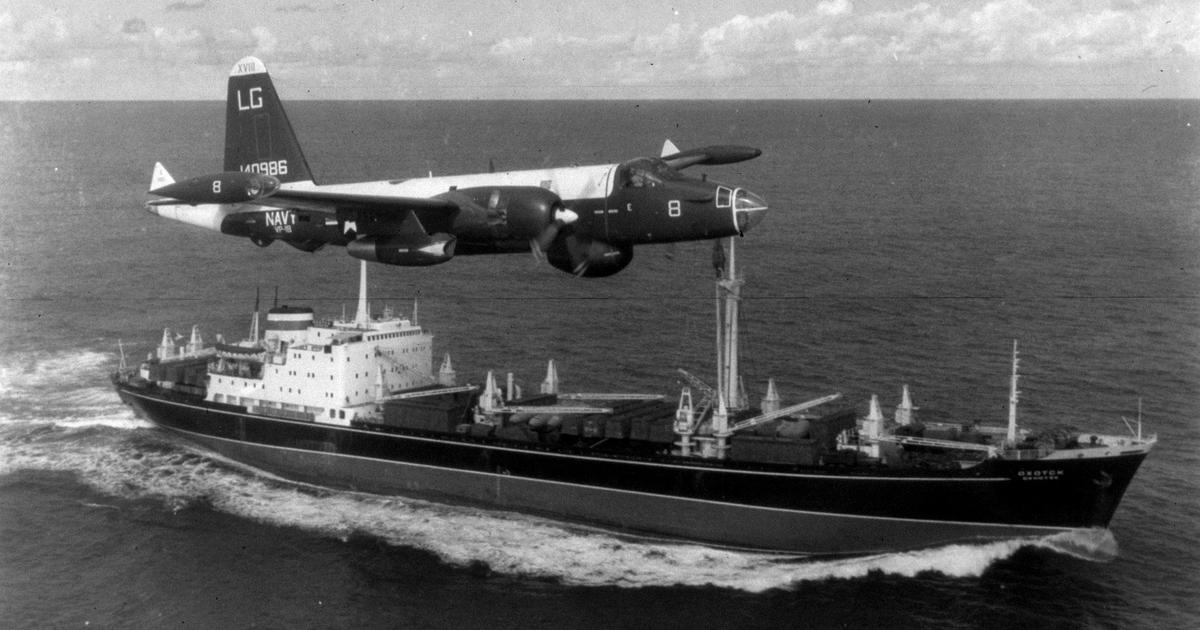
The Cuban Missile Crisis, also known as the October Crisis in Cuba and the Caribbean Crisis in Russia, was a 13-day confrontation between the governments of the United States and the Soviet Union, when American deployments of nuclear missiles in the United Kingdom, Italy and Turkey were matched by Soviet deployments of nuclear missiles in Cuba. The crisis lasted from 16 to 28 October 1962. It is widely considered the closest the Cold War came to escalating into full-scale nuclear war.
Missiles on Both Sides
In 1959 the US government deployed Thor nuclear missiles in England, an initiative known as Project Emily, and in 1961 it placed Jupiter nuclear missiles in Italy and Turkey. All were within range of Moscow. The United States had also trained a paramilitary force of Cuban exiles for a CIA-led attempt to invade Cuba and overthrow its government in April 1961. Starting in November of that year the US government carried out a campaign of sabotage and violence in Cuba that continued through the first half of the 1960s. The Soviet leadership was concerned about a Cuban drift towards China, with which the Soviets had an increasingly strained relationship.
The Soviet Decision
In response to these factors the Soviet and Cuban governments agreed, at a meeting between Nikita Khrushchev and Fidel Castro in July 1962, to place nuclear missiles on Cuba to deter a future US invasion. Construction of launch facilities began soon afterwards. In late 1961 Castro had asked the Soviet Union for more SA-2 anti-aircraft missiles, and when the request was not acted upon he began criticising the Soviets for a lack of "revolutionary boldness" and talking to China about economic assistance. In March 1962 he ordered the ousting of Anibal Escalante and his pro-Moscow comrades. The affair alarmed the Soviet leadership and raised fears of a possible US invasion, and in April the Soviet Union sent more SA-2 missiles as well as a regiment of regular Soviet troops.
Discovery
The United States first obtained U-2 photographic evidence of the Soviet missiles on 14 October 1962, when a flight piloted by Major Richard Heyser took 928 pictures on a path chosen by analysts of the Defense Intelligence Agency, and they captured images of what turned out to be an SS-4 missile construction site. President John F. Kennedy convened a meeting of the National Security Council and other key advisers, forming the Executive Committee of the National Security Council, known as EXCOMM. He was advised to carry out an air strike on Cuban soil in order to compromise Soviet missile supplies, followed by an invasion of Cuba, but he chose a less aggressive course in order to avoid a declaration of war.
The Quarantine
On 22 October Kennedy ordered a naval blockade to prevent further missiles from reaching Cuba. He called the blockade a "quarantine", not a blockade, so that the United States could avoid the formal implications of a state of war.
The Stalemate
On 26 October Kennedy told EXCOMM that he believed only an invasion would remove the missiles, but he was persuaded to wait and keep up the military and diplomatic pressure. He increased low-level flights over the island from two a day to one every two hours and ordered a crash programme to prepare a new civil government for Cuba if an invasion went ahead. At that point the crisis appeared to be at a stalemate, and the United States was in the early stages of preparing an invasion of Cuba and a nuclear strike on the Soviet Union in case it responded militarily. On the same day, at 1:00 pm, John A. Scali of ABC News met Aleksandr Fomin, the cover name of the KGB station chief in Washington, who told him that "war seems about to break out" and asked whether the United States would be interested in a diplomatic solution. According to Dean Rusk, Khrushchev "blinked". A cable from Under Secretary of State George Ball on 24 October had already told the US ambassadors in Turkey and NATO that Washington was considering an offer to withdraw missiles from Italy and Turkey in exchange for a Soviet withdrawal from Cuba, and the Turkish officials replied that they would "deeply resent" any such trade.
The Deal
An agreement was eventually reached between Kennedy and Khrushchev. The Soviets would dismantle their offensive weapons in Cuba, subject to United Nations verification, in exchange for a public US declaration and an agreement not to invade Cuba again. The United States also secretly agreed to dismantle all of the offensive weapons it had deployed in Turkey, and all the Thor missiles in the United Kingdom were disbanded by August 1963. While the Soviets dismantled their missiles, some Soviet bombers remained in Cuba, and the United States kept the naval quarantine in place until 20 November 1962, when it was formally ended after all offensive missiles and bombers had been withdrawn from Cuba.
A Submarine and a Veto
One of the most dramatic episodes took place at sea. The use of a nuclear torpedo normally required the agreement of the ship's commanding officer and political officer, but the commander of the submarine flotilla, Vasily Arkhipov, was aboard the submarine B-59, and he also had to agree. Arkhipov did not give his consent, and the nuclear torpedo was not launched. These events became publicly known only in 2002.
The international response was divided. British Prime Minister Harold Macmillan supported Kennedy, French President Charles de Gaulle gave his full support but saw the crisis as a demonstration of Europe's vulnerability to superpower conflict, and on 24 October Pope John XXIII sent a message to the Kremlin begging "all governments not to remain deaf to this cry of humanity".
Consequences
The evident need for quick and direct communication between the two powers resulted in the Moscow-Washington hotline, and a series of agreements later reduced US-Soviet tensions for several years. The compromise embarrassed Khrushchev and the Soviet Union, because the withdrawal of the American missiles from Italy and Turkey was a secret deal between Kennedy and Khrushchev, and the Soviets were seen as retreating from a situation they had started. Khrushchev's fall from power two years later was in part because of the embarrassment of the Politburo at his eventual concessions to the United States and at his ineptitude in precipitating the crisis. According to the Soviet ambassador to the United States, Anatoly Dobrynin, the top Soviet leadership regarded the outcome as "a blow to its prestige bordering on humiliation".
Why It Matters
The Cuban Missile Crisis showed how close leaders and ordinary soldiers could come to nuclear war through miscalculation, and it demonstrated the value of restraint, communication and compromise. It shaped how both superpowers managed the rest of the Cold War, and it remains the main case study of crisis decision-making in international relations.