On 26 December 1991 the Soviet Union was formally dissolved and ceased to exist as a sovereign state. The dissolution also ended the federal government of the Soviet Union and the efforts of the Soviet leader Mikhail Gorbachev to reform the Soviet political and economic system in order to stop a period of political and economic stagnation. It marked the culmination of the Revolutions of 1989 and the end of the Cold War.
Causes
The collapse of the Soviet Union in 1991 resulted from several factors: chronic economic stagnation, the unsustainable financial burden of the arms race with the United States and of foreign conflicts, intense ethnic nationalism and separatism within the union republics, and the destabilising effects of Gorbachev's reforms, particularly glasnost and perestroika. The process began with growing unrest in the union republics, which developed into an incessant political and legislative conflict between them and the central government. Until its final years the Soviet Union was made up of 15 union republics that served as the homelands of different ethnic groups.
Gorbachev's Reforms
Gorbachev was elected General Secretary by the Politburo on 11 March 1985, just over four hours after his predecessor, Konstantin Chernenko, died at the age of 73. At 54 he was the youngest member of the Politburo. His initial goal was to revive the stagnating Soviet economy, and he realised that doing so would require reforming the underlying political and social structures. The reforms began with changes of senior Brezhnev-era officials who would impede political and economic change. The freedom of speech brought by Gorbachev's reforms allowed nationalist movements and ethnic disputes within the Soviet Union to be expressed and to grow into dominant political movements. It also led indirectly to the revolutions of 1989, in which Soviet-imposed socialist regimes of the Warsaw Pact were toppled peacefully, with the notable exception of Romania, which in turn increased pressure on Gorbachev to introduce greater democracy and autonomy for the constituent republics.
The Republics Break Away
Estonia was the first union republic to declare state sovereignty, on 16 November 1988, and Lithuania was the first to declare independence, in March 1990. During the failed August coup of 1991, communist hardliners attempted to overthrow Gorbachev and reverse his reforms, but the turmoil caused the central government in Moscow to lose influence, ultimately leading many republics to declare independence in the following days and months.
The August Coup
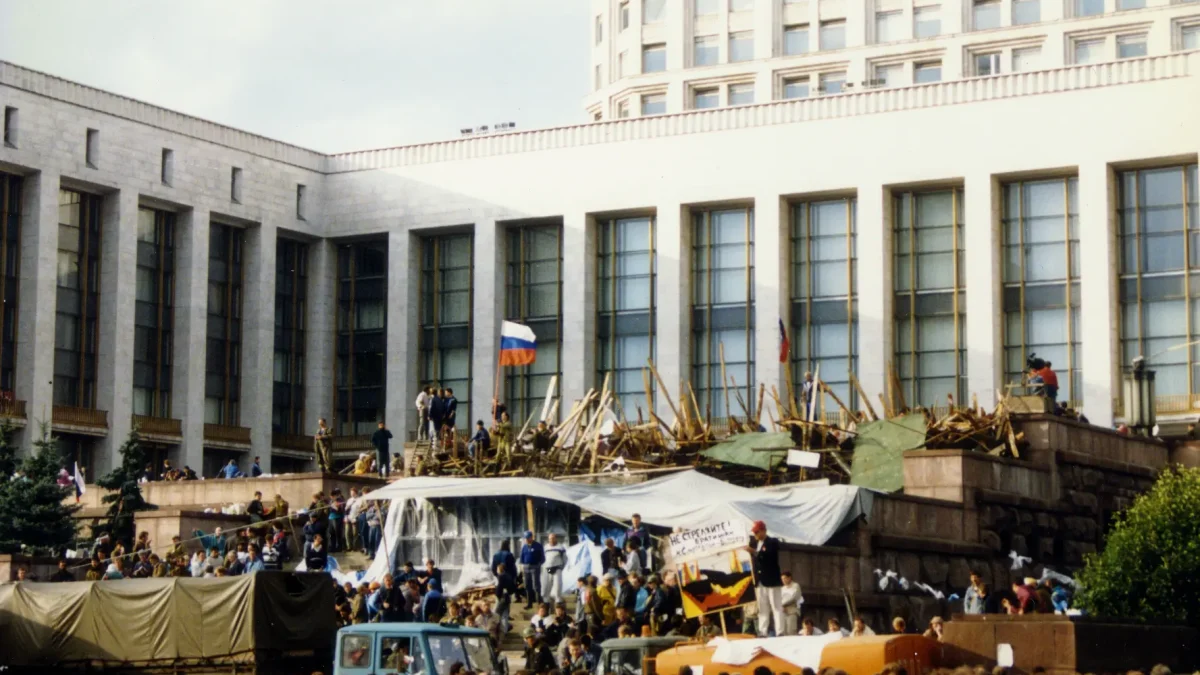
Faced with growing separatism, Gorbachev sought to restructure the Soviet Union into a less centralised state. On 20 August 1991 the Russian republic was due to sign a New Union Treaty that would have turned the country into a federation of independent republics with a common president, foreign policy and military. On 19 August Gorbachev's vice president, Gennady Yanayev, Prime Minister Valentin Pavlov, Defence Minister Dmitry Yazov, KGB chief Vladimir Kryuchkov and other senior officials formed the "General Committee on the State Emergency" to prevent it. It put Gorbachev, who was on holiday in Foros, Crimea, under house arrest and cut off his communications, and it suspended political activity and banned most newspapers. Thousands of Muscovites came out to defend the White House, the seat of the Russian parliament and of Boris Yeltsin's office, and Yeltsin rallied opposition by making speeches from atop a tank. Special forces took up positions near the building, but members refused to storm it, and the coup leaders neglected to jam foreign news broadcasts, so many Muscovites watched events live on CNN. After three days, on 21 August 1991, the coup collapsed, and Gorbachev was reinstated as president but with his power much depleted. On 24 August he resigned as general secretary of the party and dissolved all party units in the government.
The Final Months
On 24 August 1991, the day Gorbachev resigned as party leader, the Supreme Soviet of the Ukrainian republic passed a Declaration of Independence and called a national referendum on independence. Five days later the Supreme Soviet of the Soviet Union indefinitely suspended all party activity on Soviet territory, effectively ending Communist rule and dissolving the only remaining unifying force in the country. Gorbachev set up a State Council on 5 September, designed to bring him and the highest officials of the remaining republics into a collective leadership, but it never functioned properly. The Soviet Union collapsed with dramatic speed in the last quarter of 1991: between August and December ten republics seceded from the union, largely out of fear of another coup, and by the end of September Gorbachev no longer had the ability to influence events outside Moscow. The Soviet Union recognised the independence of the Baltic republics on 6 September 1991, and on 17 September Estonia, Latvia and Lithuania were admitted to the United Nations. On 6 November Yeltsin, who by then had taken over much of the Soviet government, issued a decree banning Communist Party activities on Russian territory.
The Belovezha Accords
On 8 December 1991 the leaders of the three founding republics, the Russian SFSR, the Byelorussian SSR and the Ukrainian SSR, signed the Belovezha Accords and declared that the Soviet Union no longer existed. Eight more republics joined the declaration soon after. The Accords also established the Commonwealth of Independent States to replace the Soviet Union as a community. Kazakhstan was the last republic to declare independence, on 16 December. All post-Soviet states except Georgia and the Baltic states joined the Commonwealth on 21 December by signing the Alma-Ata Protocol. Russia, as by far the largest and most populous republic, became the recognised successor state of the Soviet Union.
The Last Days
On 25 December 1991 Gorbachev resigned and transferred his presidential powers, including control of the nuclear launch codes, to the Russian president, Boris Yeltsin. That evening the Soviet flag was lowered from the Moscow Kremlin for the last time and replaced with the Russian tricolour. The following day the Soviet of the Republics, the upper chamber of the Supreme Soviet, formally dissolved the Soviet Union by adopting Declaration No. 142-N.
Aftermath
After the Cold War several of the post-Soviet states retained close links with Russia and formed multilateral organisations such as the Commonwealth of Independent States and the Collective Security Treaty Organization. A few, notably the Baltic states, moved out of the Russian sphere of influence and towards the West.
Why It Matters
The end of the Soviet Union ended the bipolar order that had defined world politics for four decades and created 15 independent states. It transformed Europe, ended the nuclear standoff between two superpowers in its previous form and opened questions about borders, minorities and security that continue to shape international politics, from the Baltic to Central Asia. It also remains a subject of debate: whether the collapse was inevitable, how much it owed to reform and how much to the pressure of nationalism and economic failure, and what its legacy means for the states that emerged from it.