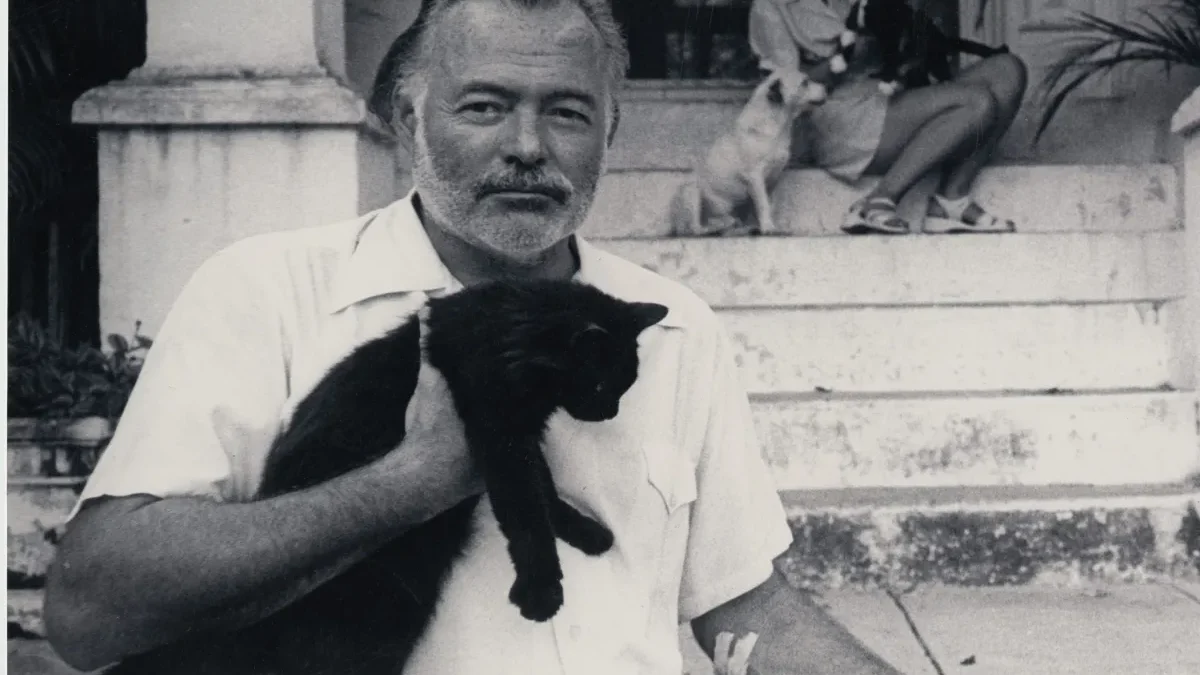
Ernest Hemingway (Ernest Miller Hemingway, 21 July 1899 to 2 July 1961) was an American novelist, short-story writer and journalist. Known for an economical, understated style that influenced later twentieth-century writers, he was romanticised for his adventurous lifestyle and blunt public image. Some of his seven novels, six short-story collections and two non-fiction works have become classics of American literature, and he was awarded the 1954 Nobel Prize in Literature. He died by suicide at his house in Ketchum, Idaho. This biography follows his life and writing.
Ernest Hemingway at a Glance
| Full name | Ernest Miller Hemingway |
| Born | 21 July 1899, Oak Park, Illinois, United States |
| Died | 2 July 1961, Ketchum, Idaho, United States (aged 61) |
| Profession | Novelist, short-story writer and journalist |
| Best-known works | The Sun Also Rises, A Farewell to Arms, For Whom the Bell Tolls, The Old Man and the Sea |
| Major awards | Pulitzer Prize for Fiction (1953), Nobel Prize in Literature (1954) |
| Wives | Hadley Richardson, Pauline Pfeiffer, Martha Gellhorn and Mary Welsh |
| Wartime service | Ambulance driver on the Italian Front in World War I |
Childhood in Oak Park
Hemingway was born in Oak Park, Illinois, an affluent suburb just west of Chicago, the second of six children of Clarence Edmonds Hemingway, a physician, and Grace Hall Hemingway, a musician. His mother taught him to play the cello, and later he said that his music lessons contributed to his writing style, as seen in the "contrapuntal structure" of For Whom the Bell Tolls. His father taught him woodcraft during the family's summers at Windemere on Walloon Lake in Michigan, where he learned to hunt, fish and camp, and these experiences gave him a lifelong passion for outdoor adventure and for living in remote places.
School and the Kansas City Star
At Oak Park and River Forest High School, between 1913 and 1917, Hemingway competed in boxing, track and field, water polo and football, played in the school orchestra and edited the school newspaper and yearbook. After leaving school he worked as a cub reporter for The Kansas City Star. He stayed only six months, but the newspaper's style guide, which said "Use short sentences. Use short first paragraphs. Use vigorous English. Be positive, not negative", became a foundation for his prose.
World War I
Hemingway wanted to go to war and tried to enlist in the US Army but was rejected because of poor eyesight. Instead he signed on as an ambulance driver with the American Red Cross in Italy, and he arrived at the Italian Front in June 1918. On 8 July, at Fossalta di Piave, he was seriously wounded by mortar fire shortly after bringing chocolate and cigarettes to men at the front line. Despite his wounds he helped Italian soldiers to safety and was decorated with the Italian Silver Medal of Military Valor. He was only 18. He later said: "When you go to war as a boy you have a great illusion of immortality. Other people get killed; not you." He suffered severe shrapnel wounds to both legs, and his return home in 1919 was a difficult time of readjustment.
Paris and the Lost Generation
After working in Toronto and Chicago, Hemingway married Hadley Richardson, who was eight years older than he was, on 3 September 1921. Two months later he signed on as a foreign correspondent for the Toronto Star, and in 1921 the couple moved to Paris, where he was influenced by the modernist writers and artists of the "Lost Generation" of expatriates. His debut novel, The Sun Also Rises, was published in 1926. In 1928 he returned to the United States and settled in Key West, Florida, and his experiences in the war supplied the material for his 1929 novel A Farewell to Arms.
Spain, Cuba and the Second World War
In 1937 Hemingway went to Spain to cover the Spanish Civil War, which formed the basis for his 1940 novel For Whom the Bell Tolls, written in Havana, Cuba. During the Second World War he was present with Allied troops as a journalist at the Normandy landings and at the liberation of Paris. In 1944 Collier's made him its front-line correspondent, and he was in Europe from May 1944 to March 1945.
The Old Man and the Sea and the Nobel Prize
His novella The Old Man and the Sea, published in 1952, was widely acclaimed and won the Pulitzer Prize for Fiction. Hemingway called his writing style the iceberg theory: the facts float above water, while the supporting structure and symbolism operate out of sight. In 1954 he was awarded the Nobel Prize in Literature. He was seriously injured in two plane crashes during a trip to Africa in the same year, which left him in pain and ill health for much of the rest of his life.
Marriages and Family
Hemingway was married four times, to Hadley Richardson, Pauline Pfeiffer, Martha Gellhorn and Mary Welsh. Pauline Pfeiffer, the daughter of a wealthy Catholic family in Arkansas, came to Paris to work for Vogue and joined the Hemingways in January 1926; Martha Gellhorn, a journalist and writer whom he had met in Key West a year earlier, accompanied him to Spain in 1937. He met Mary Welsh, a Time magazine correspondent, in London in 1944. In Paris, Gertrude Stein became his mentor and the godmother of his son Jack, and she introduced him to the expatriate artists and writers of the Montparnasse Quarter, whom she called the "Lost Generation", a term Hemingway popularised. In Cuba he and Martha rented Finca Vigia, a 15-acre property 15 miles from Havana.
Death
Hemingway underwent three electroshock treatments in the spring of 1961, was released at the end of June and was home in Ketchum, Idaho, on 30 June. Two days later, in the early hours of 2 July 1961, he took his own life, less than three weeks before his 62nd birthday. His memoir of his years in Paris, A Moveable Feast, was published after his death.
Legacy
Hemingway's influence on English-language prose is hard to overstate. His short sentences, understated emotion and technique of leaving the most important things unsaid, were imitated by generations of writers. His books remain in print around the world, and his life, with its wars, safaris and fishing trips, has become part of American legend.