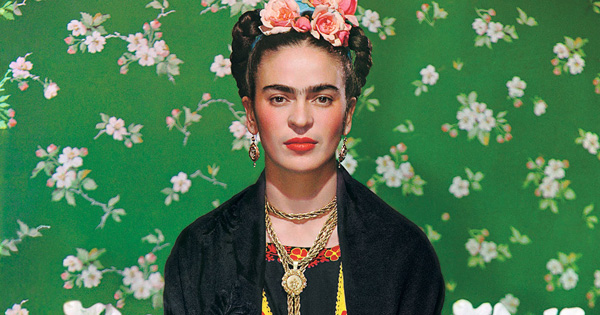
Frida Kahlo (Magdalena Carmen Frida Kahlo y Calderon, 6 July 1907 to 13 July 1954) was a Mexican painter known for her striking self-portraits, her use of bright colour and her exploration of identity, the human body and death. She was born and died in the same house in Coyoacan, in Mexico City, and she spent much of her life in physical pain. Her work, which draws on Mexican folk art, has made her one of the most recognised artists in the world. This biography follows her life and her work.
Frida Kahlo at a Glance
| Full name | Magdalena Carmen Frida Kahlo y Calderon |
| Born | 6 July 1907, Coyoacan, Mexico City, Mexico |
| Died | 13 July 1954, Coyoacan, Mexico City (aged 47) |
| Profession | Painter |
| Style | Self-portraiture, Mexican folk art, Surrealist-influenced symbolism |
| Best-known works | The Two Fridas, The Broken Column, Self-Portrait with Thorn Necklace and Hummingbird |
| Spouse | Diego Rivera (married 1929, divorced 1939, remarried 1940) |
| Home and museum | La Casa Azul (the Blue House), Coyoacan |
| Output | Mostly small self-portraits |
Childhood and Illness
Frida Kahlo was born in Coyoacan, then a village outside Mexico City, to Guillermo Kahlo, a German-born photographer, and Matilde Calderon y Gonzalez, who was of Mexican descent. She later claimed to have been born on 7 July 1910, the year the Mexican Revolution began, calling herself a "daughter of the revolution". She contracted polio in 1913, which left her disabled.
The Accident That Changed Her Life
In 1922 Kahlo entered the National Preparatory School in Mexico City, one of the few girls to be admitted, and she planned to study medicine. On 17 September 1925, when she was 18, the bus on which she was travelling collided with a streetcar. She was seriously injured, with fractures to her spine, pelvis and leg, and she spent months recovering in bed. To help her pass the time, her mother had a special easel made so that she could paint lying down, and a mirror was fixed above her bed so that she could use herself as a model. The accident left her with chronic pain and many operations throughout her life, and it set her on the path to becoming an artist.
Meeting Diego Rivera
Kahlo became involved in left-wing politics and the Mexican Communist Party, and she showed her paintings to the muralist Diego Rivera, who was one of the most famous artists in Mexico. He encouraged her work, and the two married in 1929. Their relationship was stormy, marked by infidelity on both sides. Both she and Rivera had affairs; in New York, for example, Kahlo continued a relationship with the photographer Nickolas Muray. The couple divorced in 1939 and remarried in 1940.
Detroit, New York and the Retablo Tradition
Between the late 1920s and early 1930s Kahlo travelled with Rivera in Mexico and the United States, and during this period she developed her artistic style. In Detroit she turned to votive images, or retablos, religious paintings made on small metal sheets by amateur artists to thank saints for their blessings during a calamity, a medium that was the opposite of the large mural, which was popular in Mexican art at the time. Among the works she made in this manner in Detroit are Henry Ford Hospital (1932), My Birth (1932) and Self-Portrait on the Border of Mexico and the United States (1932). Most of her paintings were self-portraits of relatively small size.
Painting and Style
Kahlo said that she painted herself because she was often alone and because she was the subject she knew best. Her paintings combine realism with symbolism, often drawing on Mexican folk art, and they depict physical suffering, miscarriage and heartbreak with striking directness. In The Two Fridas (1939), painted around the time of her divorce, two versions of the artist sit side by side, one in European dress and the other in traditional Mexican costume. The Broken Column (1944) shows her torso split open to reveal a broken classical pillar in place of her spine. Self-Portrait with Thorn Necklace and Hummingbird (1940) is one of her best-known images. Three exhibitions featured her works in 1940: the fourth International Surrealist Exhibition in Mexico City, the Golden Gate International Exposition in San Francisco, and Twenty Centuries of Mexican Art at the Museum of Modern Art in New York. Throughout the 1940s she took part in exhibitions in Mexico and the United States and worked as an art teacher at the Escuela Nacional de Pintura, Escultura y Grabado, known as La Esmeralda, and she was a founding member of the Seminario de Cultura Mexicana. She is often associated with Surrealism, although she said that she painted her own reality and not her dreams.
International Recognition
Her paintings raised the interest of the Surrealist artist Andre Breton, who arranged her first solo exhibition at the Julien Levy Gallery in New York in 1938. The show was a success and was followed by another in Paris in 1939. The French exhibition was less successful, but the Louvre purchased one of her paintings, The Frame, which made her the first Mexican artist to be featured in the museum's collection. Her first solo exhibition in Mexico was held in 1953, shortly before her death.
Health and Death
Kahlo's health declined in the 1950s, and an attempted surgery to support her spine failed. She was in constant pain and took painkillers. She died on 13 July 1954, a week after her 47th birthday, at La Casa Azul, the house where she was born. The official cause of death was pulmonary embolism, although no autopsy was performed. She was 47 years old, and her ashes are displayed in a pre-Columbian urn at La Casa Azul.
La Casa Azul and Legacy
In 1958 the Blue House was opened as a museum, the Frida Kahlo Museum, and it is now one of the most visited museums in Mexico. Her work remained relatively unknown until the late 1970s, when it was rediscovered by art historians and political activists, and by the early 1990s she had become a recognised figure in art history. The Tate Modern considers her one of the most significant artists of the twentieth century. In the decades after her death, interest in her work grew, especially with the rise of feminist art history and with Julie Taymor's 2002 film Frida, in which Salma Hayek played the artist, and which earned six Academy Award nominations. Kahlo's image has become a global symbol of resilience and of Mexican identity, and her self-portraits are among the most reproduced works in modern art. Her 1940 painting The Dream (The Bed) sold for 54.7 million US dollars in 2025, a record for a work by a woman at auction.