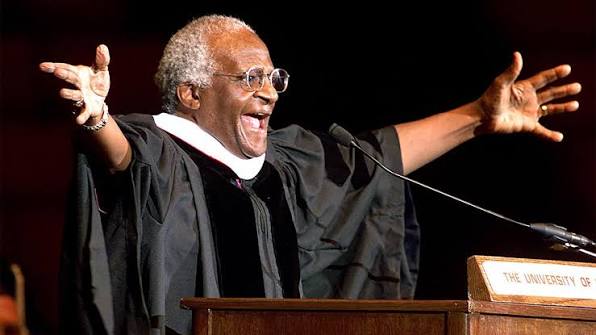
Desmond Tutu (7 October 1931 to 26 December 2021) was a South African Anglican bishop and theologian, known for his work as an anti-apartheid and human rights activist. He was Bishop of Johannesburg from 1985 to 1986 and then Archbishop of Cape Town from 1986 to 1996, in both cases the first black African to hold the position. He won the Nobel Peace Prize in 1984 and later chaired the Truth and Reconciliation Commission. This biography follows his life, his activism and his legacy.
Desmond Tutu at a Glance
| Full name | Desmond Mpilo Tutu |
| Born | 7 October 1931, Klerksdorp, Transvaal, South Africa |
| Died | 26 December 2021 (aged 90) |
| Profession | Anglican priest, bishop, theologian and human rights activist |
| Church posts | Dean of Johannesburg (1975); Bishop of Lesotho (1976); Bishop of Johannesburg (1985); Archbishop of Cape Town (1986 to 1996) |
| Nobel Prize | Peace, 1984 |
| Wife | Nomalizo Leah Shenxane (married 1955) |
| Other roles | Chair of the Truth and Reconciliation Commission; Chair of The Elders (2007 to 2013) |
Childhood in Klerksdorp
Desmond Mpilo Tutu was born on 7 October 1931 in Klerksdorp, in the Transvaal, to a poor family of mixed Xhosa and Motswana heritage. His father, Zachariah Zelilo Tutu, became the principal of a Methodist school, and his mother, Aletta, worked as a cook. He later said that although the family was not affluent, it was not destitute either. Tutu was sickly from birth, and polio atrophied his right hand. Two of his brothers died in infancy. He developed a love of reading and served as an altar boy at St Francis Anglican Church.
He entered the Johannesburg Bantu High School in 1945, where he excelled academically and developed a lifelong love of rugby. To earn money he sold oranges and worked as a caddie for white golfers. He secured admission to study medicine at the University of the Witwatersrand, but his parents could not afford the tuition, and he instead trained as a teacher on a government scholarship at Pretoria Bantu Normal College in 1951.
Teaching and Marriage
In 1954 Tutu began teaching English at Madibane High School, and the following year he moved to Krugersdorp High School, where he taught English and history. He courted Nomalizo Leah Shenxane, who was studying to become a primary school teacher, and they were legally married in June 1955. In 1953 the National Party government had introduced the Bantu Education Act to extend apartheid to schooling, and Tutu and his wife, disliking the law, left the teaching profession.
Joining the Clergy
With the support of the priest Trevor Huddleston, Tutu chose to become an Anglican priest. His request to join the Ordinands Guild was initially turned down in January 1956 because of his debts, which were then paid by the industrialist Harry Oppenheimer. In December 1960 he was ordained as an Anglican priest. In 1962 he moved to the United Kingdom to study theology at King's College London, where he and his family felt liberated by a life free of South Africa's apartheid and pass laws. He later completed a master's degree on Islam in West Africa and served as a curate in Surrey. He returned to southern Africa in 1966 and taught at the Federal Theological Seminary.
Rising Against Apartheid
In March 1975 Tutu was elected dean of St Mary's Cathedral in Johannesburg, the first black man to hold that position. He used it to speak out on social issues, publicly endorsing an international economic boycott of South Africa. In 1976 he was elected Bishop of Lesotho, and later he became general secretary of the South African Council of Churches, a post in which he condemned apartheid as evil and unchristian when giving evidence to a government commission. His outspokenness made him a leading voice against apartheid, popular among South Africa's black majority and internationally admired, although many white South Africans considered him too radical, and some anti-apartheid activists thought him too moderate.
Nobel Peace Prize
In New York in 1984 Tutu learned that he had won the Nobel Peace Prize, after earlier nominations in 1981, 1982 and 1983. The Nobel committee wanted to recognise a South African and thought Tutu a less controversial choice than Nelson Mandela or Mangosuthu Buthelezi. In December he attended the award ceremony in Oslo, which was hampered by a bomb scare. The prize gave his campaign a global platform.
Archbishop of Cape Town
In 1985 Tutu became Bishop of Johannesburg, and in 1986 Archbishop of Cape Town, the most senior position in southern Africa's Anglican hierarchy and the first time a black African held it. He emphasised a consensus-building model of leadership, oversaw the introduction of female priests, and also became president of the All Africa Conference of Churches. After President F. W. de Klerk released Nelson Mandela, Tutu helped to promote negotiations, and in November 1990 he organised a summit of church and black political leaders to try to calm violence between the ANC and Inkatha.
The Truth and Reconciliation Commission
Tutu popularised the term Rainbow Nation as a metaphor for post-apartheid South Africa after 1994. He had first used the idea in 1989 when describing a multiracial protest crowd as the rainbow people of God. After the end of apartheid, the government faced the question of how to respond to human rights abuses committed by both the state and anti-apartheid activists. A Truth and Reconciliation Commission was established, and Tutu chaired it from 1996 to 1998. He practised what liberation theologians call critical solidarity, offering support for democratic forces while reserving the right to criticise his allies, including Mandela.
The Elders and Later Activism
In January 1997 Tutu was diagnosed with prostate cancer, and he publicly revealed his diagnosis to encourage other men to have prostate exams. He faced recurrences in 1999 and 2006. In July 2007 he became chair of The Elders, a group of world leaders brought together to tackle some of the world's toughest problems, and he served in that role until May 2013. In 2009 he helped establish the Solomon Islands' Truth and Reconciliation Commission, modelled on South Africa's, and he later called for fossil fuel divestment, comparing it to disinvestment from apartheid-era South Africa.
Controversies
Tutu attracted controversy throughout his career. He was criticised by some activists as too moderate, by many white South Africans as too radical, and by Jewish groups, which accused him of making antisemitic statements. These disputes are part of the record of a man who spoke bluntly, and who did not always please his allies.
Family and Death
Tutu was married to Nomalizo Leah Tutu for more than six decades, and they had several children. He divided his later life between homes in Soweto and Cape Town. He died on 26 December 2021, at the age of 90. His public life was defined by a conviction that reconciliation requires truth, and by his insistence that oppression diminishes both the oppressed and the oppressor.
Legacy
Desmond Tutu helped to change the moral argument about apartheid at home and abroad, and the truth commission he chaired became a model that other countries studied. His phrase Rainbow Nation remains a part of South Africa's national vocabulary, and his example as a church leader who combined prayer with protest continues to inspire those who work for human rights and peace.