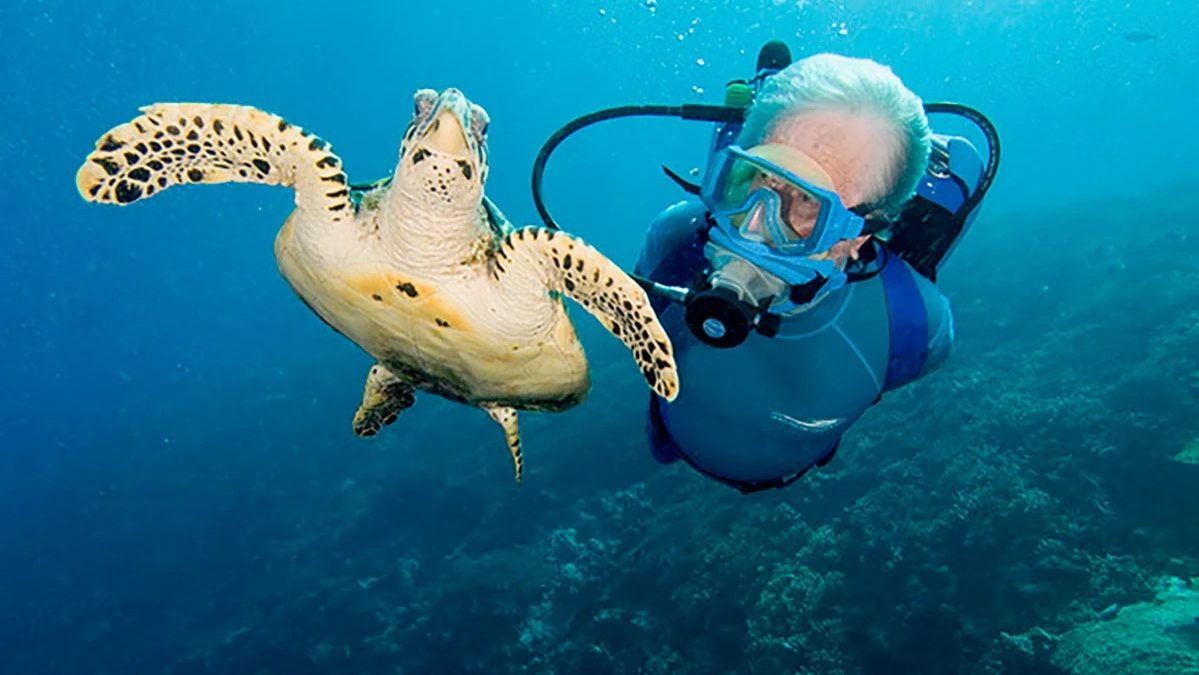
Jacques-Yves Cousteau (11 June 1910 to 25 June 1997) was a French naval officer, oceanographer, filmmaker and author. He co-invented the first successful open-circuit self-contained underwater breathing apparatus, the Aqua-Lung, which helped him produce some of the first underwater documentaries. His films and television series brought the underwater world to millions of viewers, and he later became a prominent voice for the protection of the oceans. This biography follows his life, his expeditions and his legacy.
Jacques Cousteau at a Glance
| Full name | Jacques-Yves Cousteau |
| Born | 11 June 1910, Saint-André-de-Cubzac, Gironde, France |
| Died | 25 June 1997, Paris (aged 87) |
| Profession | Naval officer, oceanographer, filmmaker and author |
| Known for | Co-inventing the Aqua-Lung; the research ship Calypso |
| Film | The Silent World (Palme d'Or at Cannes, 1956) |
| Television | The Undersea World of Jacques Cousteau (1966 to 1976) |
| Organisation | The Cousteau Society (founded 1973) |
| Honour | Presidential Medal of Freedom (1985) |
Early Life
Cousteau was born on 11 June 1910 in Saint-André-de-Cubzac in the Gironde region of France, to Daniel Cousteau and Élisabeth Duranthon. He had one brother, Pierre-Antoine. After preparatory studies in Paris he entered the École navale in 1930 and graduated as a gunnery officer. An automobile accident that broke both his arms cut short his career in naval aviation. In Toulon, where he served on the Condorcet, he carried out his first underwater experiments in 1936 using goggles lent by his friend Philippe Tailliez. He also belonged to the information service of the French Navy and was sent on missions to Shanghai and Japan between 1935 and 1938 and to the USSR in 1939.
On 12 July 1937 he married Simone Melchior, his business partner, and they had two sons, Jean-Michel, born in 1938, and Philippe, born in 1940. His sons took part in the adventures of the Calypso. In 1991, six months after Simone's death from cancer, he married Francine Triplet, with whom he already had a daughter, Diane, born in 1980, and a son, Pierre-Yves, born in 1982.
The Aqua-Lung
The years of the Second World War were decisive for the history of diving. After the armistice of 1940, Cousteau's family took refuge in Megève. In 1943 he made the film Épaves, or Shipwrecks, in which he used two of the very first Aqua-Lung prototypes, made by the company Air Liquide following instructions from Cousteau and the engineer Émile Gagnan. Cousteau is credited with improving the design that gave birth to the open-circuit scuba technology used today. According to his first book, he started diving with goggles in 1936 and in 1939 used a breathing apparatus invented in 1926 by Commander Yves le Prieur, but he was not satisfied with the length of time he could spend underwater with it, which led to the work with Gagnan.
Underwater Research and Archaeology
In 1946 Cousteau and Tailliez showed Épaves to Admiral Lemonnier, who gave them the responsibility of setting up the French Navy's underwater research group in Toulon. In 1948 the small team made a campaign in the Mediterranean aboard the sloop Élie Monnier and explored the Roman wreck of Mahdia in Tunisia, the first underwater archaeology operation using autonomous diving. In 1949 Cousteau left the French Navy. In 1950 he founded the French Oceanographic Campaigns and leased a ship called Calypso from Thomas Loel Guinness for a symbolic one franc a year. He refitted it as a mobile laboratory for field research and as his principal vessel for diving and filming.
The Silent World
In 1953 Cousteau published his first book, The Silent World: A Story of Undersea Discovery and Adventure, written with Frédéric Dumas. In it he suggested that porpoises had the ability to echolocate, after noticing that a group followed his ship through the Strait of Gibraltar. It was adapted as an underwater documentary co-directed with Louis Malle, one of the first films to use underwater cinematography to document the ocean depths in colour, and it won the 1956 Palme d'Or at the Cannes Film Festival. In 1957 he became director of the Oceanographic Museum of Monaco, and he was admitted to the United States National Academy of Sciences. From 1959 to 1973 he served as the inaugural president of the Confédération Mondiale des Activités Subaquatiques.
Living Under the Sea
In the 1960s Cousteau was involved with three projects to build underwater villages, called Conshelf I in 1962, Conshelf II in 1963 and Conshelf III in 1965. Each aimed at increasing the depth at which people could live and work on the seafloor. In 1959 he took part in inventing a diving saucer, the SP-350, which allowed exploration of the ocean floor. In October 1960 he and other French scientists publicly opposed plans by the French atomic energy commission to dump a large amount of radioactive waste in the Mediterranean, an early example of his environmental activism.
Television
A meeting with American television companies created the series The Undersea World of Jacques Cousteau, which ran from 1966 to 1976, with the commander in the red bonnet as its central character. A second series, The Cousteau Odyssey, ran from 1977 to 1982 on public television stations in the United States. In 1970 he wrote The Shark: Splendid Savage of the Sea with his son Philippe.
The Cousteau Society and Conservation
In 1973, with his two sons and Frederick Hyman, he created the Cousteau Society for the Protection of Ocean Life. Tragedy struck the family on 28 June 1979, when his second son Philippe, his preferred and designated successor, died in a flying-boat crash in the Tagus River near Lisbon, and Cousteau was deeply affected. In 1985 President Ronald Reagan awarded him the Presidential Medal of Freedom. In 1992 he was invited to the United Nations conference on environment and development in Rio de Janeiro and became a regular consultant for the United Nations and the World Bank.
Death and Legacy
Cousteau died of a heart attack on 25 June 1997 in Paris, two weeks after his 87th birthday, and was buried in the family vault at Saint-André-de-Cubzac. The Cousteau Society and its French counterpart, both founded by him, are still active, and the society is trying to turn the original Calypso into a museum. His influence is visible in modern scuba diving, underwater filming and ocean conservation. His achievement was to persuade people to love what they had never seen and, by doing so, to protect it.