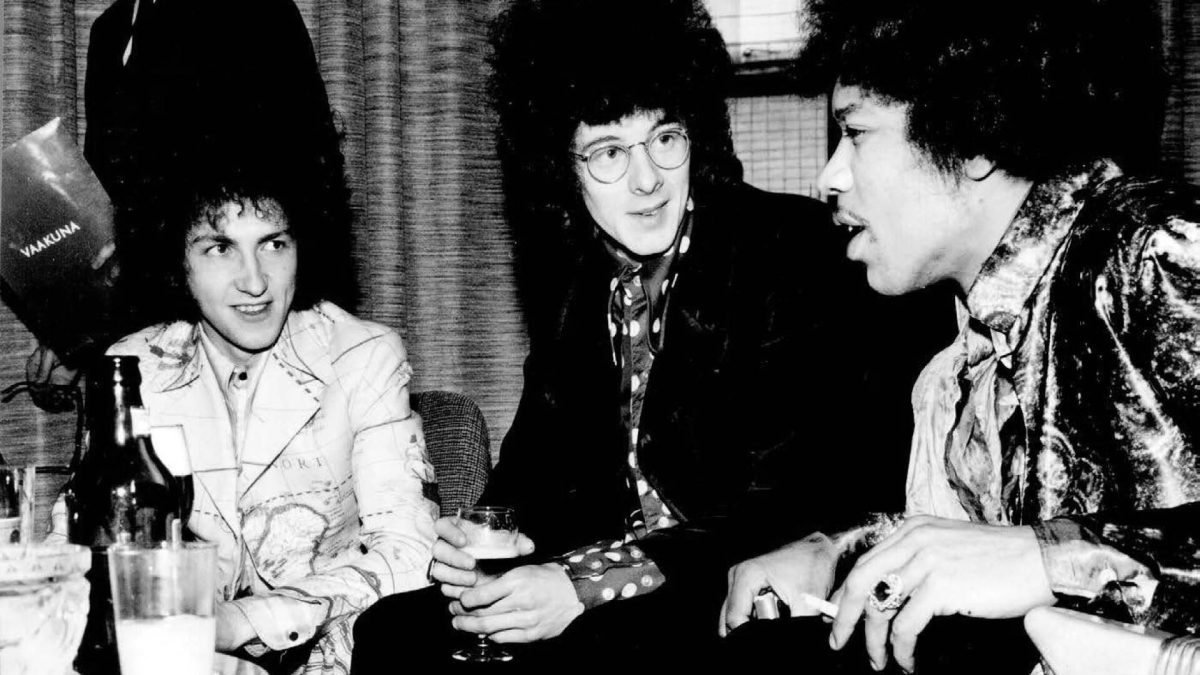
Jimi Hendrix (27 November 1942 to 18 September 1970) was an American guitarist and singer-songwriter who is widely regarded as one of the greatest and most influential guitarists of all time. Born Johnny Allen Hendrix in Seattle, he found fame in London in the late 1960s, conquered the United States after a celebrated performance at the Monterey Pop Festival, and headlined Woodstock in 1969. He died in London in September 1970, at the age of 27. This biography follows his life, music and legacy.
Jimi Hendrix at a Glance
| Full name | James Marshall "Jimi" Hendrix (born Johnny Allen Hendrix) |
| Born | 27 November 1942, Seattle, Washington, United States |
| Died | 18 September 1970, London, England (aged 27) |
| Profession | Guitarist, singer and songwriter |
| Band | The Jimi Hendrix Experience (with Noel Redding and Mitch Mitchell) |
| Best-known songs | Hey Joe, Purple Haze, The Wind Cries Mary |
| Key albums | Are You Experienced, Axis: Bold as Love, Electric Ladyland |
| Honour | Inducted into the Rock and Roll Hall of Fame in 1992 with the Experience |
Early Life in Seattle
Hendrix was born Johnny Allen Hendrix in Seattle on 27 November 1942, the first of Lucille Jeter's five children. His father, James Allen "Al" Hendrix, had been drafted into the US Army and was stationed in Alabama at the time of the birth. Al's parents had relocated to Vancouver, British Columbia, where he was born in 1919, and Al met Lucille at a dance in Seattle in 1941; they married on 31 March 1942 and he left for basic training three days later. In 1946 the boy's parents changed his name to James Marshall Hendrix, in honour of Al and his late brother Leon Marshall.
During his father's long absence, Lucille struggled to raise her son, and he was mostly cared for by family members and friends. The Hendrix family background, as described by biographers, was African-American with an alleged Cherokee ancestry. Hendrix began playing guitar at age 15, and the instrument soon became the centre of his life.
Army and the Chitlin' Circuit
In 1961 Hendrix enlisted in the US Army, but he was discharged the following year. Soon afterwards he moved to Clarksville and then Nashville, Tennessee, and began playing gigs on the Chitlin' Circuit, the network of venues that offered work to Black musicians in the segregated United States. He earned a place in the Isley Brothers' backing band and later played with Little Richard, with whom he continued to work until mid-1965. He then played with Curtis Knight and the Squires.
These years were an apprenticeship in showmanship and discipline. Hendrix learned to hold an audience, to play behind a lead singer and to survive on the road, and he absorbed the electric blues and rock and roll that inspired him. But he wanted a sound and a stage of his own, and that chance came when he was discovered in New York.
England and the Jimi Hendrix Experience
Hendrix moved to England in late 1966 after Chas Chandler, the bassist of the Animals, became his manager. Within months he formed the Jimi Hendrix Experience, with Noel Redding on bass and Mitch Mitchell on drums. The band achieved three UK top-ten hits: "Hey Joe", "Purple Haze" and "The Wind Cries Mary". London's music scene embraced the American guitarist, whose volume, feedback and flamboyant style were unlike anything the British public had seen.
His United States breakthrough came after the Monterey Pop Festival in 1967. The band's first US single, "Hey Joe", had failed to reach the Billboard Hot 100 on its release on 1 May 1967, but Paul McCartney recommended them to the festival's organisers, insisting that the event would be incomplete without Hendrix, whom he called "an absolute ace on the guitar". On 18 June 1967 Hendrix, introduced by Brian Jones as "the most exciting performer [he had] ever heard", opened with Howlin' Wolf's "Killing Floor" and closed the set by destroying his guitar and tossing pieces of it to the audience.
Albums and Studio Experimentation
The Experience released three studio albums: Are You Experienced, Axis: Bold as Love and Electric Ladyland. The last, released in 1968, became his most successful release and his only number-one album on the US Billboard 200. The recording of Electric Ladyland began as early as 20 December 1967 at Olympic Studios in London before moving in April 1968 to the newly opened Record Plant Studios in New York, with Chandler as producer and Eddie Kramer and Gary Kellgren as engineers.
The sessions were long and often chaotic. Chandler became frustrated with Hendrix's perfectionism and his demands for repeated takes, and with the many friends and guests who joined them in the studio, and he eventually severed his professional relationship with the guitarist. Redding had formed his own band, Fat Mattress, in mid-1968, and Hendrix played many of the bass parts himself. The cover stated that the album was "produced and directed by Jimi Hendrix". During the sessions he also experimented with other musicians, including Jefferson Airplane's Jack Casady and Traffic's Steve Winwood, who played bass and organ on the 15-minute slow-blues jam "Voodoo Chile".
Woodstock and the Final Years
By 1969 Hendrix was the world's highest-paid rock musician. In August he headlined the Woodstock Music and Art Fair, adding rhythm guitarist Larry Lee and conga players Juma Sultan and Jerry Velez to his line-up. His slot was moved to Monday morning, closing the show, and the band took the stage around 8:00 a.m., by which time Hendrix had been awake for more than three days. The audience, which had peaked at an estimated 400,000 people, had fallen to about 30,000. He introduced the group as "Gypsy Sun and Rainbows", and his performance included a rendition of "The Star-Spangled Banner" with copious feedback and distortion, which became one of the best-known moments in the festival's history.
After the Experience broke up he formed Band of Gypsys, set up Electric Lady Studios in New York and toured Europe. He also played the Isle of Wight Festival in 1970. His final year, like his career, was a mixture of creative drive and personal strain, with biographers noting episodes of alcohol and substance abuse.
Guitar Innovation and Influence
Hendrix favoured overdriven amplifiers with high volume and gain, and he was instrumental in popularising the previously undesirable sounds caused by guitar amplifier feedback. He was one of the first guitarists to make extensive use of tone-altering effects in mainstream rock, such as fuzz distortion, Octavia, wah-wah and Uni-Vibe, and he was the first musician to use stereophonic phasing effects in recordings. Rolling Stone wrote that Hendrix "pioneered the use of the instrument as an electronic sound source", turning effects like feedback and distortion into a controlled, fluid vocabulary as personal as the blues with which he began.
He also rejected the standard barre-chord technique used by most guitarists in favour of fretting the low sixth-string root notes with his thumb, a method he used at the start of "Little Wing" to sustain the root note of chords while playing melody. Musicologists regard this as one of the ways he broadened the vocabulary of the instrument.
Death in London
The details of Hendrix's last day are disputed. He spent much of 17 September 1970 in London with Monika Dannemann, the only witness to his final hours. She found him breathing but unconscious and unresponsive at around 11 a.m. and called an ambulance; he was pronounced dead at St Mary Abbots Hospital at 12:45 p.m. on 18 September. The coroner concluded that Hendrix had aspirated his own vomit and died of asphyxia while intoxicated with barbiturates, and, citing insufficient evidence of the circumstances, he declared an open verdict. Hendrix was 27 years old.
Legacy
The Rock and Roll Hall of Fame describes Hendrix as "arguably the greatest instrumentalist in the history of rock music", and he was inducted in 1992 as part of the Jimi Hendrix Experience. He has also been a role model for generations of young Black rock musicians, reclaiming a form of music pioneered by Black innovators such as Little Richard and Chuck Berry. More than five decades after his death, his recordings remain central to the history of rock, and his stage presence, from Monterey to Woodstock, is still an enduring image of the 1960s.