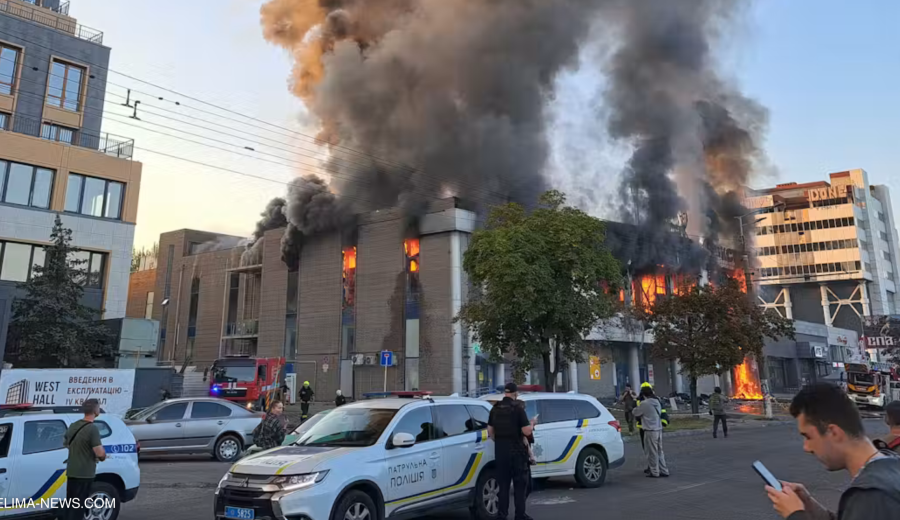
Two killed and dozens wounded in Kyiv as Russian drone attacks stretch into Thursday, while Ukraine’s president calls for tougher economic pressure on Moscow at the United Nations.
Russia launched a major wave of drone attacks against Kyiv on Wednesday, killing at least two people and injuring dozens, as Ukrainian President Volodymyr Zelenskyy urged world leaders to intensify economic pressure on Moscow and restrict the revenues sustaining its war effort.
The attacks, which began during daylight hours on September 23, continued into Thursday, September 24, with Russian ballistic missiles targeting the Ukrainian capital. Kyiv Mayor Vitali Klitschko urged residents to remain in shelters as emergency crews responded to incidents across the city.
According to The Guardian, at least 41 people were wounded in Kyiv, while the attacks also damaged buildings, warehouses and other infrastructure. Reuters reported that the number of injured had reached 45 by Wednesday evening, illustrating how casualty figures continued to change as rescue operations progressed.
The strikes came as Zelenskyy addressed the 81st United Nations General Assembly in New York, turning the latest bombardment into a stark backdrop to his appeal for international action against Russia.
Kyiv comes under sustained attack
The Russian assault was among the heaviest attacks on Kyiv in recent months, involving large numbers of drones, including faster, jet-powered models that are more difficult for Ukrainian air defences to intercept.
Explosions were heard across the capital, while plumes of black smoke rose above several districts. The strikes ignited fires and damaged residential and commercial areas, forcing emergency services to respond throughout the day and into the night. According to Reuters, Russian drones struck railway infrastructure, warehouses, fuel stations and a nine-storey non-residential building. A business centre was also hit.
The attack highlighted the growing challenge facing Ukraine’s air-defence network as Russia deploys different types of drones and missiles in sustained waves. The use of faster, higher-flying drones complicates interception and increases the pressure on Ukraine’s limited defensive resources.
The bombardment was not confined to Kyiv. In the eastern Donetsk region, Russian forces reportedly dropped four aerial bombs on the village of Oleksandrivka, killing five people and injuring six, according to regional governor Vadym Filashkin. The attacks underline the continued vulnerability of Ukrainian civilians and infrastructure despite repeated international calls for a ceasefire.
Zelenskyy urges the world to choke Russia’s revenues
Addressing the UN General Assembly, Zelenskyy called on governments to maintain and strengthen economic restrictions against Russia, arguing that revenue from international trade continues to finance Moscow’s military campaign. “Russia’s revenues must remain a target,” Zelenskyy told world leaders, according to The Guardian.
He argued that countries continuing to conduct business with Russia were indirectly providing the Kremlin with the resources needed to prolong the war. “When someone gives Russia more money through trade, they give this war more time,” he said.
The Ukrainian president urged nations to restrict trade with Russia and reduce the flow of revenue that Moscow can use to purchase weapons, maintain military operations and sustain its invasion.
His appeal reflects Kyiv’s continuing strategy of combining military resistance with economic pressure. Ukraine and its supporters have sought to limit Russia’s access to international finance, technology, energy markets and other sources of income.
However, the effectiveness of such restrictions remains a major international challenge, as Russia continues to trade with countries that have not joined Western sanctions.
Energy infrastructure and the threat of a harsh winter
Zelenskyy also warned that the coming winter could be particularly difficult for Ukraine if Russian attacks on energy infrastructure continue. Ukraine and its allies are seeking limited agreements to prevent strikes on energy facilities and Black Sea shipping before temperatures fall. Such arrangements could help protect electricity generation, heating systems and essential commercial activity.
Moscow, however, has shown little interest in broader negotiations to end the conflict. Zelenskyy warned that Ukraine would retaliate against Russian energy infrastructure if an agreement could not be reached.
“Ukrainians understand that this winter could be very harsh for us. But in response, we will have no choice but to make it painful for Russia too,” he said at the UN.
The warning signals that energy infrastructure could remain a central target for both sides as winter approaches. For Ukraine, protecting power stations and heating systems is essential to civilian survival, while attacks on Russian energy facilities could affect Moscow’s revenue and domestic energy supply. A limited energy ceasefire would not necessarily end the war, but it could reduce the immediate humanitarian consequences of the conflict.
Washington leaves door open to Putin talks
Amid the continuing fighting, the United States has indicated that diplomatic engagement with Russia remains possible. US Secretary of State Marco Rubio said Washington had invited Russian President Vladimir Putin to attend the December G20 meeting in Miami, Florida.
Rubio made the announcement after meeting Russian Foreign Minister Sergei Lavrov on the sidelines of the UN General Assembly. He said the invitation could provide Putin with an opportunity to engage with US President Donald Trump and other world leaders.
The Kremlin said Russia would consider the invitation. The development comes as efforts to negotiate an end to the war remain stalled. Although Washington has continued to pursue diplomatic channels, there has been little indication of a breakthrough in negotiations between Moscow and Kyiv.
For Ukraine, the prospect of renewed US-Russia engagement raises questions about the terms of any future settlement and the extent to which Kyiv’s security concerns would be addressed.
Ukraine strengthens international partnerships
Zelenskyy’s diplomatic efforts at the UN have also focused on expanding Ukraine’s defence partnerships. On Wednesday, he announced that Ukraine and Finland had signed a drone cooperation agreement with Finnish President Alexander Stubb.
The agreement is intended to combine Ukraine’s experience in drone warfare with the industrial capabilities of partner countries, strengthening their ability to develop and produce defence technology. Zelenskyy described the agreement as an important step towards protecting civilians and deepening bilateral cooperation.
Ukraine has increasingly sought partnerships that allow it to share its battlefield experience and expand access to military technology, particularly as drones have become a defining feature of the war.
Meanwhile, Australian Prime Minister Anthony Albanese announced an additional $60 million in support for Ukraine following a meeting with Zelenskyy in New York. These agreements demonstrate Kyiv’s efforts to secure continued international assistance while Russian attacks continue.
A war with no immediate end in sight
The latest bombardment of Kyiv underscores the distance between diplomatic efforts and conditions on the battlefield. While world leaders debate sanctions, ceasefires and negotiations at the United Nations, Ukrainian cities continue to face aerial attacks, civilian casualties and damage to critical infrastructure.
Zelenskyy’s appeal is aimed at preventing Russia from financing a prolonged military campaign and increasing the economic costs of continuing the war. But with Moscow showing little willingness to enter broader negotiations, and the prospect of another difficult winter approaching, Ukraine faces continued military and humanitarian challenges.
The coming weeks will test whether international pressure can produce meaningful progress towards limiting attacks on energy infrastructure and reopening negotiations. For now, the combination of Russian bombardment and Ukraine’s diplomatic campaign at the UN reflects a conflict in which military operations, economic pressure and international diplomacy remain closely intertwined.