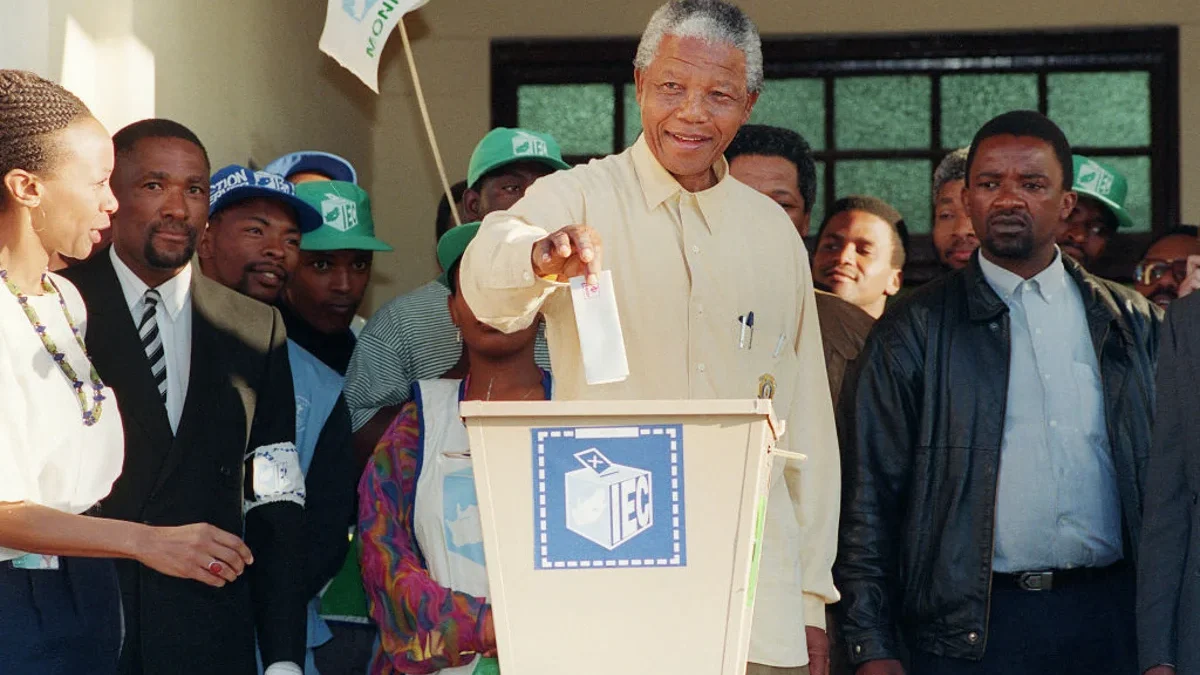
General elections were held in South Africa between 26 and 29 April 1994. They were the first elections in the country in which citizens of all races could vote, and they brought an end to the "herrenvolk democracy" that had existed since 1948 and marked the country's first election under universal suffrage. They were conducted under the direction of the Independent Electoral Commission and were the culmination of a four-year process that ended apartheid. Millions queued in lines over a four-day voting period, and altogether 19,726,579 votes were counted, with 193,081 rejected as invalid.
The Result
As widely expected, the African National Congress, whose slate included the trade union federation COSATU and the South African Communist Party, won a landslide victory, taking 62 per cent of the vote, just short of the supermajority required to amend the Interim Constitution unilaterally. As that document required, the ANC formed a Government of National Unity with the National Party and the Inkatha Freedom Party, the two other parties that won more than 20 seats in the National Assembly. The governing National Party polled just over 20 per cent and was thus eligible for a post of Vice President to the incumbent president, F. W. de Klerk. The first act of the new National Assembly was to elect Nelson Mandela as president, making him the country's first Black head of state, and he then appointed his Cabinet. 27 April is now a public holiday in South Africa, Freedom Day.
Apartheid
In 1948 the newly elected National Party government began to institute apartheid, a system of institutionalised racial segregation that placed political and social dominance in the hands of the white minority. Under the Population Registration Act of 1950 all South Africans were categorised as White, Black, Coloured or Indian. The vote was reserved for whites, interracial sexual relationships were forbidden and over 80 per cent of the land was reserved for the white minority. Members of the Black majority were stripped of citizenship under the Bantu Homelands Citizenship Act of 1970 and were made citizens of one of the country's "bantustans", territories reserved for various Black ethnic groups.
Pressure for Change
The South African government faced international condemnation against the backdrop of the decolonisation of Africa, and by the 1980s the state was struggling with major internal political violence, a war of independence in Namibia, intervention in Angola and a failing economy burdened by international sanctions and the heavy costs of national security, which effectively forced the government towards political reform. In 1983 P. W. Botha's government approved a new constitution that created a Tricameral Parliament, with additional houses for the Coloured and Indian populations, while Blacks remained unrepresented. Anti-apartheid groups reorganised under the United Democratic Front, and in 1985 the government introduced a sweeping state of emergency in response to growing civil unrest.
Mandela Freed
In 1989 F. W. de Klerk was elected State President, succeeding Botha. On 2 February 1990, in a speech at the opening of Parliament in Cape Town, he unexpectedly announced his intention to unban anti-apartheid groups such as the ANC, the South African Communist Party and the Pan Africanist Congress, to release political prisoners such as the ANC leader Nelson Mandela and to begin negotiations with the opposition. On 11 February Mandela was released from Victor Verster Prison in Cape Town, after 27 years in prison.
Negotiations
Formal negotiations between the ANC and the government were scheduled to begin on 11 April 1990, but on 26 March police opened fire on protesters in the township of Sebokeng, killing 11 people, and the ANC cancelled the talks. They were rescheduled for 2 to 4 May after an emergency meeting between Mandela and de Klerk, and the "talks about talks" at the Groote Schuur presidential estate were intended to settle terms before the more substantive constitutional negotiations. In a referendum on 17 March 1992, 68.3 per cent of voters voted "Yes" for the process to end the apartheid system. The second session of the Convention for a Democratic South Africa, CODESA 2, convened on 25 May 1992 but collapsed in deadlock. After massacres at Boipatong in June and Bhisho in September 1992, in which 29 people were killed, unofficial talks between Cyril Ramaphosa of the ANC and Roelf Meyer of the National Party led to the Record of Understanding on 26 September. On 1 and 2 April 1993 a new Multiparty Negotiating Process was first attended by 26 different organisations, and on 17 November 1993 a plenary meeting endorsed an interim constitution under which non-racial elections were to be held on 27 April 1994.
Violence
Before the transition South Africa suffered serious internal political violence, which intensified after the government's announcement of the negotiation process in 1990. It was perpetrated by various actors, including the state, anti-apartheid groups, bantustan authorities, Zulu supporters of the Inkatha Freedom Party and pro-apartheid white supremacist groups.
Election Days
Two days before the election a car bomb exploded in Johannesburg, killing nine people, and another went off the day before, injuring 13. The Conservative Party, the official opposition in the outgoing National Assembly, did not contest the election. There was some difficulty in organising the voting in rural areas, but people waited patiently for many hours amid a palpable feeling of goodwill, and an extra day was added to give everyone the chance to vote. After first announcing a boycott, the Inkatha Freedom Party reversed its decision on 19 April, days before the election, and it was added to the already-printed ballot papers by means of a sticker. International observers agreed that the elections were free and fair, although a report by the European Union criticised the Independent Electoral Commission's lack of preparedness, shortages of voting materials at many voting stations and the lack of effective safeguards against fraud in the counting. At midnight on 26 to 27 April 1994 the old "orange white blue" flag, adopted in 1928, was lowered and the old anthem Die Stem was sung, followed by the raising of the new flag and the singing of the other co-official anthem, Nkosi Sikelel' iAfrika. The 400 members of the National Assembly were chosen from party lists in proportion to each party's share of the national ballot, and the 90 members of the Senate were chosen, ten from each province, by the newly elected provincial legislatures.
Why It Matters
The 1994 election ended the system of white minority rule that had been in place since 1948, in a vote that followed four years of negotiations. It brought Nelson Mandela, who had spent 27 years in prison, to the presidency, and it created the Government of National Unity that guided the country through its transition. For many people around the world it became a symbol of the possibility of peaceful change.