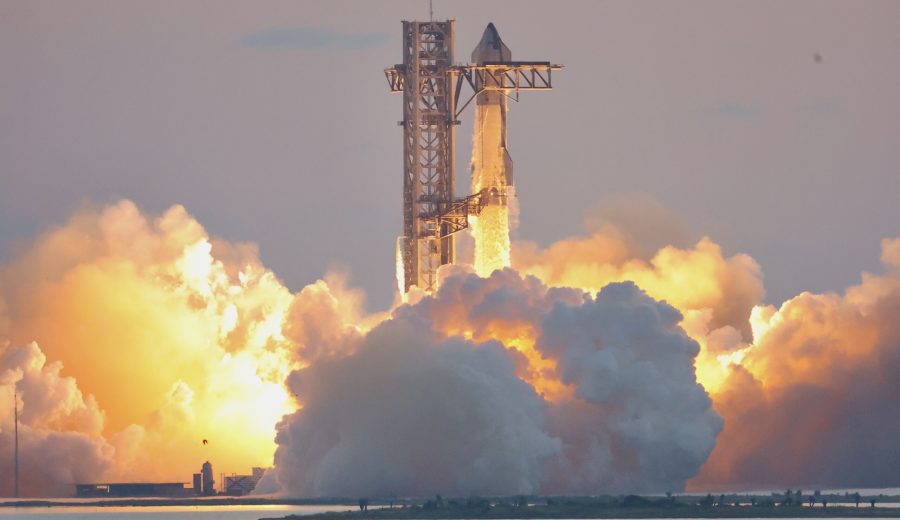
SpaceX’s Starship has reached orbit for the first time. On its 14th flight, the world’s most powerful rocket deployed 26 Starlink satellites and returned to a controlled splashdown in the Pacific three hours after launch, despite losing engines on the way up.
SpaceX’s Starship has reached orbit for the first time, after thirteen suborbital test flights.
The Super Heavy booster and Starship upper stage lifted off from Starbase, Texas, at 8:49 a.m. EDT on Monday, September 28, on the mission known as Starship Flight 14, Spaceflight Now reported.
What the Flight Achieved
- Starship climbed into a 180-mile-high orbit using two engine firings
- It deployed 26 third-generation Starlink internet satellites, the first operational satellites launched by the new rocket
- The Super Heavy booster flew back for a vertical splashdown a few miles off the Texas coast
- Starship made a controlled, tail-first splashdown in the Pacific Ocean north of Hawaii at 11:57 a.m. EDT
Engine Problems on the Way Up
The flight was not flawless. One of the booster’s 33 Raptor engines shut down early during the ascent, and a second apparently did so during the burn that turned the booster back towards the coast.
One of the upper stage’s six Raptor engines also shut down early. After assessing the data, the flight control team judged the spacecraft otherwise healthy and went ahead with the firing that completed the climb to orbit.
An Early Return
The mission had been expected to last six orbits, ending with a splashdown off the coast of Chile. Once the satellites were away, SpaceX controllers chose instead to bring the ship down well ahead of schedule.
As it neared the ocean, three engines reignited and the spacecraft flipped upright before settling into the water. As is usual with ocean splashdowns, it then tipped over and exploded as leftover propellant ignited.
The Rocket
The combined vehicle stands about 400 feet tall. Its first stage generates some 16 million pounds of thrust, which Spaceflight Now noted is twice the power of NASA’s Space Launch System Moon rocket.
Each of the new Starlink satellites has 10 times the capacity of the previous generation, according to the report.
Why NASA Is Watching
A variant of Starship is being built as the lander for NASA’s Artemis Moon programme, with the first such landing targeted for 2028.
“Gorgeous launch, getting Ship to orbit and managing every step in a safe, responsible, and especially inspirational way,” NASA Administrator Jared Isaacman wrote on X.
The task ahead remains large. A Moon mission will require up to 15 or so tanker flights to refuel the lander in orbit before it leaves for the Moon. Spaceflight Now reported that many observers doubt SpaceX can deliver a tested lander by 2028, and that NASA is funding an alternative lander designed by Blue Origin.
What Comes Next
SpaceX has two Starship pads at Starbase and three more under construction in Florida. The company plans its first launch from Florida late this year or early next.
The booster is designed to be caught by mechanical arms on its launch tower, which SpaceX has done four times. The upper stage is designed to be caught in the same way, but that has not yet been attempted.
Image: A Starship lifts off from Starbase on an earlier test flight, October 2024. Photo by Steve Jurvetson via Wikimedia Commons, CC BY 2.0.