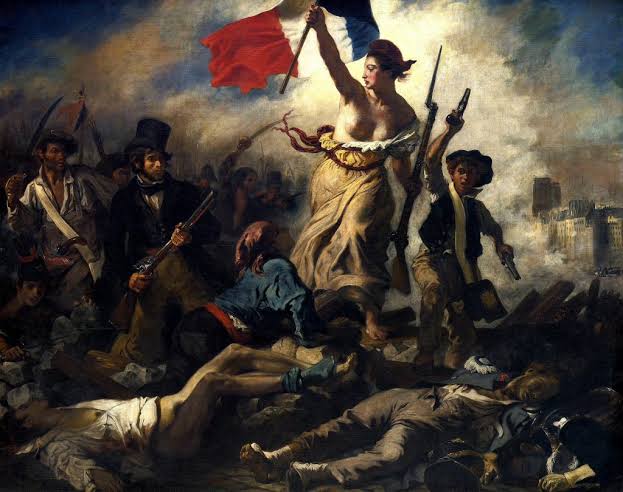
The Storming of the Bastille took place in Paris on 14 July 1789, when revolutionary insurgents attempted to storm and seize control of the medieval armoury, fortress and political prison known as the Bastille. After four hours of fighting and 94 deaths, the insurgents were able to enter. The governor of the Bastille, Bernard-Rene Jourdan de Launay, and several members of the garrison were killed after surrendering. At the time the Bastille represented royal authority in the centre of Paris. The prison contained only seven inmates when it was stormed and was already scheduled for demolition, but the revolutionaries saw it as a symbol of the monarchy's abuse of power. Its fall was the flashpoint of the French Revolution.
An Economic Crisis
During the reign of Louis XVI, France faced a major economic crisis, caused in part by the cost of intervening in the American Revolution and exacerbated by regressive taxes and by poor harvests in the late 1780s. The finance minister Calonne, who had replaced Jacques Necker, thought that lavish spending would secure loans by presenting the monarchy as wealthy, which only added to the king's financial woes.
The Estates General and the National Assembly
On 5 May 1789 the Estates General convened to deal with the issue, but it was held back by archaic protocols and by the conservatism of the Second Estate, representing the nobility, which made up less than 2 per cent of the population of France. On 17 June the Third Estate, whose representatives were drawn from the commoners, reconstituted itself as the National Assembly, a body whose purpose was the creation of a French constitution. The king initially opposed that development but was forced to acknowledge the authority of the assembly, which renamed itself the National Constituent Assembly on 9 July.
Paris on the Brink
Paris, close to insurrection and, in the words of the historian Francois Mignet, "intoxicated with liberty and enthusiasm", showed wide support for the Assembly. The press published the debates, and political debate spread beyond the Assembly into the public squares and halls of the capital. The Palais-Royal and its grounds became the site of an ongoing meeting, and a crowd broke open the Prisons of the Abbaye to release some 14 grenadiers of the French Guards who had reportedly been imprisoned for refusing to fire on the people. The rank and file of the regiment, which had been considered reliable, now leaned toward the popular cause.
The Dismissal of Necker
On 11 July 1789 Louis XVI, acting under the influence of the conservative nobles of his privy council, dismissed and banished Necker, who had been sympathetic to the Third Estate, and completely reconstituted the ministry. News of the dismissal reached Paris on the afternoon of 12 July, and Parisians generally presumed that it marked the start of a coup by conservative elements. They were further enraged by the fear that a concentration of royal troops, brought from frontier garrisons to Versailles, Sevres, the Champ de Mars and Saint-Denis, would try to shut down the Assembly, which was meeting at Versailles. Crowds gathered throughout Paris, including more than 10,000 at the Palais-Royal, where Camille Desmoulins rallied the crowd by mounting a table, pistol in hand, and calling on his fellow citizens to take up arms.
Looting, Cavalry and a Citizens' Militia
On 12 July Charles Eugene, Prince of Lambesc, unleashed a cavalry charge that dispersed the remaining protesters at the Place Louis XV, now the Place de la Concorde. The royal commander, Baron de Besenval, fearing a blood bath among the poorly armed crowds or defections among his own men, then withdrew the cavalry towards Sevres. Parisians attacked the customs posts that were blamed for higher food and wine prices and plundered places where food, guns and supplies might be hoarded. That night rumours spread that supplies were hoarded at Saint-Lazare, a large clerical property that functioned as a convent, hospital, school and jail, and a mob broke in and seized 52 wagons of wheat, which were taken to the public market. The Gardes Francaises, the permanent garrison of Paris, had many local ties and were favourably disposed to the popular cause, so the rebellious citizens now had a trained military contingent. On the morning of 13 July the electors of Paris agreed to recruit a "bourgeois militia" of 48,000 men from the 60 voting districts of the city, with blue and red cockades, the colours of Paris. The Marquis de Lafayette was elected its commander on 14 July and renamed it the National Guard, and on 27 July he added white to the cockade to make the famous French tricolour. White was the historic colour of the Bourbon monarchy, and his decision to keep it in the new symbol of national identity illustrates his aim of achieving a constitutional monarchy rather than a revolutionary republic.
The militia had stormed the Hotel des Invalides to gather the weapons held there, between 29,000 and 32,000 muskets, but without powder or shot. The commandant had taken the precaution of transferring 250 barrels of gunpowder to the Bastille for safer storage in the previous days, and so the fortress became the next target.
The Fall of the Fortress
On 14 July the insurgents moved against the Bastille, a fortress that held both an armoury and a prison. After four hours of fighting and 94 deaths the insurgents were able to enter, and the governor, de Launay, and several members of the garrison were killed after surrendering. The fortress had held only seven prisoners, and it was already scheduled for demolition, but the symbolism of the event was far greater than its military importance.
Bastille Day
In France, 14 July is a national holiday called the Fete nationale francaise, which commemorates both the anniversary of the storming of the Bastille and the Fete de la Federation, which took place on its first anniversary in 1790. In English it is commonly referred to as Bastille Day.
Why It Matters
The storming of the Bastille showed that the people of Paris were prepared to fight the king's soldiers and that royal authority could be broken by force. It turned a political dispute in the Assembly into a revolution that would abolish the old order in France, execute the king and send shockwaves through monarchies across Europe. The fortress that stood in the centre of Paris as a symbol of arbitrary power became a symbol of the revolution that overthrew it.