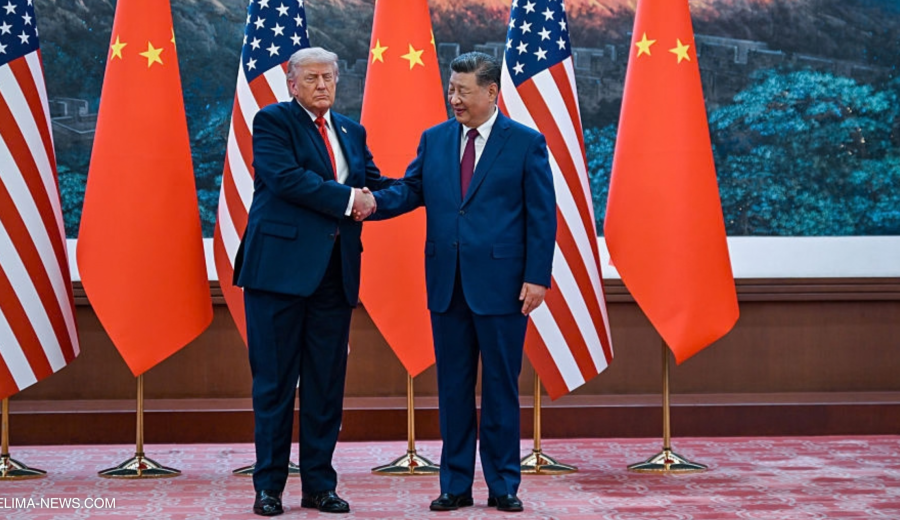
Donald Trump and Xi Jinping are meeting in Washington for their second face-to-face encounter of 2026, with trade, technology, Taiwan, critical minerals and the war involving Iran among the most sensitive issues on the agenda.
Chinese President Xi Jinping arrived in Washington on September 23 for a three-day state visit, where US President Donald Trump is hosting him at the White House on September 24. Xi’s visit is his first to the United States in more than a decade and comes at a critical moment for the relationship between the world’s two largest economies.
The meeting follows months of efforts by Washington and Beijing to stabilise relations after years of tariff disputes, technology restrictions and tensions over Taiwan. Rather than signalling the end of those disagreements, the summit is expected to focus on managing them while preserving economic ties.
Trade truce and tariffs
Trade is expected to be at the centre of the meeting. The United States and China have agreed to extend their existing trade truce until January 10, beyond its previous November 10 expiration date. The extension gives both governments additional time to negotiate wider economic arrangements and prevents an immediate return to the tariff escalation that had disrupted global supply chains.
Trump is also seeking greater Chinese purchases of American goods, particularly agricultural products and potentially Boeing aircraft. Washington has been pressing Beijing to fulfil earlier purchasing commitments, while China wants greater access to the US market and relief from restrictions affecting Chinese companies.
The two sides have also discussed establishing a Board of Trade covering non-sensitive goods and reciprocal tariff reductions involving roughly $30 billion of products. The details, however, remain under negotiation.
Rare earths and critical minerals
Another major issue is China’s control over critical minerals and rare-earth supply chains. These materials are essential to industries ranging from electric vehicles and electronics to aerospace, defence and artificial intelligence. Washington wants more reliable access to Chinese-controlled supplies, while Beijing is seeking assurances that the United States will not use technology and export controls to restrict China’s development.
Rare-earth exports have previously become a major bargaining tool in US-China trade disputes. Any understanding on supply stability could therefore have consequences well beyond the two countries, particularly for global manufacturers.
Artificial intelligence and technology
AI has emerged as a newer dimension of the US-China relationship. The two countries are simultaneously competing for technological leadership while confronting common risks from increasingly powerful AI systems. Ahead of the summit, US and Chinese officials discussed creating an AI dialogue, including a proposed notification mechanism for incidents involving serious national-security risks.
At the same time, Washington continues to restrict China’s access to some advanced technologies, while Beijing opposes what it regards as excessive US technology controls. The challenge is therefore twofold: establishing communication mechanisms to prevent dangerous incidents while maintaining intense competition over semiconductors, computing power and AI capabilities.
Taiwan remains a sensitive issue
Taiwan is likely to be among the most politically sensitive subjects discussed by Trump and Xi. China regards Taiwan as part of its territory and opposes US arms sales to the island. The United States maintains unofficial relations with Taiwan and remains its principal international arms supplier.
According to Reuters, Beijing is seeking clearer US language on Taiwan, while Washington is expected to maintain its longstanding position. Any change in US policy could have wider consequences for relations between Washington and its Asian allies. The issue therefore represents one of the sharpest differences between the two governments, even as they attempt to keep economic negotiations on track.
Iran and the wider geopolitical relationship
The war involving Iran adds another layer to the summit. China maintains close economic ties with Tehran and is a major buyer of Iranian oil. The Trump administration has been seeking greater Chinese cooperation on Iran, while Beijing has shown limited willingness to align itself with Washington’s approach.
US officials have indicated that China’s economic relationship with Iran will remain part of the broader discussions. The issue illustrates how the Trump-Xi relationship now extends beyond bilateral trade into wider questions of global security and geopolitical alignment.
A summit focused on managing rivalry
The meeting comes with expectations of practical progress rather than a comprehensive settlement. The two countries have strong incentives to prevent another major trade escalation, but significant disagreements remain over Taiwan, advanced technology, critical minerals and geopolitical influence.
For Trump, the summit offers an opportunity to demonstrate that negotiations with Beijing can produce economic gains. For Xi, maintaining stable access to global markets while protecting China’s technological and strategic interests remains central.
The significance of the Washington meeting will therefore depend less on whether decades of rivalry can be resolved in a single summit and more on whether the two governments can establish mechanisms that prevent economic and strategic competition from escalating into a broader confrontation.
For the global economy, the immediate focus will be on trade and supply chains. For Asian security, Taiwan will remain the critical issue. And for the future of technology, the discussions over AI and advanced semiconductors could help define the next phase of US-China competition.