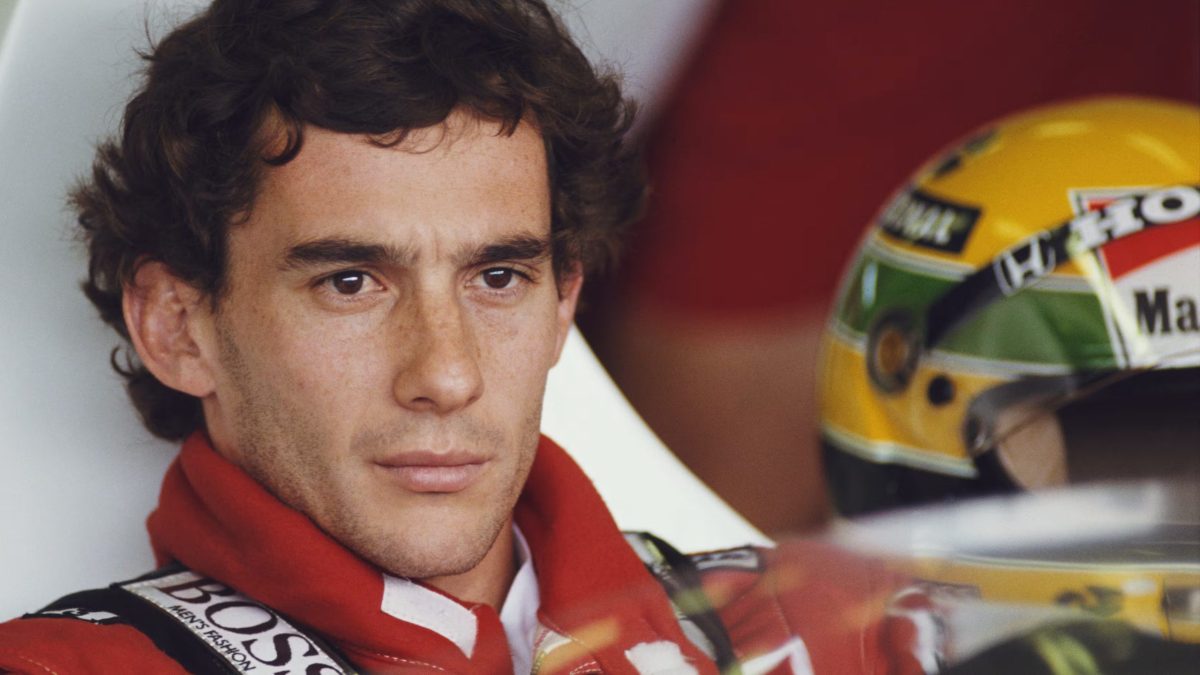
Ayrton Senna (Ayrton Senna da Silva, 21 March 1960 to 1 May 1994) was a Brazilian racing driver who won the Formula 1 World Championship three times, in 1988, 1990 and 1991, all with McLaren. He is widely regarded as one of the greatest drivers in the history of the sport, famous for his speed in qualifying and his skill in wet conditions. He was killed in a crash during the San Marino Grand Prix at Imola in 1994, at the age of 34. This biography follows his life and career.
Ayrton Senna at a Glance
| Full name | Ayrton Senna da Silva |
| Born | 21 March 1960, Sao Paulo, Brazil |
| Died | 1 May 1994, Bologna, Italy, after a crash at Imola (aged 34) |
| Profession | Racing driver |
| Formula 1 teams | Toleman (1984), Lotus (1985 to 1987), McLaren (1988 to 1993), Williams (1994) |
| World titles | Three (1988, 1990, 1991) |
| Career record | 41 Grand Prix wins and 65 pole positions |
| Charity | The Ayrton Senna Institute, founded by his sister Viviane after his death |
Childhood and Karting
Senna was born in Sao Paulo into a wealthy family, the son of Milton da Silva, a businessman, and Neide Senna da Silva. He had an older sister, Viviane, and a younger brother, Leonardo. His first go-kart was built by his father using a lawnmower engine, and he began competitive kart racing at the age of 13. After twice finishing runner-up at the Karting World Championship, he moved on to car racing.
Into Formula 1
Senna moved to England and progressed to Formula Ford in 1981, dominating the British and European championships in his debut seasons. He then won the 1983 British Formula Three Championship after a close title battle. He made his Formula 1 debut in 1984 with Toleman. His first season brought several points finishes. In the rain-soaked Monaco Grand Prix that year he qualified 13th, passed Niki Lauda for second place and was cutting into the gap to the race leader, Alain Prost. In 1985 he moved to Lotus, replacing Nigel Mansell, and took his first pole position and his first victory at the rain-affected Portuguese Grand Prix. He stayed at Lotus for the 1986 and 1987 seasons, winning races in each and finishing third in the 1987 championship.
McLaren and the Rivalry With Prost
In 1988 Senna joined McLaren, where he was paired with the French driver Alain Prost. The team was dominant, and Senna won the 1988 world championship at the Japanese Grand Prix at Suzuka, after a start in which his engine stalled and he fought his way through the field. Senna won the 1988 championship by three points from Prost after winning what was then a record eight Grands Prix. Their rivalry, one of the fiercest in the history of sport, turned bitter. At Suzuka in 1989 the two drivers collided in a late attempt to pass, and Prost went on to win the title when Senna was disqualified. In 1990 they clashed at the same circuit, with Senna, by then the points leader, taking the title after the two cars collided at the start. Senna took seven victories in 1991, including his home Grand Prix in Brazil, and secured his third title. Senna won the championship again in 1991.
Monaco and Wet-Weather Brilliance
Senna won the Monaco Grand Prix six times, a record, five of them in a row from 1989 to 1993. He was widely admired for his pace in the wet and for his qualifying laps, which earned him 65 pole positions in total. He was also known for his intense focus, his religious faith and his emotional commitment to his country, and he often celebrated wins while carrying the Brazilian flag.
Last Year at Williams
The Williams-Renault combination was the dominant package in 1992 and 1993, but Senna still won several races in each of his last two seasons at McLaren, including a record-breaking sixth Monaco victory in 1993, and he finished runner-up to Prost in the championship. He negotiated a move to Williams for 1994, replacing the retired Prost to partner Damon Hill, and drove the Williams FW16. The season began badly: he retired from the first two races. At the San Marino Grand Prix at Imola on 1 May 1994, the day after the Austrian driver Roland Ratzenberger had been killed in qualifying, Senna's car left the track at the Tamburello corner and hit a concrete wall. Before the race he had told Prost that he was "not optimistic at all about this race", and the weekend had been marked by a string of accidents. Senna crashed on lap 7 while leading, driving the Williams FW16, and he was airlifted to Bologna's Maggiore Hospital, where he was pronounced dead at 18:40 local time, although the official time of death under Italian law was 14:17, the time of the crash. He was 34.
Death, Funeral and Safety Reforms
The Brazilian government declared three days of national mourning, and his state funeral, the largest funeral procession in the country's history, was attended by about 3 million people. He was buried in the Morumbi Cemetery in Sao Paulo. Following the safety reforms that came after the deaths of Senna and Ratzenberger, he was the last fatality in the Formula 1 World Championship until Jules Bianchi in 2014.
Family and Personal Life
Senna married Lilian de Vasconcelos Souza in 1981, and the marriage ended in divorce in 1982, a year after the wedding. He had no children. He was close to his sister Viviane and his brother Leonardo, and after his death Viviane established the Ayrton Senna Institute, a non-profit organisation that works on education for young people in Brazil.
Legacy
Senna's reputation has only grown since his death. Asif Kapadia's BAFTA-winning 2010 documentary Senna, which traces his championship years at McLaren and his efforts to improve safety in the sport, introduced his story to a new generation. From 1995 to 2021 Williams carried a small "S" logo on the front wing of its cars in his honour. He holds a place in the Brazilian national memory comparable to that of national heroes, and his name is invoked as a symbol of excellence and dedication. His rivalry with Alain Prost, his dominance at Monaco and his achievements in the wet remain central to the mythology of Formula 1.