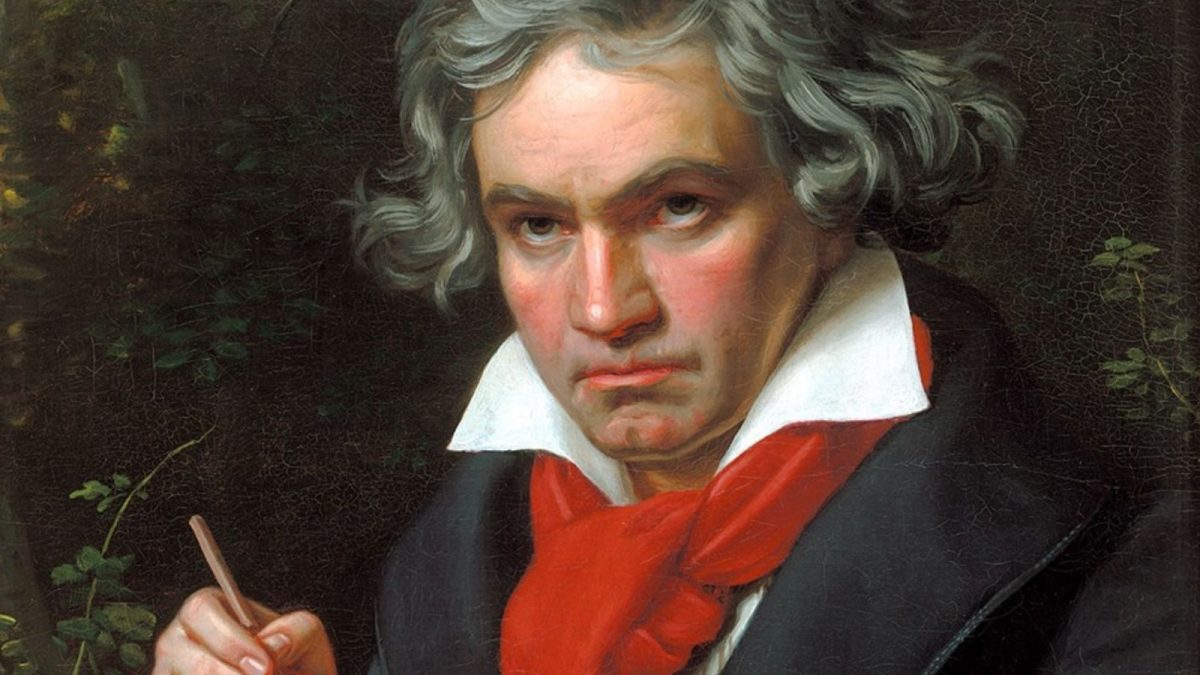
Ludwig van Beethoven (baptised 17 December 1770 to 26 March 1827) was a German composer and pianist, one of the most influential figures in the history of Western music. He bridged the Classical and Romantic eras and is best known for his nine symphonies, his piano sonatas, his string quartets and his only opera, Fidelio. He began to lose his hearing in his twenties and was almost completely deaf in later life, yet he went on composing some of his greatest works. He died in Vienna at the age of 56. This biography follows his life and music.
Ludwig van Beethoven at a Glance
| Full name | Ludwig van Beethoven |
| Born | Bonn, Electorate of Cologne (baptised 17 December 1770; exact birth date unknown) |
| Died | 26 March 1827, Vienna, Austrian Empire (aged 56) |
| Profession | Composer and pianist |
| Best-known works | Symphony No. 5, Symphony No. 9, Moonlight Sonata, Fidelio |
| Teachers | Christian Gottlob Neefe, Joseph Haydn |
| Marriage | Never married |
| Guardian of | His nephew Karl |
Early Life in Bonn
Beethoven was born in Bonn, the son of Johann van Beethoven, a singer in the court of the Elector of Cologne, and Maria Magdalena Keverich. His date of birth is not recorded; he was baptised on 17 December 1770, and the date of his birth is generally taken to be the day before. His father recognised his musical talent and subjected him to harsh training, hoping that the boy might become a child prodigy like Mozart. He studied with the court organist Christian Gottlob Neefe, who introduced him to the music of Johann Sebastian Bach, and he became a court musician while still a teenager.
Move to Vienna
Beethoven was the grandson of another Ludwig van Beethoven, a musician from Mechelen who had moved to Bonn and become the court Kapellmeister in 1761, and a portrait of his grandfather remained displayed in his rooms as a talisman of his musical heritage. He was born at what is now the Beethoven House Museum on Bonngasse 20, and of the seven children born to Johann, only Ludwig and two younger brothers, Kaspar Anton Karl and Nikolaus Johann, survived infancy. He found relief from a difficult home life with the family of Helene von Breuning, whose children he befriended and taught piano. At the age of 21 he moved to Vienna, which became his base. In 1792 Beethoven moved to Vienna, then the musical capital of Europe, where he studied with Joseph Haydn and quickly established a reputation as a brilliant pianist and improviser. Supported by aristocratic patrons, he published his early piano sonatas, trios and quartets, and his First Symphony premiered in 1800. His music in these years was in the Classical tradition of Haydn and Mozart, but it already showed a force and originality that audiences found striking.
Deafness
While at Teplitz in 1812 he wrote a ten-page love letter to his "Immortal Beloved", which he never sent, and the identity of the intended recipient remains a subject of debate; the musicologist Maynard Solomon has argued that it was Antonie Brentano. That same year he met Goethe, who wrote that Beethoven's talent amazed him but that he was "an utterly untamed personality". In his late twenties Beethoven began to lose his hearing, and he suffered from ringing in his ears. He tried various treatments without success, and he feared that his deafness would end his career. In 1802, while staying in the village of Heiligenstadt near Vienna, he wrote a long letter to his brothers, known as the Heiligenstadt Testament, in which he described his despair and the thought of suicide, but also his resolve to continue because of his art. His hearing gradually worsened until, in his last years, he could hear almost nothing and communicated with visitors through written conversation books.
The Heroic Period
After this crisis Beethoven entered what is often called his middle or heroic period. His Third Symphony, the Eroica, first performed in 1805, was longer and more ambitious than any symphony before it, and it marked a turning point in the history of music. It was followed by the Fifth Symphony, with its famous four-note opening, the Sixth Symphony, the Pastoral, the Fourth and Fifth Piano Concertos and the Violin Concerto. His only opera, Fidelio, a story of conjugal courage and political freedom, was first staged in 1805 and revised in later years.
Family and Personal Life
Beethoven never married. His personal life was marked by conflict, especially over his nephew Karl, the son of his brother Kaspar Karl, over whose upbringing he fought a long dispute with the boy's mother. Beethoven fought a long legal battle with Karl's mother for guardianship of the boy and tried to direct his education, and the dispute caused him great anxiety. Their relations remained stormy, and in August 1826 Karl, who had been seeing his mother again against Beethoven's wishes, attempted suicide by shooting himself, and he survived.
The Ninth Symphony and Late Works
In his last decade, though almost deaf, Beethoven composed some of his most profound music. His Missa Solemnis and the Ninth Symphony, which was first performed in Vienna on 7 May 1824, include a choral finale based on Friedrich Schiller's poem "Ode to Joy". It was the first major symphony to use human voices. The Ninth was the first major example of a choral symphony. His Diabelli Variations and late piano sonatas, particularly the Hammerklavier, are summits of the keyboard literature, and his late string quartets, including the Grosse Fuge of 1825 to 1826, are considered pinnacles of the genre. He also wrote the late piano sonatas and the late string quartets, which are among the most searching works in the repertoire and were often not well understood by his contemporaries.
Death and Funeral
Beethoven became seriously ill in late 1826 and spent several months in bed in Vienna. He died on 26 March 1827 at the age of 56. His funeral procession on 29 March 1827 was attended by an estimated 10,000 people, and Franz Schubert was among the torchbearers. An autopsy revealed significant liver damage, which could have been due to heavy alcohol consumption.
Legacy
Beethoven's influence on later composers, including Schubert, Brahms and Wagner, is difficult to overstate, and his belief in the composer as an independent artist, rather than a servant of a court, helped to shape the Romantic idea of the genius. His Ninth Symphony, with its message of human brotherhood, was adopted as the anthem of the European Union, and his works are among the most frequently performed in the world. The story of a composer who created great music while losing his hearing remains one of the most moving in the history of art.