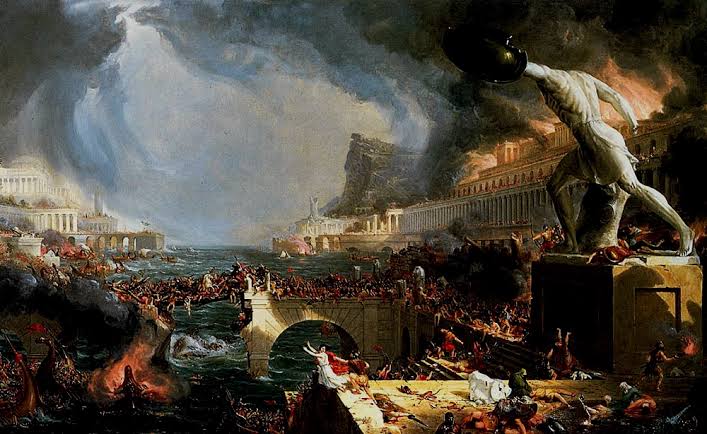
The fall of the Western Roman Empire, also called the fall of Rome, was the loss of central political control in the western half of the Roman Empire. It was a process in which the empire failed to enforce its rule and its vast territory was divided among several successor kingdoms. Modern historians point to a wide range of factors: the effectiveness and numbers of the army, the health and size of the Roman population, the strength of the economy, the competence of the emperors, internal struggles for power, religious change and the efficiency of the civil administration. Growing pressure from invading peoples outside Roman culture also contributed greatly, and climatic changes and both endemic and epidemic diseases drove many of these immediate factors. The reasons for the collapse are a major subject in the study of the ancient world, and they inform much modern discussion of state failure.
The Decisive Decades
In 376 a large migration of Goths and other non-Roman people, who were fleeing from the Huns, entered the empire. Roman forces were unable to exterminate, expel or subjugate them, as was their normal practice. In 395, after winning two destructive civil wars, the emperor Theodosius I died. He left a collapsing field army, and the empire was divided between the warring ministers of his two incapable sons. The Goths and other non-Romans became a force that could challenge either half of the empire. Further barbarian groups crossed the Rhine and other frontiers, an event often dated to 406 or 405, and the sack of Rome in 410 sent a shock through the Mediterranean world. The armed forces of the Western Empire became few and ineffective, and despite brief recoveries under able leaders, central rule was never again effectively consolidated.
476: The Last Emperor
By 476 the position of Western Roman Emperor wielded negligible military, political or financial power and had no effective control over the scattered western domains that could still be described as Roman. Barbarian kingdoms had established their own power in much of the western empire. In 476 the Germanic king Odoacer deposed the last emperor of the Western Roman Empire in Italy, Romulus Augustulus, and the Senate sent the imperial insignia to the Eastern Roman emperor Zeno. Some scholars date the end of the Western Empire a few years later, to the death of Julius Nepos in 480. Whatever date is chosen, the Western Empire never again had the strength to rise.
The East Survives
The Eastern Roman, or Byzantine, Empire survived and remained for centuries an effective power of the eastern Mediterranean, although it lessened in strength. Its capital, Constantinople, would not fall until 1453, almost a thousand years after the end of the western half. The legitimacy of the Roman name lasted for centuries longer in the West, and Rome's cultural influence, in law, language, religion and architecture, remains.
Gibbon and the Idea of Decline
Since 1776, when Edward Gibbon published the first volume of his The History of the Decline and Fall of the Roman Empire, "decline and fall" has been the theme around which much of the history of the Roman Empire has been structured. The historian Glen Bowersock wrote that "from the eighteenth century onward, we have been obsessed with the fall: it has been valued as an archetype for every perceived decline, and, hence, as a symbol for our own fears." Gibbon's book quickly became the standard text, and it shaped how generations of readers understood the end of antiquity.
A Transformation, Not Only a Fall
From at least the time of Henri Pirenne (1862 to 1935), scholars have described a continuity of Roman culture and political legitimacy long after 476. Pirenne postponed the demise of classical civilisation to the eighth century. He challenged the notion that Germanic barbarians had caused the Western Empire to end, and he did not equate the end of the Western Empire with the end of the office of emperor in Italy. He pointed to the essential continuity of the economy of the Roman Mediterranean even after the barbarian invasions and suggested that only the Muslim conquests represented a decisive break with antiquity. The more recent idea of a historical period called "late antiquity" emphasises the transformation of the ancient into the medieval world within a cultural continuity. In recent decades, arguments based on archaeology have extended the continuity in material culture and patterns of settlement as late as the eleventh century. Observing the political reality of lost control, with the attendant fragmentation of commerce, culture and language, but also the cultural and archaeological continuities, some historians describe the process as a complex cultural transformation rather than a fall. In one formulation, the late antique period is "no longer seen as an era of decline and crisis but as an epoch of metamorphosis in the Mediterranean region".
Four Turning Points
A synthesis by the historian Harper in 2017 identified four decisive turns of events in the transformation from the height of the empire to the early Middle Ages. The reasons that historians give for the collapse differ, and so do the dates that they treat as most important, including the Crisis of the Third Century, the crossing of the Rhine in 406 or 405, the sack of Rome in 410 and the death of Julius Nepos in 480.
Why It Matters
The fall of the Western Roman Empire is one of the most studied events in history because it marks the end of the ancient world as most people imagine it and the beginning of medieval Europe, in which kingdoms ruled by Germanic rulers replaced a single imperial government. It also continues to serve as a warning and a mirror: each generation has looked at Rome and asked whether its own society faces the same dangers. The debate between those who see a catastrophic fall and those who see a gradual transformation shows that even the most famous events in history can be understood in more than one way, and that the date 476 is as much a symbol as a precise turning point.