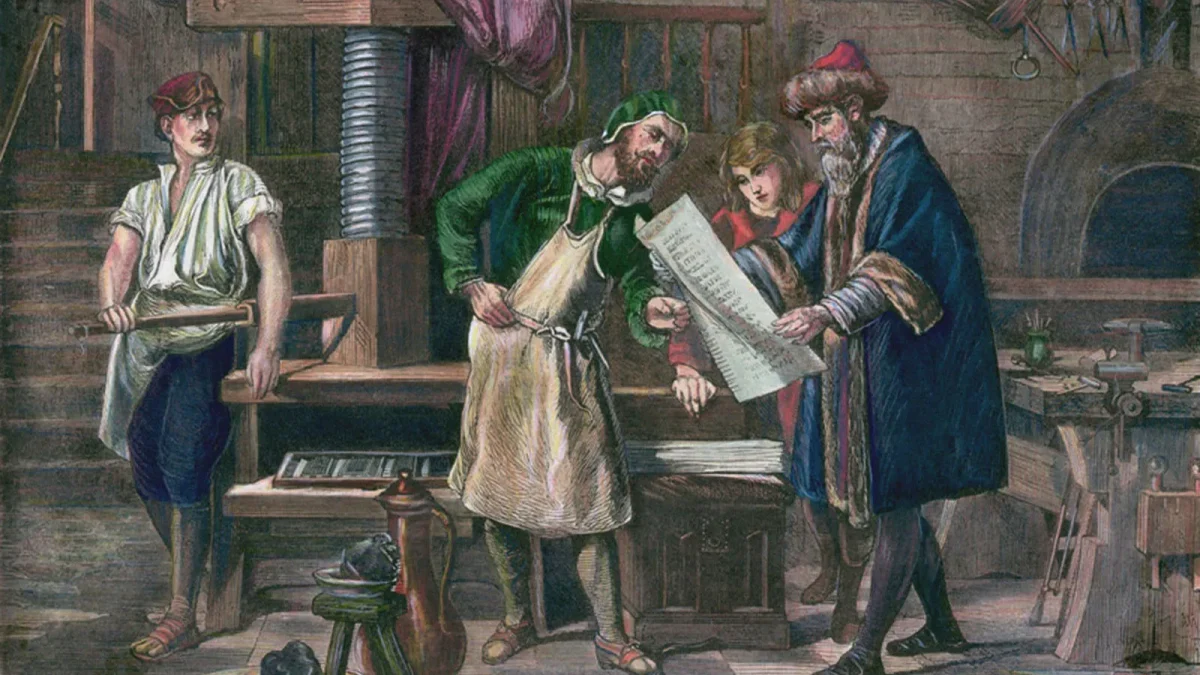
Johannes Gensfleisch zur Laden zum Gutenberg, born between about 1393 and 1406 and died in 1468, was a German inventor and craftsman who invented the movable-type printing press. Although movable type was already in use in East Asia, Gutenberg's invention of the printing press enabled a much faster rate of printing. The printing press later spread across the world and led to an information revolution and the unprecedented mass spread of literature throughout Europe. It had a profound impact on the development of the Renaissance, the Reformation and the humanist movements.
What He Contributed
Gutenberg's many contributions to printing include the invention of a process for mass-producing movable type, the use of oil-based ink for printing books, adjustable moulds, mechanical movable type and a wooden printing press similar to the agricultural screw presses of the period. His method for making type is traditionally considered to have included a type-metal alloy and a hand mould for casting type. The alloy was a mixture of lead, tin and antimony that melted at a relatively low temperature for faster and more economical casting, cast well and created a durable type. His major work, the Gutenberg Bible, was the first printed version of the Bible and has been acclaimed for its high aesthetic and technical quality.
An Influential Figure
Gutenberg is often cited as among the most influential figures in human history and has been commemorated around the world. To celebrate the 500th anniversary of his birth, the Gutenberg Museum was founded in his hometown of Mainz in 1900. In 1997 Time Life picked Gutenberg's invention as the most important of the second millennium.
Early Life in Mainz
Gutenberg was born in Mainz, a wealthy city on the Rhine, between the fourteenth and fifteenth centuries. His exact year of birth is unknown; on the basis of a later document indicating that he came of age by 1420, scholarly estimates have ranged from 1393 to 1406, and the year 1400 is commonly assigned to him for the sake of convenience. Tradition holds his birthday to be 24 June, the feast day of Saint John the Baptist, but there is no verification. His full name drew on the family's residences in Mainz, and the Hof zum Gutenberg was a large Gothic-style residence inherited by his father. His father, Friele Gensfleisch zur Laden, was a patrician and merchant, likely in the cloth trade, and a member of the minting cooperative of the city. In 1386 Friele married his second wife, Else Wyrich, the daughter of a shopkeeper, and Johannes was probably the youngest of their three children. Because his mother was a commoner, Gutenberg would never be able to succeed his father at the mint, and according to the historian Ferdinand Geldner this may have disillusioned him with high society and encouraged his unusual career as an inventor.
Conflict and Exile
The patrician class of Mainz, including the Gutenbergs, held a privileged status, and their efforts to preserve it brought them into frequent conflict with the younger generations of guild craftsmen. A particularly violent conflict arose in February 1411 amid an election dispute, and at least 117 patricians fled in August. The archbishop mediated a peace that allowed the family to return to Mainz that autumn, but the situation remained unstable and hunger riots forced the family to leave again in January 1413.
Education and Strasbourg
No documents survive about Gutenberg's childhood or youth, and the biographer Albert Kapr remarked that "most books on Gutenberg pass over this period with the remark that not a single fact is known". He is assumed to have studied at the University of Erfurt, where a student called Johannes de Altavilla enrolled in 1418, Altavilla being the Latin form of Eltville am Rhein. In March 1434 a letter by him shows that he was living in Strasbourg, where he had relatives on his mother's side, and he appears to have been a goldsmith enrolled in the Strasbourg militia. In 1437 there is evidence that he was instructing a wealthy tradesman on polishing gems, and in 1436 or 1437 his name appears in court in connection with a broken promise of marriage to a woman from Strasbourg.
The Press
Around 1439 Gutenberg was involved in a financial misadventure in making polished metal mirrors for sale to pilgrims to Aachen, which were believed to capture holy light from religious relics, and in which the capital that had been spent could not be repaid when the event was delayed by a year because of a severe flood. He lived in Strasbourg until at least 1444 and then returned to Mainz, where the printing press and the Gutenberg Bible followed.
Printing in Mainz
Until at least 1444 Gutenberg lived in Strasbourg, and in 1440 he is said to have perfected and unveiled the secret of printing, based on his research and mysteriously entitled Aventur und Kunst, "enterprise and art". After that there is a gap of four years in the record. In 1448 he was back in Mainz, where he took out a loan from his brother-in-law Arnold Gelthus, possibly for a printing press or related equipment. By 1450 the press was in operation, and a German poem had been printed, possibly the first item to be printed there. Gutenberg persuaded the wealthy moneylender Johann Fust to lend him 800 guilders, and Peter Schoffer, who became Fust's son-in-law, also joined the enterprise. Schoffer had worked as a scribe in Paris and is believed to have designed some of the first typefaces. The workshop was set up at the Humbrechthof, a property belonging to a distant relative. For the Bible project Gutenberg borrowed another 800 guilders from Fust, and work began in 1452, while the press also printed other, more lucrative texts, possibly Latin grammars. One of the profit-making enterprises of the new press was the printing of thousands of indulgences for the church, documented from 1454 to 1455. In 1455 Gutenberg completed his 42-line Bible, known as the Gutenberg Bible, of which about 180 copies were printed, three quarters on paper and the rest on vellum.
The Court Case
In 1456 there was a dispute between Gutenberg and Fust, in which Fust demanded his money back and accused Gutenberg of misusing the funds. The two rounds of financing, totalling 1,600 guilders at 6 per cent interest, now amounted to 2,026 guilders, and Fust sued at the archbishop's court, which decided in his favour and gave him control over the Bible printing workshop.
Why It Matters
The printing press changed how knowledge was produced and shared. Before it, books were copied by hand and were scarce and expensive; afterwards, texts could be produced in large numbers, and the ideas of the Renaissance, the Reformation and the scientific revolution travelled faster and further than before. Printing also helped to standardise languages, spread literacy and make authors and readers of a much wider class of people. Its place in the story of communication, from the printed book to the digital age, is the reason that Gutenberg is so often named among the most important people in history.